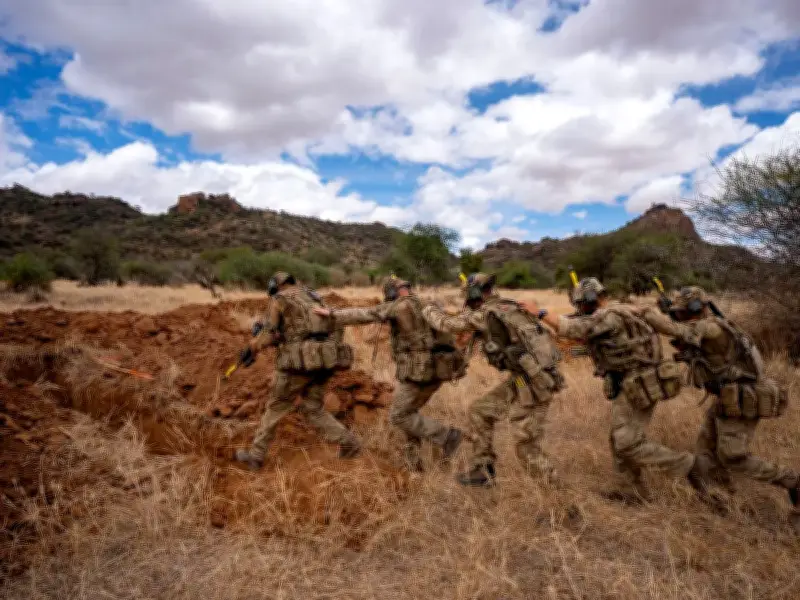
The UK Army Reserves has extended its maximum age for potential service from 55 to 65, meaning people born between 1961 and 1971 could be called up if conscription is enacted. The change comes amid escalating fears of war and rising global tensions, as reported by The Mirror.
Conscription age bracket widened
Earlier this year, the age bracket for the Army Reserves was extended from 55 to 65. As a result, individuals born between 1961 and 1971 could potentially be required to serve their nation if conscription - when a government imposes mandatory military service - is introduced.
Historically, the most notable examples of conscription occurred during World War Two. In 1939, half a year before the outbreak of the war, men aged between 20 and 22 were conscripted in the UK. Neville Chamberlain's government developed plans during the spring of 1939 due to the increasing likelihood of conflict with Nazi Germany.
Once war was declared, the age range was broadened to men between 18 and 41. By 1942, men as old as 60 were called to serve as the death toll continued to rise. Women and all childless widows aged 20 and 30 were conscripted by the end of 1941, while men up to age 51 were summoned for military service. Those aged between 52 and 60 were obliged to participate in some form of military service.
Fears of 21st century war rising
In 2026, fears of war have escalated in recent months. This year has seen escalating Russian hybrid warfare against NATO countries, with reports claiming Russia is using fishing trawlers to spy on Britain's critical undersea cables. The Kremlin has also been blamed for arson, sabotage, and assassinations in European nations, with overt threats against the UK over the summer due to its support for Ukraine.
Earlier this week, Defence Secretary Wes Streeting warned Britain has to 'prepare for the worst' and be 'ready for war' in under three years. He said the country's enemies are likely to be in a position to attack by 2030, and the UK has around 1,000 days to be in a position to 'fight and win'.
Writing in The Daily Telegraph, Mr Streeting said: "My defining priority... is to make sure that this country is ready to fight and win a war. To prevent the worst, we have to prepare for it. In the first instance, that means expanding our capabilities so our adversaries think twice about attacking us. Should that fail, we must ensure that Britain is ready for war."
Reservists to be called first
According to retired army chief Lord Dannatt, the UK will already have a particular method of enlisting people to defend the country, suggesting a contingency plan is already in place. Lord Dannatt noted that the UK would initially turn to army reservists, recalled former service personnel, and younger adults in the case of a major conflict breaking out. After this, the government would consider the wider population.
"I would expect to see the Army Reserve mobilised first, then Regular Reservists recalled to active service, and then His Majesty's Government would need to consider conscription, starting with 18-24-year-olds," Lord Dannatt said. "Britain would not necessarily begin by compelling civilians with no military experience to join the armed forces. Reservists and former service personnel would provide an initial pool of people with military training, although recalling them at scale would present substantial logistical challenges."
Be ready to fight with our allies
Mr Streeting was speaking days after the government launched its 'Be Ready' campaign, advising households to stockpile non-perishable food, bottled water, and other essential items in the event of a cyber-attack or severe weather incident that could shut down critical national infrastructure.
"Our adversaries' willingness to harm us is not new. What has changed is their capacity," Mr Streeting said. "By 2030 their force strength and war economy could put them in a position to attack. That gives us a little over 1,000 days to complete our mission: to be ready with our allies to fight and win. This Government will make sure it is mission accomplished."
His comments came as British and French troops took part in a wargame designed to show how NATO territory could be defended against an attack. The exercise involved one of the largest airborne operations in the past 20 years, with British and French paratroopers jumping from RAF transport planes over Germany. Exercise Rhino Titan, held at the Sennelager military training centre in Germany, has been testing the UK's 16 Air Assault Brigade against an enemy equipped with drones and electronic warfare, the kind of technology Russia could be expected to deploy.