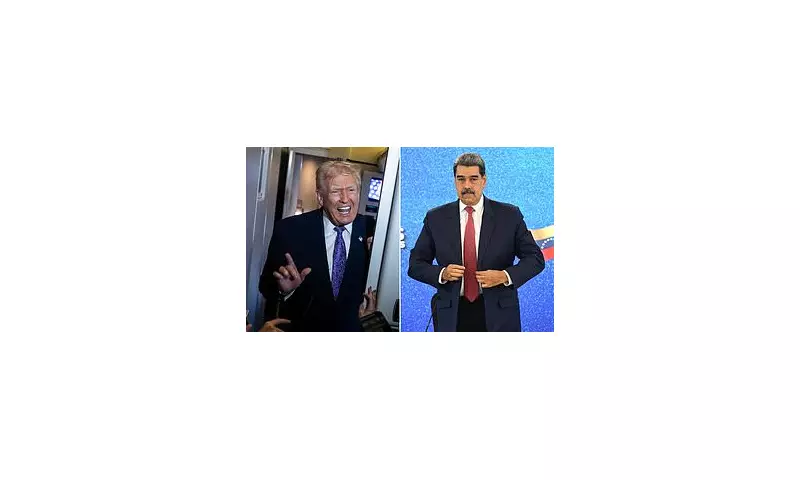
In a dramatic escalation of tensions, former US President Donald Trump has issued a stark warning to Venezuelan leader Nicolás Maduro, urging him to flee the country immediately with his family or face the consequences. This ultimatum comes alongside a significant US military buildup in the Caribbean region.
A High-Stakes Phone Call
The crucial conversation between Trump and Maduro occurred on Friday, against a backdrop of lethal American drone strikes. These strikes targeted suspected Venezuelan drug traffickers, resulting in over 80 casualties. According to reports from The Miami Herald, Trump assured Maduro of safe passage for himself, his wife, and his son if he agreed to resign immediately.
A source familiar with the discussion revealed that Maduro attempted to negotiate terms. He first requested global amnesty, which President Trump outright rejected. The Venezuelan leader then proposed maintaining his control over the nation's armed forces in exchange for holding free elections, an idea that was also swiftly dismissed by Trump. Following these rejections, Maduro immediately refused to step down from power.

Military Buildup and Rising Tensions
The United States is intensifying pressure on the Caracas regime through a multi-pronged approach. This includes a major military deployment of warships and troops to the Caribbean. Washington has also designated an alleged drug cartel run by Maduro, referred to as the 'Cartel of the Suns', as a terrorist organisation. Furthermore, Trump has issued an ominous declaration that Venezuelan airspace is effectively 'closed'.
While the official US position is that this military deployment, initiated in September, aims to curb regional drug trafficking, the Venezuelan government insists that the ultimate goal is regime change. Caracas has condemned what it labels as US preparations for an attack.
Confirmation and Further Details
President Trump confirmed the conversation on Sunday while speaking to reporters aboard Air Force One, offering a characteristically ambiguous assessment. "I wouldn't say it went well or badly. It was a phone call," he stated.
Additional reports from publications like The New York Times and The Wall Street Journal suggest the call also broached the possibility of a face-to-face meeting and detailed potential amnesty conditions should Maduro agree to relinquish power. Adding to this, Republican Senator Markwayne Mullin disclosed on CNN that the United States had presented Maduro with the option to leave Venezuela for a destination such as Russia.
The US accuses Maduro of heading the 'Cartel of the Suns' and has placed a $50 million bounty on his capture. However, Venezuela and its allies vehemently deny the existence of such an organisation, with several experts suggesting it is a label for the corruption of high-level officials by criminal gangs. The US does not recognise Maduro as the legitimate winner of last year's presidential election.
Although Trump has not publicly threatened military force, he has indicated that efforts to halt Venezuelan drug trafficking "by land" would commence "very soon," signalling a potentially new phase in this international standoff.