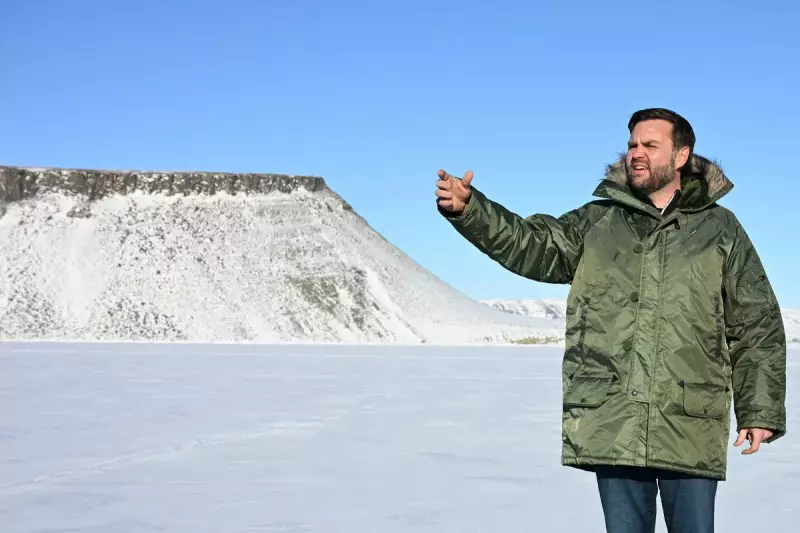
Former US President Donald Trump has ignited a fresh international crisis by threatening the United Kingdom, Denmark, and several other European nations with punitive tariffs. The move is a direct response to their opposition to a proposed American takeover of Greenland, a vast, self-governing Danish territory.
The Core of the Crisis: Tariffs and Territorial Ambitions
On Saturday, 17 January 2026, Trump declared that 10 per cent tariffs would be imposed on Denmark, Norway, Sweden, France, Germany, the UK, the Netherlands, and Finland from 1 February. He warned these levies would escalate to 25 per cent on 1 June and remain until a deal is struck for the US to purchase Greenland. Framing the dispute in stark terms, Trump asserted, "World Peace is at stake! China and Russia want Greenland, and there is not a thing Denmark can do about it."
This stance was echoed by senior advisor Stephen Miller, who declared Greenland should be part of the US and that "nobody will fight" over the island's future. Both the Danish government, a longstanding NATO ally, and Greenland's own administration have firmly rejected these threats, insisting the Greenlandic people will determine their own destiny.

Why Greenland? Five Strategic Imperatives
The confrontation stems from Greenland's immense and growing geopolitical value, fuelled by climate change and global competition.
1. A Pivotal Arctic Location
Greenland's position is its primary asset. With over two-thirds of its landmass within the Arctic Circle, it has been crucial to North American defence since the US occupied it during the Second World War. It guards the North Atlantic approaches and the strategically vital GIUK (Greenland, Iceland, United Kingdom) Gap, a key chokepoint for monitoring Russian naval movements. As diminishing ice opens new trade routes, control of Greenland offers a commanding position in the emerging Arctic theatre.
2. A Treasure Trove of Rare Earth Minerals
The island is believed to hold vast deposits of rare earth minerals, essential components for mobile phones, computers, electric vehicle batteries, and advanced military hardware. This makes it a focal point for Western powers, including the US, seeking to break China's dominance over these critical supply chains. However, exploitation is hampered by a harsh climate and Greenland's strict environmental protections.
3. An Established US Military Footprint
The United States already maintains a significant military presence via the Pituffik Space Base in northwestern Greenland. Operated under a 1951 defence agreement with Denmark, this remote base is critical for US and NATO missile warning, defence, and space surveillance operations. Trump's administration accuses Denmark of not sufficiently bolstering regional security, using this as a pretext for more direct control.
4. Denmark's Reinforced Defences
In response to growing Arctic tensions, Denmark has moved to strengthen its military posture. In 2025, a 14.6 billion-kroner (£1.7bn) agreement was announced with Greenland and the Faroe Islands to enhance surveillance and sovereignty. This was followed by a further 27.4 billion-kroner investment in October 2025 for maritime patrol aircraft and naval upgrades. Denmark's Joint Arctic Command is headquartered in Nuuk, and the elite Sirius Dog Sled Patrol operates across the frozen wilderness.
5. Mounting Security Threats from Russia and China
The Arctic has become a zone of renewed competition. Russia is strengthening its military capabilities in the region, citing concerns over NATO activity, a stance amplified since its 2022 invasion of Ukraine. Meanwhile, China has declared itself a "near-Arctic state" and proposed a "Polar Silk Road," raising fears among Western leaders about Beijing's strategic ambitions. Former US Secretary of State Mike Pompeo previously warned against letting the Arctic become a new South China Sea.

Implications and Escalating Tensions
Trump's tariff threat represents a severe escalation, directly targeting European allies over a territorial dispute. It undermines NATO unity at a time of heightened global instability and sets a confrontational precedent for resolving geopolitical claims. The situation leaves the UK and other European nations balancing their alliance with the US against the principles of sovereignty and international law. As the 1 February tariff deadline looms, the standoff over Greenland's frozen landscape is poised to become a defining test of transatlantic relations and the future of Arctic security.