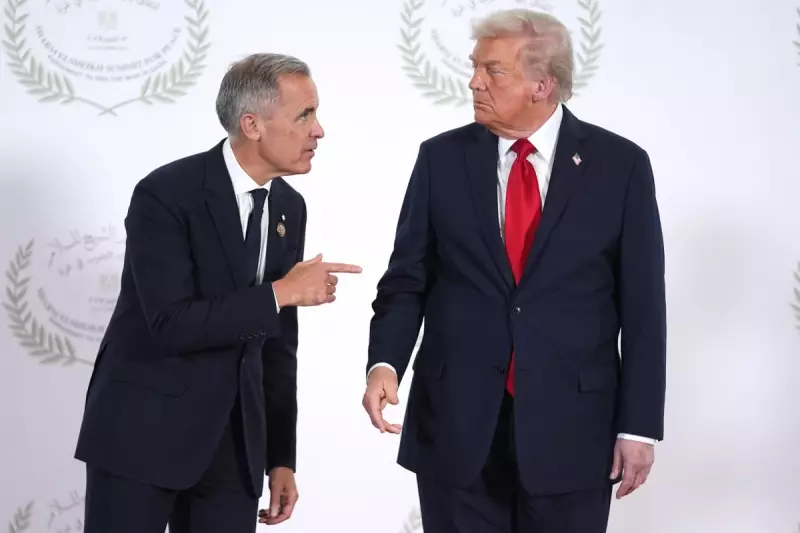
President Donald Trump has reportedly turned his attention northwards, expressing significant concern over Canada's "vulnerability" to foreign adversaries and initiating talks to bolster its defences. This move follows a series of bold unilateral actions across the Western Hemisphere during his first year back in office.
A Strategic Pivot from '51st State' Rhetoric
According to multiple unnamed officials speaking to NBC News, Trump has recently fixated on the Arctic regions of Canada, griping that they are exposed to potential encroachment by China and Russia. U.S. officials are now reportedly exploring ways to coordinate with Ottawa to strengthen Canada's vast northern border. This represents a notable shift from Trump's previous characterisation of Canada as America's "51st state," which had previously strained diplomatic relations.
One official stated that "Trump is really worried about the U.S. continuing to drift in the Western Hemisphere and is focused on this." The protection of Canada's northern frontier is framed as fundamental to Trump's goal of "solidifying" the Western Hemisphere under a strategy he has branded the "Donroe Doctrine."

Arctic Security and the Greenland Question
The administration's focus is squarely on the strategic Arctic. "At the end of the day, this is to stop Russia and China from having a further presence in the Arctic," an official explained, adding that "Canada stands to benefit from the U.S. having Greenland." Trump's repeated interest in acquiring the Danish territory of Greenland remains a point of contention, with Canadian Prime Minister Mark Carney stating last Friday that he stands behind the Kingdom of Denmark, a fellow NATO member.
Discussions between US and Canadian officials are said to include several key measures:
- Updating early-warning systems in Canada for detecting adversaries.
- Increasing joint military training and operations.
- Expanding joint air and water patrols, as well as American ship patrols in the Arctic.
Unlike the situation with Greenland, officials stress that annexation of Canada is not the aim. Instead, the goal is to partner with Prime Minister Carney to shore up continental defences.
Strained Alliances and a Shifting World Order
Trump's assertive approach has triggered alarm among critics and allies alike. A Pew Research poll from July 2025 found that a majority of Canadians now view Trump's America as their biggest threat. Critics argue his measures undermine the longstanding US-Canada alliance.
Prime Minister Carney hinted at this strain, telling reporters that the "multilateral system" has been "eroded." This week, Carney travelled to Beijing to meet Chinese President Xi Jinping, where he secured a bilateral trade deal and vowed to strengthen ties, commenting that "the world has changed much" and referencing "the new world order."
In a surprising response, Trump told reporters on Friday that the new Canada-China trade deal was "a good thing," adding, "That's what he should be doing. If you can get a deal with China, you should do that."
Trump's unilateralist stance was further underscored in a recent interview with The New York Times. When asked what limits constrain him on the global stage, he replied: "There is one thing. My own morality. My own mind. It's the only thing that can stop me." This follows dramatic actions earlier in January, when he directed a military strike in Venezuela leading to the capture of Nicolás Maduro.
As the Trump administration pushes for deeper Arctic security cooperation, the proposal sits uneasily with a Canadian public and leadership increasingly wary of American power and actively cultivating other strategic partnerships in an uncertain global landscape.