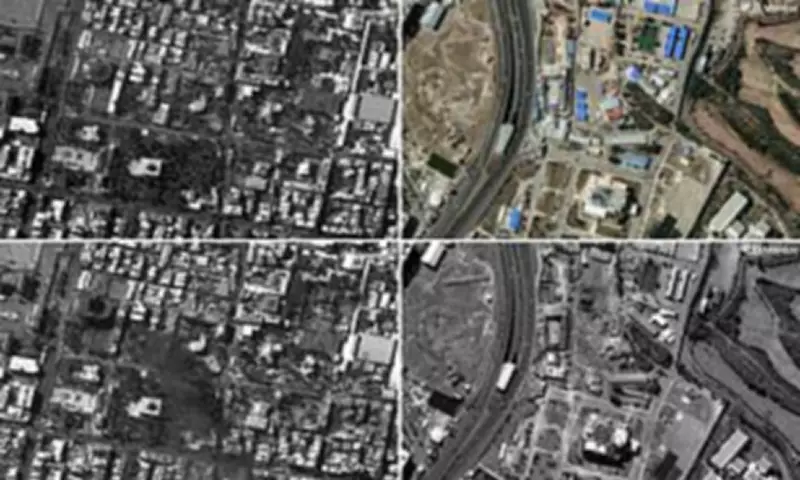
Newly released satellite photographs have exposed the comprehensive scale of devastation across Tehran, following an intense five-day bombardment campaign conducted by American and Israeli forces. The imagery reveals numerous locations rendered almost unrecognisable, with dust and debris clearing to show the stark aftermath of coordinated military action.
Joint Operation Executes Long-Planned Strategy
Executing a strategy developed over several months, the United States and Israel initiated joint airstrikes against their longstanding adversary on Saturday. The operation reportedly eliminated nearly fifty high-ranking commanders within mere minutes, including Supreme Leader Ali Khamenei. Israeli forces have maintained a relentless assault on strategic targets throughout the nation, systematically destroying government structures, missile storage facilities, military installations, and nuclear research sites.
Civilian Infrastructure Reportedly Impacted
There have been emerging reports indicating that civilian infrastructure has also been affected during the campaign. Most notably, Iranian state media has alleged that over one hundred and fifty-three girls lost their lives when a bomb struck their primary school located near a military base. This claim has drawn international attention and raised concerns about collateral damage.

Israeli Prime Minister Benjamin Netanyahu has publicly declared that no area within Iran remains shielded from the ongoing military campaign, boasting specifically about strikes reaching "the heart of Tehran." This assertion is visually corroborated by the satellite evidence showing widespread damage across the capital city.
Initial Wave Targets Leadership Compound
The devastation became apparent from the very onset of operations. During the first wave of attacks, which commenced at approximately 9:40 AM on Saturday, thirty bombs targeted the Supreme Leader's residential and administrative compound in central Tehran. This assault resulted in the death of Ali Khamenei alongside members of his immediate family.
Numerous buildings housing critical branches of the Iranian regime have similarly been devastated, as clearly documented in comparative satellite photographs. These range from judicial courts and intelligence headquarters to military command centers and educational institutions.
Political Rhetoric Escalates Tensions
Former United States President Donald Trump commented on the situation during a CNN interview on Monday, stating, "We're knocking the cr** out of them. I think it's going very well. It's very powerful. We've got the greatest military in the world and we're using it." He further escalated his rhetoric by warning, "We haven’t even started hitting them hard. The big wave hasn’t even happened. The big one is coming soon."
Detailed Analysis of Key Target Sites
Presidential Complex and Khomeini Residence: Comparative images from February 22 and March 3 show the presidential complex and Khomeini residence in central Tehran before and after the initial strike wave. This location served as the primary target during the opening phase of operations. Through advanced intelligence gathering, American and Israeli forces identified that Khamenei would be convening with senior military commanders at this site, enabling them to seize a critical opportunity. The Supreme Leader was killed in the attack, and multiple structures within the compound were completely leveled.
Islamic Revolutionary Guard Corps Headquarters: Satellite photographs from February 27 and March 3 document the transformation of the IRGC headquarters in Tehran. The IRGC functions as an armed force specifically tasked with defending the current regime, making its neutralization essential for any effort to destabilize the government. The imagery reveals substantial damage inflicted upon this strategically vital installation.
Islamic Revolutionary Court: Images captured on March 1 and March 3 illustrate the complete erasure of entire buildings at the Islamic Revolutionary Court complex following a major airstrike. This court was known for conducting highly secretive trials, often convicting individuals without jury representation, legal defense, or substantial evidence. Verdicts were sometimes based solely on extracted confessions.

National Defense University: Comparative views from January 18 and March 3 show the former site of the National Defense University, a prestigious educational institution under the jurisdiction of Iran's General Command of the Armed Forces. This facility served as a training ground for military commanders and security officials being prepared for high-level positions within the regime's defense apparatus.
Gandhi Hospital: Photographs from March 1 and March 3 depict Gandhi Hospital in Tehran, where a radio mast has been toppled by nearby strikes and additional damage is visible in the surrounding area. The hospital was evacuated after attacks fell in close proximity, prompting Iranian authorities to demand international intervention to protect medical facilities.
Judiciary Complex and Intelligence Ministry: Further imagery reveals significant damage at the judiciary complex between March 1 and March 3, as well as alterations at the Intelligence Ministry site between February 22 and March 3. Although American and Israeli intelligence capabilities provided operational advantages, this ministry continuously gathered information about the regime's adversaries. Iranian officials were subsequently compelled to deny reports that the Intelligence Ministry had contacted the CIA to negotiate conflict termination terms.