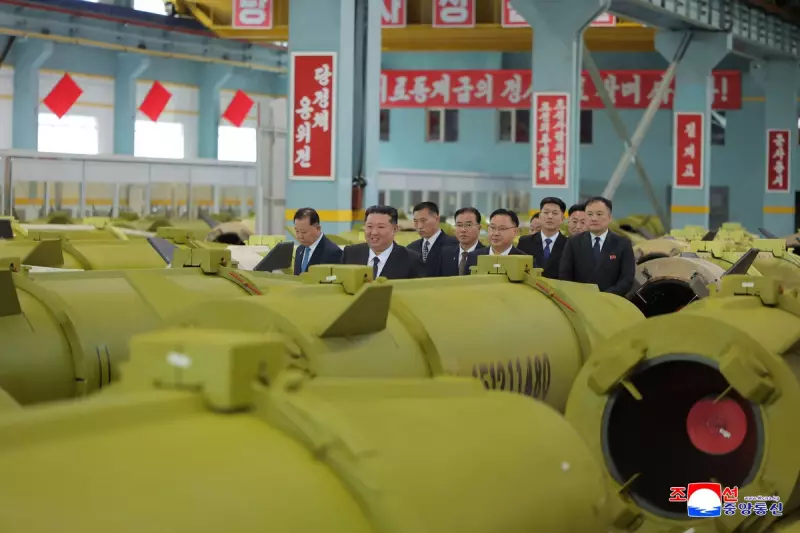
North Korea has conducted a significant test of its long-range strategic cruise missiles, an action it states was designed to evaluate the reliability of its nuclear deterrence capabilities. The launch, which took place on Sunday, was personally overseen by the country's leader, Kim Jong Un.
Kim Jong Un's 'Great Satisfaction' with Missile Launches
The official state media, the Korean Central News Agency (KCNA), reported that the missile launches occurred off North Korea's west coast on Sunday. It detailed that Kim Jong Un expressed "great satisfaction" with the exercise. The North Korean leader framed the test as a responsible exercise of the right to self-defence and war deterrence, a move he claims is necessary in the face of external security threats, an apparent reference to the United States and its allies.
South Korea's military confirmed it had detected several cruise missile launches from the North Korean capital region of Pyongyang on Sunday morning. The Joint Chiefs of Staff stated that South Korea, in alliance with the United States, maintains a firm readiness to counter any potential provocations from the North.

Regional Reactions and Strategic Implications
The test has drawn immediate condemnation from regional powers. Japan issued a warning about the threat posed to international security, describing the latest provocation as 'unprecedented'. While United Nations Security Council resolutions explicitly ban North Korea from testing ballistic missiles, the rules on cruise missiles are less clear. However, analysts note that cruise missiles pose a severe threat due to their high manoeuvrability and ability to fly at low altitudes, evading radar detection. Their primary purpose in a conflict would likely be to target US warships and aircraft carriers in the region.
This latest display of military hardware is part of an accelerating pattern from Pyongyang. It follows last week's test of new anti-air missiles and the revelation of a largely completed hull for a developmental nuclear-powered submarine. North Korea has hinted it intends to arm such a submarine with nuclear missiles, a capability that would significantly extend the range and stealth of its nuclear strike force.
Broader Context: Diplomacy, Alliances, and Future Tests
The weapons testing spree occurs within a complex geopolitical landscape. Since the collapse of denuclearisation talks with former US President Donald Trump in 2019, North Korea has focused intensely on expanding its nuclear arsenal. Observers suggest that Pyongyang could further ramp up weapons demonstrations ahead of its planned ruling Workers' Party congress early next year.
Some security experts posit that North Korea's recent alignment with Russia, including supplying military equipment for the war in Ukraine, may have facilitated a transfer of crucial technologies to advance its own programmes. Despite the aggressive posturing, Kim Jong Un suggested in September that a return to talks with the US might be possible if Washington abandons its "delusional obsession" with North Korea's denuclearisation. Experts believe Kim likely views his enlarged nuclear arsenal as providing greater leverage for any future negotiations.