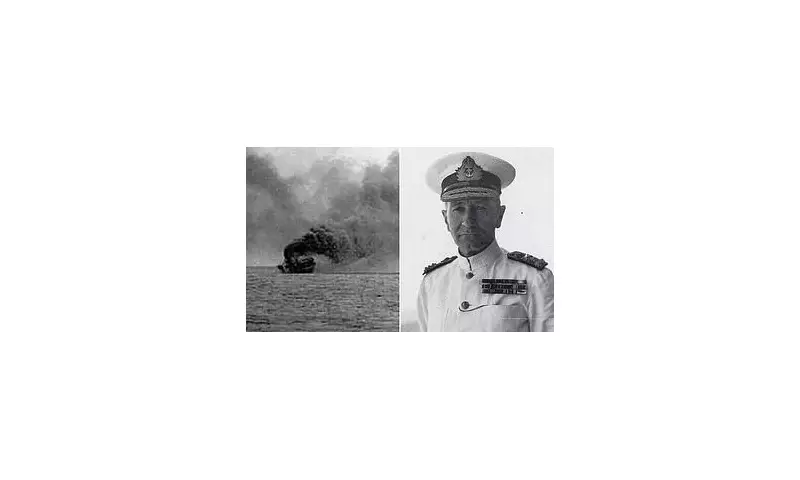
The harrowing story of a Royal Navy admiral forced to make an agonising wartime decision, sacrificing 900 drowning sailors to ensure the safe evacuation of the Norwegian royal family, has come to light following the auction of his medal collection.
The Impossible Choice in the Norwegian Sea
In June 1940, Admiral Sir John Cunningham was commanding the cruiser HMS Devonshire on a critical mission. He had been tasked with evacuating King Haakon VII of Norway, along with other VIPs and the nation's gold reserves, following the Nazi invasion of their homeland. The ship was under strict orders to maintain radio silence to avoid detection by German forces.
Events took a devastating turn on June 8, 1940, when HMS Devonshire, having just left Tromsø, intercepted a distress signal. The aircraft carrier HMS Glorious, along with two escorting destroyers, had been attacked and crippled by the German battleship Scharnhorst. The vessels were sinking rapidly, and hundreds of men were in the water.

HMS Devonshire was within 50 miles of the disaster and was the only Allied ship to pick up the SOS. Yet, Admiral Cunningham faced an unbearable dilemma. Revealing his position by breaking radio silence or diverting to assist could jeopardise his primary mission: the safe passage of the Norwegian king. He made the fateful decision to suppress the signal and continue his course.
Aftermath and Survival
The consequences were catastrophic. Of the approximately 900 men who abandoned the sinking HMS Glorious, only 40 survived. These few survivors endured days in rubber lifeboats before being rescued by a Norwegian merchant vessel bound for the Faroe Islands on June 10, 1940.
Remarkably, the Admiralty in London remained unaware of the sinking until German radio broadcasts announced it 48 hours later. The failure to mount a rescue operation became a profound embarrassment for the Royal Navy, prompting difficult questions in the House of Commons.
Historical accounts reveal that Cunningham showed the distress signal to King Haakon, who asked what his orders were. The Admiral is said to have replied, 'to bring you safely to England.' The King later reflected, 'I realised this was not to Admiral Cunningham's liking.'
A Distinguished Career Despite Tragedy
Despite the shadow of the HMS Glorious tragedy, Sir John Cunningham's naval career continued to ascend. In August 1943, he was promoted to Admiral and given command of all Allied shipping in the Mediterranean. He oversaw major amphibious operations at Anzio in Italy and during the invasion of Southern France.
His service was recognised with the highest ranks: he became First Sea Lord in 1946 and was appointed Admiral of the Fleet in 1948 before retiring. He later attended the coronation of Queen Elizabeth II in 1953.
The poignant tale has resurfaced after Sir John's impressive group of 22 medals sold at auction for £20,000, sparking a bidding war that exceeded their £12,000-£16,000 estimate. The collection, which includes the Most Honourable Order of the Bath and the Royal Victorian Order, was part of the epic holdings of the late American numismatist James Risk.
Nimrod Dix, deputy chairman of auctioneers Noonans, noted the group 'reflected the seniority of his rank and the important service he saw during the Second World War.' The sale ensures that the memory of this difficult chapter in naval history, and the heavy burden of command, is preserved for future generations.