
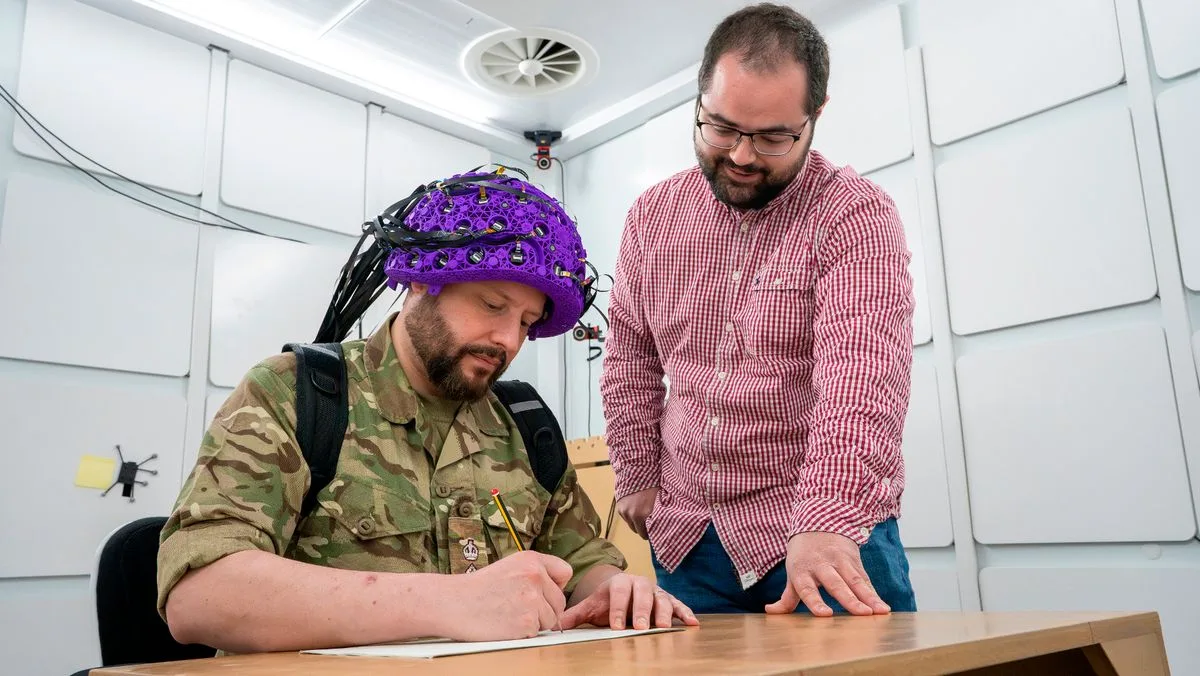
British troops are set to receive the world's first mobile brain scanners, designed to assess the effects of blast exposure on the battlefield. The £3.1 million device, built by scientists at the University of Nottingham, will be used by the Army, Navy, and Air Force to detect mild Traumatic Brain Injury (mTBI) caused by repeated exposure to low-level blasts from the military's own weaponry.
The portable magnetoencephalography (MEG) scanner will be deployed to firing ranges, field hospitals, and rehabilitation centres, allowing researchers to monitor brain activity within minutes of an incident. This marks a significant advance in understanding the long-term health impacts of blast exposure, which can lead to lifelong conditions such as dementia and epilepsy.
Lt Col James Mitchell, Consultant Neurologist at the UK Defence Medical Services, said: 'Over the last five to ten years we have started to appreciate the role of low-level blast from our own weapon systems. This new system will be transformative for research into the effects of blast exposure on our personnel.'
The device, developed by Cerca Magnetics in collaboration with the Universities of Nottingham and Birmingham, is expected to be operational by March 2026. Minister for Veterans and People, Louise Sandher-Jones MP, stated: 'This funding demonstrates our commitment to renewing the nation's contract with those who serve, but also shows how defence innovation benefits wider society.'
Beyond military use, the scanner will also aid research into sports concussion, dementia, and epilepsy. Professor Matthew Brookes of the University of Nottingham said: 'This new generation of MEG lifts limitations that have historically confined scanners to universities, paving the way for mobile systems that can be taken directly to those who will benefit most.'




