

France Forges New Nuclear Deterrence Framework with Eight European Allies
In a landmark strategic shift, France is moving to align its nuclear deterrent more closely with European allies while retaining exclusive control over any decision to launch a strike. This unprecedented coordination, announced by President Emmanuel Macron, represents a crucial step toward strengthening Europe's strategic autonomy in an increasingly uncertain security landscape.
Doubts About US Reliability Drive European Nuclear Rapprochement
Experts suggest this initiative reflects growing concerns across Europe regarding the reliability of American defense commitments. Since Britain's departure from the European Union in 2020, France has stood as the bloc's sole nuclear power. Macron's new approach essentially positions France to offer a "nuclear security guarantee" to partners during crises, according to Florian Galleri, a nuclear deterrence expert at MIT's security studies program.
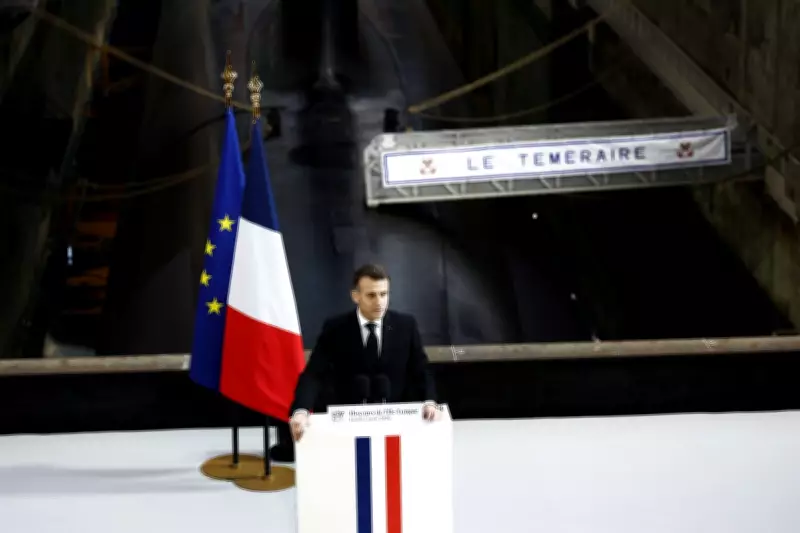
Speaking from a top-secret submarine base in Western France, Macron declared "a new step of France's deterrence." His announcement could herald a major policy transformation, potentially allowing for the temporary deployment of French nuclear-armed aircraft to allied nations for the first time in history.

Eight Nations Engage in Nuclear Dialogue with Paris
Macron revealed that France has initiated nuclear discussions with eight European countries: Britain, Germany, Poland, the Netherlands, Belgium, Greece, Sweden, and Denmark. Participating nations would see their territory "gain a clearly affirmed link to our deterrence," the French president stated, emphasizing that Europe must shoulder greater responsibility for its own security.
This development comes amid heightened tensions with Russia, which maintains a vast nuclear arsenal while developing new missiles, and as China expands its nuclear capabilities. "Our way of thinking must change," Macron asserted, outlining what he termed a "forward deterrence" strategy.
French Constitutional Authority Remains Absolute
Despite this enhanced coordination, Macron insisted that France will not share nuclear decision-making authority. Under the French constitution, the president retains sole responsibility for any decision to employ nuclear weapons. This creates what Galleri describes as a "fundamental contradiction" in the strategy.
"The strategic backing intended to integrate French nuclear deterrence into a collective European defense framework necessarily requires a degree of coordination and joint planning," Galleri argued. "One cannot, for example, carry out a nuclear strike without consulting a partner."
Expanded Cooperation and Enhanced Arsenal
The new approach will allow partner nations to participate in deterrence exercises and could see French nuclear forces supported by European conventional capabilities during crises. This might involve allied early warning systems, satellite and radar networks for missile detection and tracking, air defense and anti-drone protections, and long-range deep-strike capabilities.
Macron also announced that France will increase its nuclear warhead count for the first time since the 1990s, citing evolving defenses among competitors, emerging regional powers, potential adversary coordination, and proliferation risks. France currently possesses approximately 290 warheads.
Héloïse Fayet, a nuclear deterrence specialist at the French Institute of International Relations, highlighted Macron's statement that France's nuclear deterrent aims to inflict "damage from which they would not recover" on adversaries. "We must always be able to inflict that kind of damage," Fayet noted, while criticizing Macron's decision not to disclose specific warhead numbers.
Complementing NATO's Established Mission
Macron clarified that any European nuclear coordination would supplement rather than replace NATO's nuclear mission, from which France abstains. Ian Lesser, a NATO expert at the German Marshall Fund, observed that Macron's move "reflects the state of security in Europe" following Russia's full-scale invasion of Ukraine and "growing uncertainty about the American security commitment to Europe."

"Europe now has to 'deal with a more aggressive Russia for some time to come,'" Lesser stated, emphasizing that "the bulk of Europe's conventional deterrence is lodged in NATO" through American troop presence and US nuclear weapons stationed in Germany, Belgium, and the Netherlands.
"NATO is critical," Lesser stressed. "France is really not looking to weaken that. So the point about it being complementary is important." This delicate balancing act between enhanced European coordination and continued NATO reliance defines Macron's ambitious nuclear strategy overhaul.





