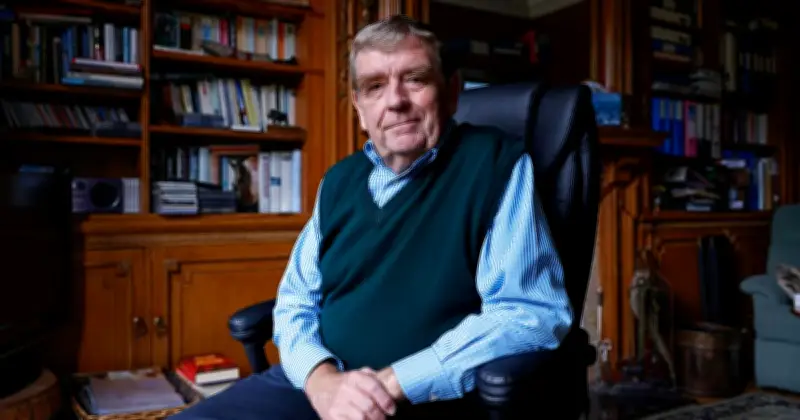
Retired Major General Tim Cross, who cautioned both US Defence Secretary Donald Rumsfeld and Prime Minister Tony Blair about the lack of a proper plan for the aftermath of the Iraq war, has now issued a warning to Prime Minister Andy Burnham about the future of Britain's armed forces.
With Britain and her allies facing the renewed threat of an aggressive Russia, Cross says the UK's political leaders must agree what strength of military is required and ensure the funding, the equipment and the training is in place without delay. “There are no prizes for coming second on a battlefield,” he warns.
Army 'too small' for what is asked of it
The size of Britain's Regular Army has plummeted from 104,254 personnel in April 2012 to just 73,657 in July. Cross believes the Army is “too small” for what is asked of it and stresses the vital role of the armed forces in deterring foes.
“It's about showing a potential enemy that you've got the capability, the physical stuff, to actually do something if they decide to cause trouble,” he says.
With the Budget looming, Prime Minister Andy Burnham and Chancellor John Healey – who quit as Sir Keir Starmer's Defence Secretary over underfunding – are under intense pressure to show how they will ramp up defence spending. The UK has pledged to hit the Nato target of spending 3.5% of GDP by 2035 but Mr Burnham astonished many MPs last month when he said that national security “can't come at the expense of social security”.
Leadership choices and training
If the Government is unwilling to cut welfare spending to fund the military, Cross asks: “Where are you going to get the money from?” He warns that it will require more than a cash injection to strengthen the UK's forces because military capability “takes years to put in place”.
The 75-year-old understands the dilemmas facing Mr Burnham but says: “He is the Prime Minister of the nation who's responsible for taking these hard and tough choices. And continually kicking them down the road, in my view, is not leadership. That is an abrogation of leadership.”
He warns against cutting back on training, describing its vital role in forging the forces which were able to liberate the Falklands and do so well in both Gulf Wars and Afghanistan. “Being together, suffering together, being cold, dirty, and hungry and frightened together builds a team of people who are robust,” he says.
Explaining how the “will to fight” is created, he says: “Friendship, trust and loyalty, duty, honour and courage are the sort of words which build up a moral component in any organisation – not just the Army.”
Lessons from Iraq and Kosovo
He describes the Strategic Defence Review published last year as a “pretty good piece of work” but warns that “the bottom line is nothing basically has happened since that review was published, and we need to get on with it”.
Cross has witnessed first-hand the consequences of failures of leadership. In the build-up to the 2003 invasion of Iraq he was based in Washington DC. He had “no doubt that the military plan” for the overthrow of Saddam Hussein's regime would succeed. “The question was: are we clear what it is that's going to happen afterwards?” He was alarmed at the lack of a plan for “phase four”, the post-conflict scenario.
“The Americans' view was, ‘We do not need a plan for phase four because everything will be fine. The Iraqi people will be so delighted that we're there, [that we] got rid of Saddam Hussein, they will rise up and give us a thunderous round of applause, and we can reduce our military commitment substantially within six months’.”
He told Rumsfeld about the mass troop numbers required when he served in Northern Ireland and Kosovo – vastly smaller territories than Iraq. Rumsfeld, he recalls, “turned away and started talking to the other American commanders”. “I was the only non-American in the room,” he says. “He didn't want to hear it.”
Cross also warned the UK PM. “Unlike a lot of people, I don't condemn the Prime Minister for his choices at the time… I think when he sat on his own, I think he genuinely believed the Americans would not allow this thing to go pear-shaped and that the really important strategic relationship that we had with America had to be sustained, and therefore we had to be alongside them.”
Faith, marriage and veterans
Cross speaks with a clear love for the military and the men and women who serve in the armed forces. He joined the Army aged 16 because, he has said, he wanted to be “out and about”. In the early 1970s he led a bomb disposal unit in Northern Ireland. His first job was attending the scene of the La Mon restaurant bombing, one of the most horrific atrocities in the Troubles. Twelve people were killed and 30 other were injured when the Provisional IRA detonated a bomb containing a napalm-like substance while the Irish Collie Club and the Northern Ireland Junior Motor Cycle Club were holding dances.
Today, Cross hopes the UK Government will take new action to protect ageing veterans from vexatious prosecutions. He argues the spectre of prosecution has an impact on today's military, with parents warning young soldiers: “If you go on an operation and something happens, you could find yourself in court.”
He is known for the depth of his Christian faith and regularly meets with scores of young believers at Sandhurst. For Cross, concepts such as sin and evil are not abstract theological terms but realities the world cannot ignore. He explains: “I have watched the mass graves being dug up in Iraq and elsewhere; I've watched what people did to each other in Northern Ireland; I've watched what ethnic cleansing means in the Balkans… [There] are bad people around, and there are times when we have to stand up for justice and righteousness and be prepared to use force if necessary… Internationally, we need a capability of dealing with the Hitlers, the Stalins, the Pol Pots, the Saddam Husseins, the Miloševićs, and all the other hoods that I found myself dealing with.”
A turning point in his life occurred on his 30th birthday in 1981 when, as a young captain, he visited Jerusalem over Easter Sunday and found himself at the Garden Tomb, a possible burial site of Jesus. As he lent against the entrance to the tomb, the thought hit him that if it was not empty on that first Easter Sunday, if the resurrection did not happen, then “billions” of Christians were “wasting their time”. But if the resurrection really did take place, this demanded serious attention.
He and his wife, Christine, married in 1972 and he speaks with gratitude of their “very happy relationship” which has now spanned more than half a century. He vastly prefers the traditional language of marriage to talk of having a “partner”, arguing that people walk away from partnerships “pretty quickly”. “I was a lousy bridge player, so they went and found another bridge partner,” he remarks. “I was not a good tennis player, so they found somebody else to play tennis with.”
Faith and friendship, plus a willingness to say sorry when needed, are at the heart of their marriage. As he puts it: “Christine and I sit down every week, we pray for the family, we say grace at the table... We're just good mates really.”