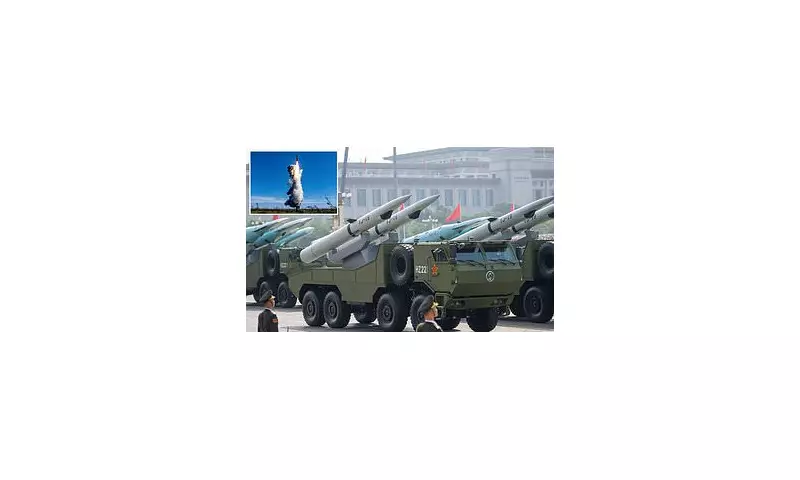
A stark new assessment from the Pentagon has laid bare a significant escalation in China's nuclear capabilities, revealing that Beijing has now armed more than 100 long-range missiles capable of reaching the continental United States. The report, delivered to the US Congress on December 23, details a rapid military build-up that is making the American homeland "increasingly vulnerable."
Underground Arsenal and Strategic Deployment
The report identifies that China's military has placed over 100 DF-31 intercontinental ballistic missiles (ICBMs) into hardened underground launch sites, known as silos. These missiles are a formidable threat due to their use of solid fuel, allowing for a rapid launch with minimal preparation time compared to older liquid-fueled systems.
US intelligence has pinpointed vast missile silo fields in three remote regions of northern and western China: near Hami in Xinjiang, Yumen in Gansu, and Yulin in Inner Mongolia. While these fields collectively contain approximately 320 silos, American officials assess that just over 100 are currently loaded with missiles. This surplus capacity allows China to potentially move its arsenal between silos in a strategic 'shell game,' complicating enemy targeting in a conflict.

Reach and Readiness: A Direct Threat to US Security
The DF-31 missiles have an estimated range of up to 6,800 miles, putting most of the United States within striking distance from their Chinese launch sites. China demonstrated this capability in 2024 by test-firing one such missile into the Pacific Ocean, where it travelled a long-distance trajectory before landing near French Polynesia.
The Pentagon's analysis warns that this build-up is a core part of China's plan to amass over 1,000 nuclear warheads by 2030, enhancing its readiness for swift counterattacks. The report states China's current nuclear warhead stockpile is in the "low 600s," indicating an increase of roughly 100 warheads per year this decade. This positions China as having the world's third-largest nuclear arsenal, behind only Russia and the US.
Broader Ambitions and Regional Tensions
The military expansion is framed within China's overarching ambition to become a global superpower by 2049, backed by a world-class military. The Pentagon notes that Beijing views defending territorial claims—including over Taiwan—as "core interests" on which it will not compromise. The report further warns that China is building its forces to be prepared for a potential invasion or blockade of Taiwan by 2027.
Tensions are compounded by China's growing frustration with America's network of alliances in Asia, particularly with Japan, South Korea, and the Philippines. Beijing reportedly believes there is a bipartisan consensus in the US Congress to 'contain' its rise.
Despite the alarming revelations, a senior US Department of War official stated that the White House and Pentagon are actively working to de-escalate the situation. The official emphasised that President Trump seeks "stable peace, fair trade, and respectful relations with China," supported by efforts to open wider military-to-military communication channels with China's People's Liberation Army.