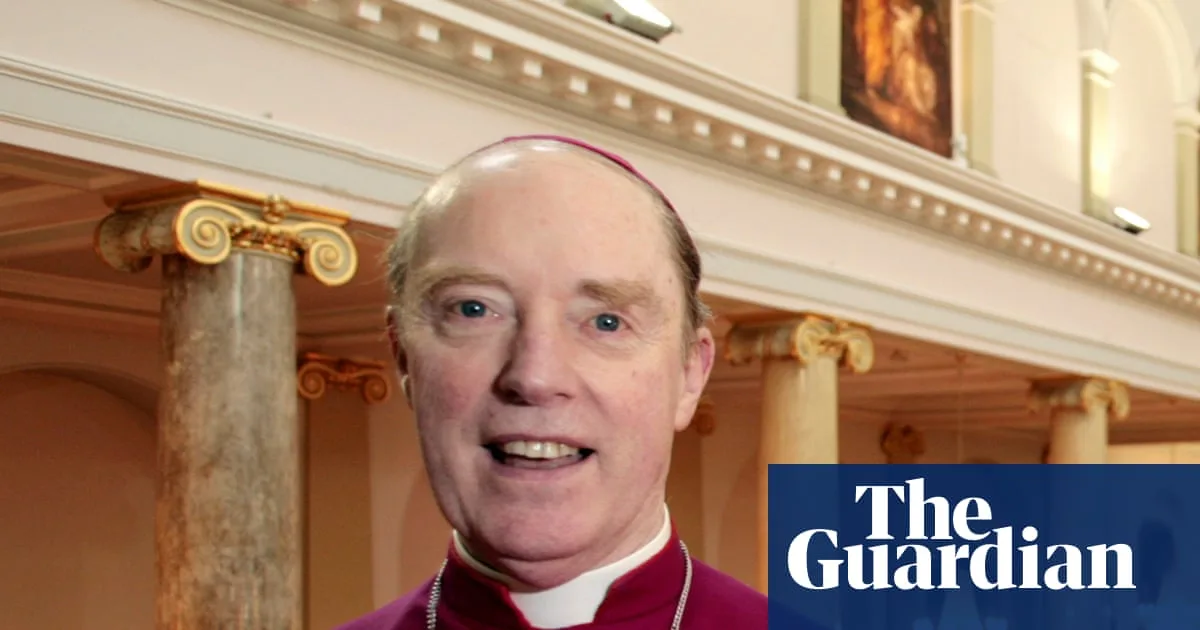
Bishop Thomas McMahon dies at 89: A complex legacy of peace activism and tradition
Bishop Thomas McMahon dies, aged 89

The Right Reverend Thomas McMahon, the former Roman Catholic Bishop of Brentwood whose career blended staunch peace activism with deeply traditionalist views, has died at the age of 89. His passing marks the end of a distinctive chapter for the English Catholic church, where he was both a vocal critic of nuclear arms and a defender of orthodox teaching.

A Bishop of Contradictions: Peace Protests and Traditional Beliefs

Thomas McMahon, who served as Bishop of Brentwood from 1980 until 2014, defied easy political categorisation. He was a prominent figure in the Catholic peace organisation Pax Christi, serving as its vice-president from 1989. Dressed in full clerical garb, his tall frame and distinctive hairstyle became a familiar sight at protests, including those outside arms fairs in London's Docklands and the former US embassy in Mayfair.

He was an unswerving opponent of nuclear weapons, a stance that set him apart from many of his fellow bishops in England and Wales. In 1999, he publicly challenged Foreign Secretary Robin Cook's 'ethical foreign policy' over arms sales to Indonesia. Again in 2006, he opposed the Labour government's plans to renew the Trident missile system.

Yet, this outspoken liberal stance on defence did not extend to other issues. McMahon adhered strictly to traditional Catholic doctrine. In 2004, he joined the anti-abortion group Helpers of God's Precious Infants in a picket of a Marie Stopes clinic in Buckhurst Hill, Essex—an action most English and Welsh bishops had avoided.

The Lasting Monument: The Rebuilding of Brentwood Cathedral

Perhaps the most visible and controversial legacy of McMahon's tenure was the dramatic remodelling of Brentwood Cathedral. Between 1989 and 1991, he commissioned the architect Quinlan Terry to transform the Victorian Gothic building with a 1960s extension into a neoclassical edifice.

Terry's design, mixing Italian Renaissance and English Baroque styles with a portico inspired by Wren's St Paul's, was funded by an anonymous donation specifically for the project. McMahon refused to give further details, though rumours later suggested the benefactor was the conservative chaplain Mgr Alfred Gilbey, of the Gilbey's gin family.

The multi-million pound project was fiercely criticised. Many argued the funds should have been directed towards tackling poverty, not architecture. The result, hailed by some as a masterpiece and by others as a white elephant, is now the Cathedral Church of St Mary and St Helen's most defining feature.

From Surrey to Essex: A Life of Service

Born in Dorking, Surrey on 17 June 1936 to Irish parents, Thomas McMahon was educated at St Bede's Catholic grammar school in Manchester. He took the unusual step for an English clergyman of training for the priesthood at Saint-Sulpice in Paris, before his ordination in 1959.

After serving in Essex parishes, his role as chaplain to Essex University from 1972 brought him to wider attention. He was appointed Bishop of Brentwood in 1980 at the relatively young age of 44. His diocese stretched into east London, where he engaged in multifaith work and maintained a close ecumenical relationship with Anglican bishops, establishing shared churches and schools.

A man of strong convictions and colourful personality, McMahon chose not to live in the official bishop's residence. Instead, he remained in a cottage in the village of Stock, near Billericay, filled with antiques, where he would entertain priests for dinner. After submitting his resignation at 75 as required, he stayed on for three extra years before retiring to Stock, where he served as parish priest until his death on 24 November 2025.

Though once tipped for higher office, his vivid and uncompromising character did not fit the Vatican's standard blueprint for a cardinal. He leaves behind a complex legacy: a peace campaigner who upheld tradition, and a bishop who forever changed the skyline of his Essex diocese.




