

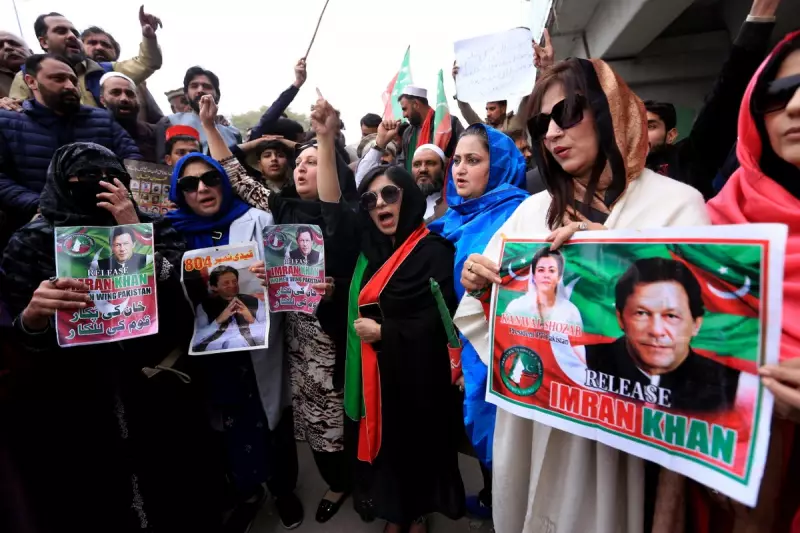
Pakistan has firmly rejected criticism from the United Nations human rights chief regarding sweeping constitutional amendments that grant lifelong legal immunity to the country's powerful army chief and other senior officials. The move coincides with escalating international and domestic concern over the treatment and condition of imprisoned former prime minister Imran Khan, who has been denied all family and legal visits for weeks.
UN Warns of "Far-Reaching" Consequences for Democracy
UN High Commissioner for Human Rights Volker Turk issued a stark warning earlier this week, stating that the constitutional changes approved by Pakistan's parliament this month "risk subjugating the judiciary to political interference and executive control." The amendments guarantee lifelong immunity from prosecution to Field Marshal Asim Munir, the army chief widely seen as the nation's most powerful figure, along with several other top officials.
Furthermore, the reforms establish a new Federal Constitutional Court, a move that diminishes the authority of the Supreme Court and tightens government control over the judiciary. Mr Turk argued that "sweeping immunity provisions like these undermine accountability," which he described as a cornerstone of human rights and democratic control of the military. He cautioned the reforms could have "far-reaching consequences for the principles of democracy and rule of law."

In a statement on 30 November, Pakistan's foreign ministry dismissed these concerns as "baseless," asserting that Islamabad remains "fully committed" to the rule of law. The ministry expressed regret that Pakistan's views and "ground realities" were not reflected in the UN official's remarks.
"Complete Darkness": Imran Khan's Family Pleads for Access
These constitutional changes unfold against a backdrop of intense anxiety regarding the welfare of former premier Imran Khan, who has been imprisoned since August 2023. His son, Kasim Khan, issued a public plea on Thursday, demanding proof his father is alive and safe after all family contact was blocked.
Kasim Khan stated his 73-year-old father has now spent 845 days in detention and is confined to a "death cell" in "complete isolation." He claimed that for the past six weeks, Mr Khan has been kept alone with no phone access or visits, despite clear court orders permitting meetings with his sisters. "No phone calls, no meetings, and no news of his well-being," he wrote on social media platform X, insisting this "complete darkness" is not a security protocol but an attempt to conceal his father's health.
The former prime minister's sisters corroborated these claims. Aleema Khanum said visits to Adiala Jail had become "unpredictable and increasingly futile," with family members often waiting for hours only to be turned away. Another sister, Noreen Niazi, said no relative has been allowed access for four weeks, describing the situation as "the pinnacle of oppression." Senior members of Mr Khan's Pakistan Tehreek-e-Insaf (PTI) party also reported being denied scheduled appointments.
Political Motives and Military Supremacy
Senior PTI member Zulfi Bukhari directly linked the timing of Mr Khan's isolation to the constitutional amendments. He suggested authorities wanted to silence the government's most prominent critic during a politically sensitive period. "They've just cut all access to the outside world at a very crucial time when crazy amendments are being passed in parliament," he told The Independent.
This perspective resonates in a nation with a long history of military dominance. Pakistan, a country of 250 million people, has been under direct military rule for nearly half of its existence since 1947. The armed forces have remained the dominant institutional power even under civilian governments. Analysts fear that granting lifetime immunity to the current army chief further entrenches this military supremacy, particularly while the main civilian political opposition figure is held incommunicado.

Adiala Jail authorities have strongly rejected claims of mistreatment, insisting the former leader is in good health and receiving all necessary care. They labelled reports of a secret transfer as "entirely baseless."
Imran Khan, elected prime minister in 2018 and ousted by a no-confidence vote in 2022, maintains that the dozens of criminal cases against him are politically motivated to block his comeback. He and his wife were sentenced in January to 14 and seven years in jail respectively on corruption charges they say were fabricated.





