
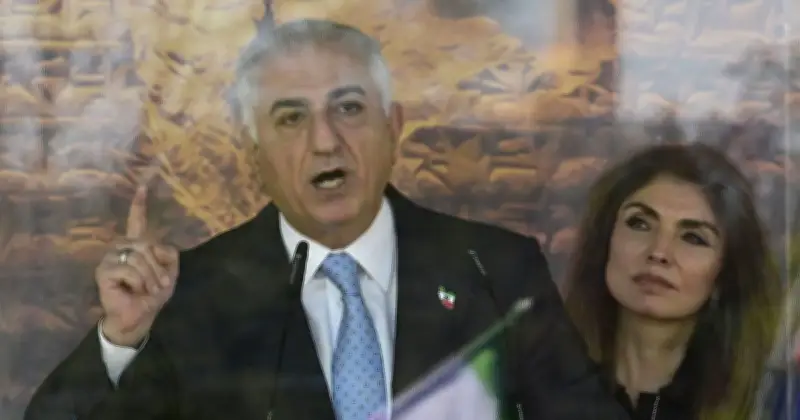
Iran's exiled Crown Prince has accused Donald Trump of abandoning anti-regime protesters, saying many now feel "betrayed" by a peace agreement.
By Michael D. Carroll 04:56, Fri, Jun 19, 2026 Updated: 04:56, Fri, Jun 19, 2026
The 65-year-old, regarded by many as the unofficial leader of the Iranian opposition, said Iranians who opposed the Islamic regime feel "betrayed" by Donald Trump's peace agreement with Tehran because the future of ordinary citizens has been ignored.
Mr Pahlavi said those killed during anti-regime demonstrations in January had "not died for a nuclear deal or the Strait of Hormuz" and argued that the interests of the Iranian people have been absent from negotiations.
The 65-year-old also criticised Sir Keir Starmer after the Prime Minister offered to lift British sanctions on Iran following the agreement, accusing Western leaders of "validating and rewarding blackmail".
Speaking to the Daily Mail in London, he said he remained convinced the current regime would eventually collapse and predicted the peace arrangement would not endure because it is "not tenable".
What has Iran said about the agreement?
New Supreme Leader Mojtaba Khamenei said he had "issued the permission" for the deal to be signed, but insisted the agreement did not mean Iran would accept the position of its opponents in future negotiations. Mr Khamenei also claimed Mr Trump had reached the agreement "out of desperation".
Iranian President Masoud Pezeshkian praised the memorandum, describing it as "a reflection of the voice of a nation that did not trade its dignity and independence for any threat or pressure".
The comments came after Mr Trump signed a controversial Memorandum of Understanding in Versailles on Wednesday aimed at bringing the conflict to an end. Under the terms, Tehran will receive $300 billion (£227 billion) in reparations alongside sanctions relief, provided it reopens the Strait of Hormuz, disposes of its enriched uranium and commits to not developing nuclear weapons.
Why does Reza Pahlavi oppose the deal?
Speaking with the Daily Mail, Mr Pahlavi - whose father was Iran's last Shah before the 1979 Islamic Revolution - said many Iranians were now questioning whether promises of regime change would ever be fulfilled. He said citizens feel "betrayed" and are asking whether that promise is "going to be delivered or not", adding: "That's on the conscience of this President and this administration."
Mr Pahlavi also said: "It's been abhorrent for us that nowhere in the discussions have the Iranian people even been considered as being part of the issue." He said Iranians were seeking freedom, an end to political imprisonment, a halt to executions and greater respect for human rights.
The opposition figure warned that funds secured by Tehran would not "trickle down to the people" but instead would be used to strengthen groups including Hezbollah, Hamas and the Houthis.
The nature of 'the beast'
Mr Pahlavi also criticised remarks by Mr Trump suggesting "it's OK" for Iran to retain some ballistic missiles because other countries possess them. "The nature of the beast is that they are dangerous in nature, that should be the calculation," Mr Pahlavi said. "It's a beast that they're dealing with, not rational people who calculate and are accountable to their own citizenry. If they were, they would not shoot 40,000 people just to survive."
Despite his criticism, Mr Pahlavi said he believed "the door is still open" for Mr Trump to take further action. Reflecting on the memorandum, he added: "I don't think it's going to last. It's not tenable, it's not legitimate in the eyes of the people."
He urged Sir Keir and other Western leaders to remember that "executions are continuing in Iran" and said Britain should "stick with us, help us overcome this". Despite concerns over the agreement, Mr Pahlavi said Iranians remained "resilient in their fight for freedom".
The US military has confirmed it has lifted the naval blockade of Iranian ports. Israel has refused to withdraw from Lebanon under the terms of the memorandum, drawing criticism from US Vice President JD Vance. Israeli Prime Minister Benjamin Netanyahu was sidelined during negotiations and is not a signatory to the agreement.




