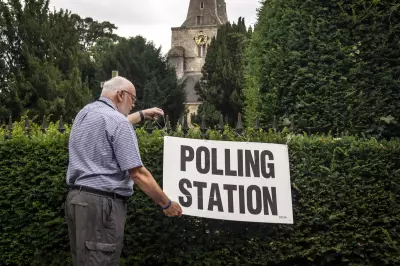
In Focus: Is a pumped-up Farage proof that it is time for politics without politicians? The Reform leader and populism are the big winners at the ballot box, but do these local election results hint at a bigger change needed in our political system? Political theorist Hélène Landemore thinks so, and says citizen assemblies could be the real reform we all need.
Why the local election results spell disaster for Keir Starmer
Young people do not hate democracy. They just do not feel represented by it. Across Western democracies, a familiar story is told about young people and politics: they are radical, but unserious, quick to protest and slow to vote — even quiescent. But what if we are misreading the signal? Young people are not turning away from democracy because they do not care. They are turning away because democracy, as currently structured, does not see them and does not hear them.
In my own work, I argue that democracy at its best should bring out the shy. By shy, I do not mean only introverts. I mean those who feel powerless and invisible: citizens without networks, without institutional access, without confidence that their voice matters. Shyness, in this sense, is political. Today, young people are among the structurally shy.

The data bears this out. Those aged 18-29 are the most likely to say no party really represents them. This is not mere partisan frustration. Typically, young respondents say the government needs significant changes no matter who we elect, compared to older respondents. Younger people are more likely to be sceptical of the system itself, not just of particular politicians. A July 2024 study by Interdisciplinary Perspectives on the Politics of Adolescence and Democracy found that 49 per cent of young respondents were dissatisfied with the way democracy works in the United Kingdom. Only 29 per cent were satisfied. Sixty-two per cent feared that economic and political changes would threaten their future.
When young people say democracy is not working, and most fear for their economic prospects, we are not facing a communication problem. We are facing a problem of representation. My Yale colleague Sam Moyn calls this the problem of the gerontocracy, rule by the old. In the US, while half of Americans are under 40, only one in 20 in Congress is. Almost a quarter are 70 or older. In the UK, the House of Commons remains disproportionately older: in 2019, of 650 MPs, 200 were aged 50-59, 105 were 60-69, and 21 were 70 or older. The average age of MPs elected in 2024 was 48, consistent with a long-term average of around 50. For a generation facing student debt, housing precarity, and climate breakdown, the political class can look not only unresponsive but demographically distant, too.
Populism wins
Globally, the story is similar. A 2020 study by Cambridge's Bennett Institute, surveying 75 countries, found that millennials were more dissatisfied with democratic performance than older cohorts. Youth dissatisfaction correlated strongly with economic inequality: the more unequal the country, the more dissatisfied its young citizens. The study contained an intriguing twist. Democracies experiencing populist waves sometimes showed higher levels of youth satisfaction than those governed by moderates. In countries with elected populists, youth democratic satisfaction increased by over 15 per cent after four years. Leaders and movements identified ranged from Jeremy Corbyn in the UK to Marine Le Pen in France, the Five Star Movement in Italy, and Donald Trump in the US. However troubling this may be, populism appears, at least temporarily, to make some young people feel politically visible.
This should give defenders of liberal democracy pause. Populism thrives on moral clarity and binary narratives: the pure people versus the corrupt elite. It reduces complexity, but it offers something powerful in return — recognition. It tells the politically invisible: you matter. The lesson is not that democracies should become populist. It is that democracies must learn to recognise the structurally shy before populists do. Younger citizens are systemically critical, but their scepticism is institutional, not nihilistic. They are not rejecting democracy. They are rejecting a democracy that does not include them meaningfully.

If democracy is to bring out the shy, it must do more than encourage turnout. It must redesign spaces of decision-making so that those who feel structurally invisible experience themselves as co-authors of the political order. This is where citizens' assemblies — spaces for what I call politics without politicians — matter.
Citizens' assemblies
Citizens' assemblies bring together randomly selected, demographically representative groups to deliberate on public issues. Participants hear from experts, question witnesses, deliberate in small groups, and formulate recommendations. Unlike opinion polls, assemblies are not snapshots of preference; they are structured processes of listening and reasoning. Participants are chosen by lottery from the public, often with quotas to ensure the group broadly matches the population. Random selection is crucial. It bypasses party hierarchies, professional ambition, and those informal networks that usually decide who gets heard. You do not need connections, rhetorical polish, or campaign funds to enter the room. You are invited because you are a citizen.
Once there, the shy are not only present; they are supported to speak. Skilled facilitation, small-group formats, and time for reflection allow quieter participants to find their voice. In the French Citizens' Convention on Climate, the youngest participant was 16. Like other minors, he attended with a chaperone but deliberated as an equal. All participants repeatedly describe the experience as transformative: not because they won arguments, but because they were taken seriously. This matters for young citizens who have grown up feeling that decisions about housing, debt, climate, or work are made elsewhere, by older generations, in closed rooms.
Citizens' assemblies also soften the generational divide. Instead of boomers and Gen Z confronting each other through caricature or social media outrage, everyone sits at the same table. Opposing views are then encountered as lived experiences rather than abstract enemies. The process does not erase disagreement, but it reframes it and often leads to convergence. Finally, assemblies regenerate the social fabric. People learn to understand each other across divides, including generational ones, and to care for each other. As an older woman told the youngest member of the French citizens' assembly: I hope your blond hair turns a lovely grey. What better answer to the rage cultivated by populists than love for your fellow citizens, whatever their age?
Members hear from experts and affected communities and then vote on proposals or produce a final report with recommendations for government or parliament. Critics argue that assemblies are too small, too advisory, or too technocratic to really matter. These concerns are real if assemblies are treated as one-off experiments. But when embedded institutionally — through guaranteed parliamentary debate on recommendations or links to referendums — they could help reshape democratic ecosystems and produce one where we all feel seen and heard.
Reform without rupture
For those who believe the system itself needs significant change, assemblies offer reform without rupture. They supplement representative democracy rather than replacing it. The alternative is stark. If democracies fail to bring out the shy, others will. Populist movements will continue to offer recognition through division. And some young citizens may conclude that the only way to be heard is to withdraw or to burn the house down.
Democracy survives not because citizens are endlessly patient, but because institutions evolve. In the 19th century, reform meant expanding the franchise. In the 20th century, it meant securing civil rights and social protections. In the 21st century, it may mean institutionalising deliberative spaces alongside elections. A democracy that brings out the shy does not wait for the loudest voices. It creates structures that invite the quiet in and then helps them speak. Citizens' assemblies are not a panacea. But they are one concrete way to ensure that those who feel structurally invisible, including many young people, experience democracy not as a distant spectacle but as a shared practice. If we want people, especially the next generation, to believe in democracy, then democracy must first believe in them.
Hélène Landemore is a political theorist and author of 'Politics Without Politicians'.