
Donald Trump has taken a further sideswipe at the UK for refusing to be drawn into the Iran conflict.
The US president renewed his criticism of Prime Minister Sir Keir Starmer as he pointed out countries now wanted to be involved in reopening the Strait of Hormuz but “not while the war was going on”.
His latest rebuke came as it emerged the interim peace deal to end the nearly four-month war between the US and Iran only secures toll-free passage of the strategic waterway for 60 days, and does not rule out future fees being levied.
Ending Tehran’s stranglehold on the critical Gulf channel, which has disrupted global oil and gas supplies and driven up fuel and food prices, had been a key demand in negotiations.
A joint statement issued by leaders at the G7 summit in France, which welcomed Mr Trump’s “breakthrough” agreement with Tehran, stressed “the right of transit without restrictions was the bedrock of international trade”.
It backed the UK-French-led effort to enable shipping to pass safely through waterway once hostilities with Iran ended.
The proposed defensive mission includes the deployment of autonomous mine-hunting equipment.
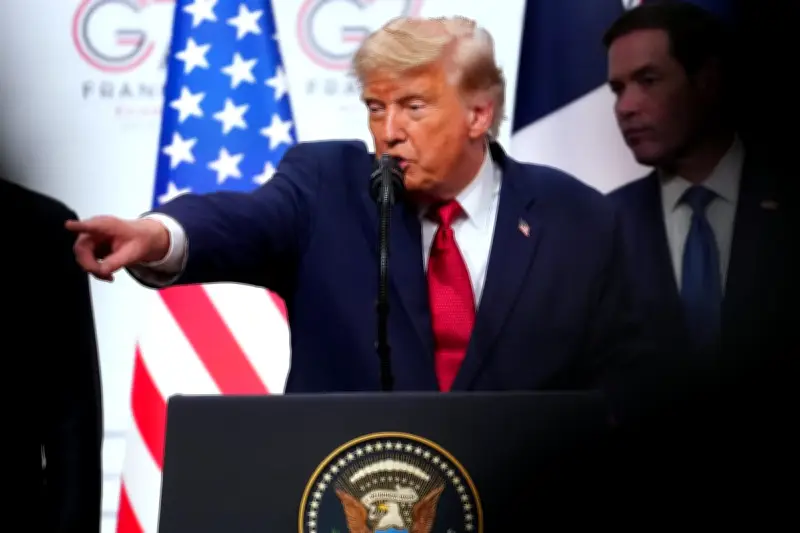
Asked at a news conference about whether he had requested help from other G7 nations, Mr Trump said: “We don’t need it.
“Oh, by the way, they all want to do it. They all want to do it, every single one of them.
“They want to go be a part of it now, not while the war was going on.
“I was really disappointed.
“The UK, I said ‘it’d be nice’, I didn’t put a hard sell on, but I said ‘it’d be nice if you sent some ships’, and the Prime Minister said ‘they’ll be there, sir, as soon as the war is over’.
“I said, ‘Did you say that?’ I couldn’t believe it, actually.”
Mr Trump also criticised Japan for not being willing to be drawn into the war.
He said: “Nobody did, we did it ourselves with Israel and with the Arab states that got hit, surprisingly.”
Earlier, speaking during talks with India’s Prime Minister Narendra Modi, Mr Trump was asked whether he wanted European allies to send minesweepers to the strait.
Responding, the President said: “We don’t need them but if they want to send them, I think it’s good.”
The US agreement with Iran, along with Ukraine, topped the agenda at this week’s meeting of heads from the G7 group of leading democracies in Evian, France.
While Sir Keir and his counterparts supported the deal with Iran, they underlined the need for a “robust and comprehensive” follow-up accord “that can bring peace and security for all in the region”.
As part of this, they highlighted further negotiation was required to ensure Iran can “never obtain a nuclear weapon”.
The US-Iran agreement is due to be formally signed in Switzerland on Friday by US vice president JD Vance, although Mr Trump has not ruled out attending in person.
Iran has also suggested the deal could be signed by Mr Trump and Iranian president Masoud Pezeshkian.
Such a meeting would represent a major step for the two countries, which broke off diplomatic relations in 1980 over the US embassy hostage crisis in Tehran.
According to the officials, the draft agreement includes a new “minimum” standard for diluting highly enriched Iranian uranium and has provisions to ensure the “territorial integrity” of Lebanon after Israel’s latest attacks against Hezbollah militants in the country.
In return, the US will move to waive, but not eliminate, some wide-ranging sanctions against Iran once the deal is signed.
It also holds out the prospect of providing at least 300 billion US dollars (£223 billion) to Iran to rebuild after the war, although it is understood this would be subject to a final agreement being concluded on its nuclear programme.
Mr Trump has said the US was “not putting up 10 cents” for the fund and it remains unclear how it would be bankrolled, with Gulf nations likely to be reluctant after Iranian attacks.
The interim deal opens a two-month period for nuclear negotiations and appears to offer Iran several benefits up front while providing little in return.
The move to allow Iran to sell its oil immediately, and the offer to eventually lift all sanctions, represent major concessions that go beyond the terms of Iran’s 2015 nuclear pact with world powers, which Mr Trump unilaterally withdrew the US from in his first term, branding it the “worst deal ever”.
The accord is likely to face opposition in Washington and appears to be a major setback for Israeli Prime Minister Benjamin Netanyahu, who launched the military offensive with Mr Trump on February 28.
Much of the agreement would restore the status quo before the war, including ending hostilities, restarting negotiations between the US and Iran over Tehran’s nuclear programme, and reopening the strait.
While claiming the deal was “very strong”, Mr Trump also left the door open to ditching it.
He said: “It’s a memorandum of understanding, and if I don’t like it, we’ll go back to shooting at them, dropping bombs.”




