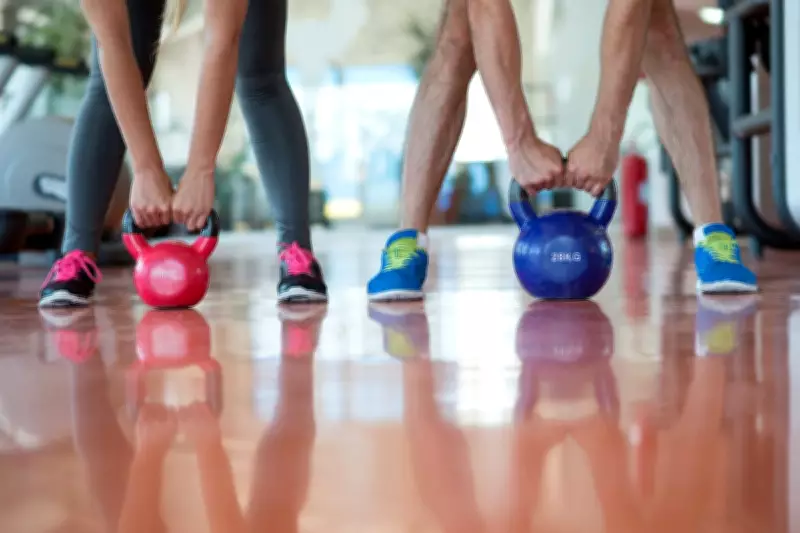
Exercise has become an expensive pursuit. I recently heard about a man who spent more than £1,000 while training for a marathon – a mountain of shoes, clothes, gels and physio funds responsible for clobbering his bank balance. The kettlebell is the antithesis to this. You pay a one-off fee for a lump of iron with a handle; it lasts a lifetime, and it can improve every area of fitness fathomable – if you know how to use it.
“If you were to stick me in a prison where all I had was a 16kg or 20kg kettlebell, and you told me I would only be let out when I was in the best shape of my life, I could pull it off,” coach Dan John tells me. “Coach” is, perhaps, an inadequate term here. John is a key reason why kettlebells now sit in most UK gyms, having invented staple exercises like the goblet squat and farmer’s carry. He explains how anyone can use kettlebells to transform their fitness fortunes in five simple steps – no four-figure fee necessary.
First: The Foundations
“There is a triad of things that helps you stay in shape,” John says. “These are strength training, walking and caloric correctness.” For better health, you need to be moving a decent amount on a daily basis through walking, strength training exercises several times per week, and consuming an appropriate amount of food and drink to support these activity levels, ideally including protein, fibre and fruits and vegetables with each meal.

“The habit of fitness has to be the first thing you learn,” John says. The most effective way to do this, he continues, is to do something every day. This doesn’t mean committing to daily hour-long slogs – just keeping the body ticking over. “As you learn more moves, you can figure out that one day a week is a mobility day, one or two days a week are ‘get sweaty’ days, one or two days a week are ‘get strong’ days,” says John. “The piece of equipment remains the same – the kettlebell.”
“You also always have to leave something in the tank,” he continues. “If you work out so hard today that it impacts your workout tomorrow, you’ll actually end up regressing. It’s far better to have 365 days of training consistently than one incredibly hard session followed by nothing for the next few days.”
Step One: Learn the Three Essential Exercises
“The body is one piece,” John tells me. Every part of you is working together in some way to complete any physical task. That is why he prefers training movement patterns rather than specific muscles – as bodybuilders have popularised. There are five basic human movements, according to John: push, pull, hinge, squat and loaded carry. If you can do all of these on a regular basis, your fitness will flourish.
You can touch on all five of these movements in some form with just three fundamental kettlebell exercises. These are the kettlebell swing, goblet squat and press-up. This trio can also be combined in myriad ways for fun, effective workouts. Here is how to do them correctly.
Goblet Squat
Stand upright with your feet just outside shoulder-width apart and your toes pointed outward slightly. Play around with this position to find what feels comfortable for you. Hold a kettlebell in both hands in front of your chest. Brace your core by imagining someone is about to strike you in the stomach and tightening your midsection muscles accordingly. Keeping your chest proud throughout, push your hips back, then lower them between your legs until your elbows touch the insides of your knees. Drive through your feet to return to the starting position. Your weight should be between your midfoot and heel. To check if this is the case, you should be able to wiggle your toes at any point during the exercise.

Kettlebell Swing
Start with your feet just outside shoulder-width apart and the kettlebell on the ground in front of you. Keeping your spine long, hinge at the hips to bend over and grasp the kettlebell with an overhand grip. Brace your core then, without bending your arms and keeping your eyes forward, pull the kettlebell back between your thighs. This is position one. Explosively squeeze your bottom to shoot your hips (and the kettlebell) forward and stand tall. Your arms should stay straight throughout this movement. This is position two. Once the kettlebell reaches its highest point, allow it to arc back down and return to position one before repeating the movement, alternating between position one and position two. If you struggle to learn this move or you do not feel ready for a dynamic exercise like this, you can swap it for a bodyweight glute bridge or kettlebell glute bridge.
Press-Up
Assume a high plank position. This means you are facing the ground with your weight supported by your hands and toes. Your hands should be under your shoulders and your body should form a straight line from your heels to the back of your neck. Think about screwing your hands outward and into the ground to tuck your elbows towards your body. This will create a strong, stable starting position. Brace your core, then bend your elbows to lower your chest toward the floor. You should feel in control of the movement at all times. Once your chest is within an inch of the floor, press through your hands to return to the starting position. If this is too challenging, you can drop your knees to the floor for kneeling press-ups or perform wall-press-ups against a sturdy vertical surface.
Workout One: The Humane Burpee
The best single-kettlebell workout, in John’s eyes, is “the humane burpee” – a session of his design that exclusively uses the three exercises above. “Every quality you want to chase is going to be in there somehow,” he says. “You get sweaty, you get stronger, and you’re going to become a little bit more mobile too.” Complete 10 rounds of the circuit below. Each round, perform one less goblet squat and one less press-up.
- Kettlebell swing x15
- Goblet squat x10
- Press-up x10
Step Two: Don’t Neglect Your Mobility
Mobility is your capacity to move. To move, you need the strength to get to a position and the flexibility to access it. Mobility is the intersection of these two factors, and it is an essential element of successful strength training.
Workout Two: Mobility Protocol
To improve your mobility, John prescribes a refreshingly simple protocol: spend 30 seconds hanging from a pull-up bar, then 30 seconds sitting in the bottom of a goblet squat. Repeat this sequence for a few rounds, and that can be the extent of a beginner’s mobility workout.
Step Three: Incorporate Loaded Carries into Your Workouts
“Loaded carries offer the most bang for your buck of any exercise,” says John. And they do exactly what they say on the tin: you pick up a load (in this case, a kettlebell) then you carry it for a bit. “The weird thing about the whole loaded carry family is, I don’t care what you do, you will benefit just by doing them,” he continues. “If you’ve never done a loaded carry, try it, then ask me more questions.”
These exercises are among the most overlooked in your average exercise plan. We squat a lot, and press, and pull, and hinge, but we rarely carry. It’s become a rarity in daily life too – even our suitcases now have wheels. Yet loaded carries are a one-stop shop to a stronger, more robust body. The best place to start is the farmer’s carry. This involves holding a kettlebell in each hand and walking tall for as far as you can. If you only have one kettlebell, try the suitcase carry, where you hold a kettlebell in one hand (à la a suitcase) and walk tall for as far as you can. You could also hold the kettlebell in a front rack position (nestled between your forearm and the front of your shoulder) or with your arm extended overhead. Then, you guessed it, walk tall for as far as you can.
Workout Three: Sparhawk
John’s Sparhawk workout (his loaded carry workouts are named after hawks as a nod to their talon shape) is a good introduction to loaded carries. Here’s how to do it:
- Goblet squat x8
- Right-handed suitcase carry x60ft
- Goblet squat x7
- Left-handed suitcase carry x60ft
- Continue decreasing the number of squats by one until you are down to one
“You can make it harder if you want by going farther or increasing the reps,” John says. Or make it easier by starting with a lower number of goblet squats, using a lighter weight or reducing the length of the suitcase carries.
Step Four: Introduce a Second Kettlebell
Owning one kettlebell offers incredible training potential. Owning two widens these horizons even further. Pressing a pair overhead is “the best thing you can do with kettlebells,” John says, with this exercise promising improved strength and stability throughout the body. There are three key double kettlebell exercises he recommends learning first: the double kettlebell clean, double kettlebell press and double kettlebell front squat. This is how to perform each one.
Double Kettlebell Clean
Start with two kettlebells on the ground two feet in front of you, handles angled slightly towards you to form a V. Assume a stance slightly wider than shoulder width. With soft knees, hinge at the hips to bend over and grab a kettlebell in each hand with an overhand grip. Keeping your spine long, arms straight and eyes forward, pull the kettlebells back between your thighs. From here, squeeze your glutes to explosively drive your hips forward. As you do this, stand up straight and allow the momentum from your hip drive to arc the kettlebells up to the front rack position – elbows at your sides pointing down, thumbs against your chest, ‘bells between the fronts of your shoulders and forearms. Allow the kettlebells to fall away from your body, curving back between your thighs, then repeat.
Double Kettlebell Press
Clean two kettlebells into the front rack position. Drive your fists to the sky until your arms are fully extended overhead, biceps by your ears. Your wrist will rotate inwards slightly as you do this, ending with your palm facing forward, and the kettlebells should follow a shallow J-shape when viewed head-on. Control the weights back down to the front rack position then repeat.
Double Kettlebell Front Squat
Clean two kettlebells into the front rack position. Create tension throughout your body then, keeping your chest up, push your hips back slightly to initiate the squat. From here, bend your knees and lower your hips as far as you can while keeping your chest up. Drive through your feet to return to the starting position.
Workout Four: Armour Building Formula (ABF)
John’s favourite workout for incorporating these three exercises is his Armour Building Formula, or ABF for short. Here is how to do it:
- Double kettlebell clean x2
- Double kettlebell press x1
- Double kettlebell front squat x3
There are near-infinite ways to use this workout. You can use heavy kettlebells to target strength gains, resting for a few minutes between each round. You can pick up moderate kettlebells and complete this matrix of movements every minute for 10 minutes for more of a muscle-building hit. Or you can set a 20-minute timer and complete as many rounds as you can with lighter weights to set your heart, lungs and muscles alight.
Whatever option you choose, the ABF has the power to transform how your body looks and feels from the ground up. “You can call the area from your neck to your knees whatever you want,” John says. “Lots of people call it the core, but saying ‘the core’ is like saying ‘doing cardio’ – it’s an overused term. The three words I use for this area are armour, anaconda and arrow.” Armour means packing on muscle, anaconda is the harnessing of internal pressure (bracing) for stability, and arrow refers to the ability to move powerfully. The first of these is what gives this workout its name, but the session will help you develop all three.
Step Five: Train Outside
You don’t need me to tell you that spending time in nature is measurably beneficial for your health. So why not shoehorn this perk into your workouts? Pick a park then lug your kettlebell there. By the time you arrive, your loaded carry work is done and your warm-up is well underway. Training outdoors also forces you to be more adaptable.
“Training outside makes you more like a jazz performer,” John says. “Maybe the ground is soggy so you can’t do a lot of ground work like Turkish get-ups; maybe it’s unseasonably hot; maybe your usual spot has been taken by a family picnic. You have to adapt. I think unexpected adaptations make for great training programmes. Every good idea I’ve ever had as a coach has come from not having access to perfect conditions and making adaptations.”
Adaptation is the reason we exercise. We do it because we want something to change, whether that’s in our psychology or physiology. So it makes sense to train in an environment that encourages this plasticity.
Workout Five: Coyote
John says his Coyote workout – named after Coyote Point, the California spot where he created the session – is a top option for training outside. Again, it uses the three foundational kettlebell exercises we learned at the beginning of this article. Here is how to do it. Beginners should start with five rounds, then as you become fitter you can build up to the full 20 rounds. The aim is to move smoothly during the workout, performing each exercise with good technique and resting only as needed. You can swap the press-ups for kneeling press-ups. Or make it harder by upping the number of press-ups in each round, then increasing the weight of the kettlebell.
John’s formula of a couple of “get strong” days each week (Armour Building Formula and Sparhawk), a couple of “get sweaty” days each week (the Humane Burpee and Coyote) and a decent dose of mobility and movement around this is a solid recipe to follow. However, his approach also encourages intuitiveness. No one knows your body better than you do, and you can use the information above to create an exercise plan that fits your needs. If you are a beginner, plenty of mobility work and scaled-back versions of the workouts – using glute bridges instead of the kettlebell swings and reducing the total number of repetitions – may suit you best. If you are a kettlebell veteran, you might want to take 32kg weights for a spin on the Armour Building Formula. Either party, provided you progress these workouts gradually over time in line with your improving fitness levels, can enjoy excellent results. Better still, your bank balance shouldn’t look too shabby either.