
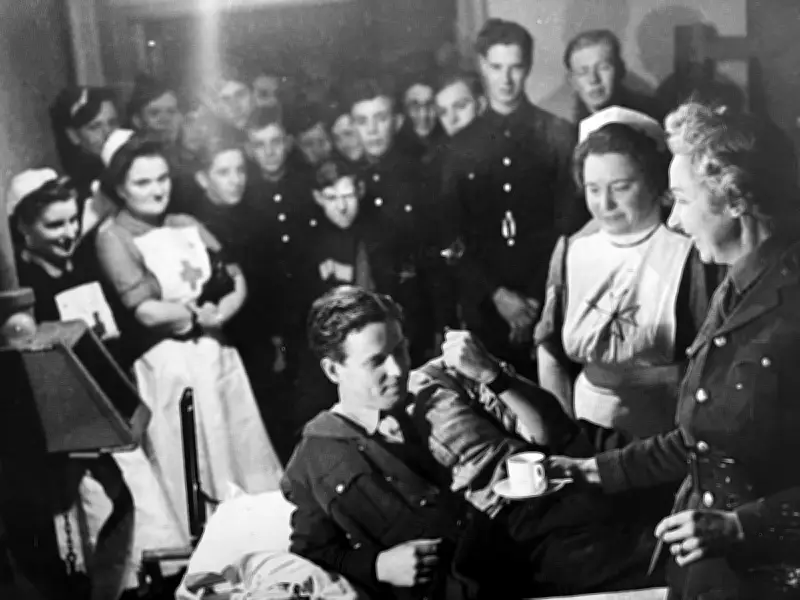
A new book, The Lifesavers, by historian and former British Army reservist Roderick Bailey, celebrates the team behind the Army Blood Transfusion Service (ABTS), whose innovations during World War Two continue to save lives today. The ABTS, which started with 5,000 donors in 1939 and grew to half a million by the war's end, pioneered the use of dried plasma, a technique now being used on the front lines in Ukraine.
Plasma: A Game-Changer on the Battlefield
Under the command of Brigadier Sir Lionel Whitby, an amputee who lost a leg in World War One and was himself transfused on the Somme, the ABTS stationed its blood supply depot at Bristol's Southmead Hospital. Whitby and his wife, Ethel, a doctor responsible for bleeding donors, discovered that using plasma was more efficient than whole blood. By stripping red blood cells, which cause blood to decay quickly, plasma could be stored longer and administered without blood-typing, reducing the risk of deadly reactions. The UK pioneered freeze-drying plasma into a powder, which could be shipped worldwide in sealed glass bottles and reconstituted with distilled water in seconds.
Revived Techniques for Modern Warfare
According to Bailey, the MOD and NHS have revived dried plasma production in Cambridge, and it is being used as a lifeline for wounded soldiers in Ukraine. During the war, the ABTS provided blood and plasma for troops across Europe, North Africa, and Asia. By 1943, the depot was preparing 20,000 to 25,000 pints of processed blood monthly.
Ethel Whitby personally drew blood from an estimated 40,000 people during the war and was one of the first women commissioned in the Royal Army Medical Corps, rising to the rank of major. The 500-strong Army blood team was 90% female.
Innovative Recruitment and Field Adaptations
Wing Commander Guy Gibson, leader of the Dambusters raid, was the first donor in Bristol's 'Blood for Victory' campaign in 1944, aimed at recruiting donors ahead of D-Day. 'Beer for blood' campaigns also successfully recruited donors from troops.
In North Africa, Major Gladwin Buttle, a larger-than-life character who worked 14-hour shifts, improvised by filling gin and whisky bottles from officers' clubs in Cairo to transport blood to the front line. His ingenuity had a phenomenal impact on survival rates in the desert.
Lives Saved in POW Camps
Marten Reed, a transfusion service worker captured by Japanese forces in 1942, used his skills to save hundreds of fellow prisoners. He made scalpels from nails, used bamboo shoots as needles, and improvised stethoscope tubes to administer blood, manually removing clots for transfusion.
Lessons for Today
Bailey warns that the UK is unprepared for a conflict on the scale of World War Two. The NHS can provide enough blood for about 100 serious casualties in a day, which would use a quarter of all blood stores. On the first day of the Somme in 1916, there were nearly 60,000 British casualties. Bailey emphasizes that the challenges of finding enough blood for hundreds of thousands of casualties remain the same today, but the lifesavers of WWII showed it can be done. The Lifesavers is published by Viking on 25 June.




