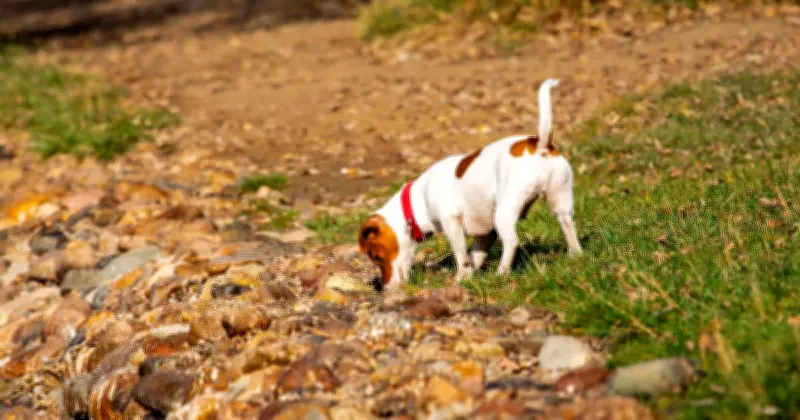
Dog owners are all too familiar with the moment their pet suddenly stops during a walk to sniff a patch of grass - and sometimes the discovery is another dog's pee. While it might seem like a gross habit to us, scientists have suggested there could be much more going on when dogs investigate each other's scents.
It prompted Reddit users to ask: "What can dogs learn from smelling each other's urine? Can they tell the difference between a vicious guard dog and a Chihuahua from a sniff?"
Dogs don't just sniff for the sake of it
Roberto Cazzolla Gatti, a researcher at Tomsk State University in Russia, studied whether dogs could recognise their own scent. He developed what he called the "sniff test of self-recognition" (STSR), which he believed could be better suited to dogs than traditional tests involving mirrors.

The study involved four stray dogs, which were tested four times a year. During each test, the dogs were presented with five containers - four containing urine samples from each of the dogs and one containing an odourless substance. They were then given five minutes to investigate the containers.
They were more interested in other dogs' pee
The dogs spent more time sniffing the urine samples belonging to the other dogs than their own. According to Tomsk State University, this suggested the dogs could recognise their own scent and were therefore less interested in investigating it.
The study also found that older dogs spent more time sniffing the other dogs' samples than younger dogs. Gatti suggested this could support the idea that self-awareness increases with age.
Why not use a mirror?
Scientists have previously investigated self-awareness in animals using the so-called "mirror test". The test involves placing a visual mark, such as a coloured dot, on an animal and then seeing whether it recognises itself in a mirror and attempts to investigate the mark on its own body. While some species have passed the test, many have not.
However, Gatti argued that this might not necessarily mean those animals lack self-awareness. Dogs rely far more heavily on their sense of smell than humans do, so he believed testing their response to scent could provide a more appropriate measure.
It could even be linked to empathy
The theory becomes even more interesting when considering the link between self-awareness and empathy. Researchers believe that if an animal can distinguish between itself and others, this could suggest it is also capable of understanding or responding to the experiences of others.
Based on Gatti's findings, the dogs' behaviour could therefore indicate that they have some level of self-recognition and potentially the ability to empathise. The research is only one study involving a very small number of dogs, so it doesn't prove that dogs understand themselves in the same way humans do.
But the next time your dog stops mid walk to investigate another dog's pee, you might want to give them a moment. What looks like an unpleasant habit could be their way of gathering important information about the world around them - and perhaps even other dogs in the neighbourhood.