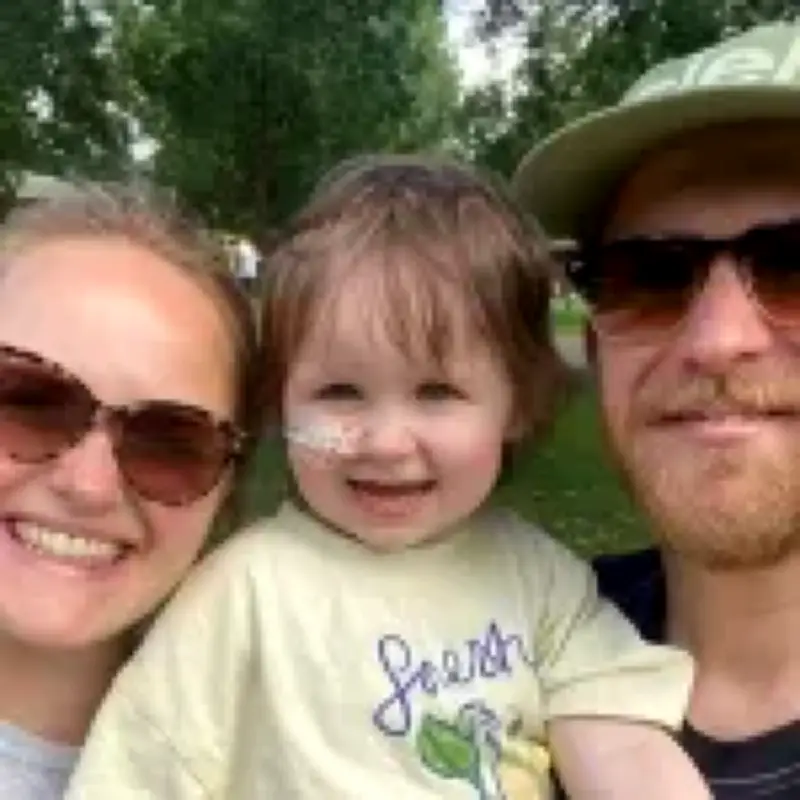
Parents Anna Chattaway and Dom Wilde say doctors missed their baby daughter's 2kg tumour six times, telling them she was constipated. Florence, then one year old, was diagnosed with neuroblastoma in November 2024 after her belly ballooned over three weeks. The tumour weighed 2kg while Florence weighed just 13kg, making up nearly 15% of her body weight.
Repeated GP visits dismissed as constipation
Anna, a clinical psychologist from Stourbridge, said doctors told them Florence was constipated on at least six occasions in the three weeks before her diagnosis. She was forced to give her daughter laxatives for three weeks, which she described as 'horrendous'.
'We were told she was constipated at the GP,' Anna explained. 'For three weeks I had to force-feed her laxatives which was horrendous.' Florence was crying in pain and unable to sleep on her own, so Anna cradled her upright at night.

'When her stomach hadn't gone down, doctors gave her more laxatives, but it was getting bigger,' she said. 'She wasn't right and the laxatives weren't helping so we had to keep pushing the doctors.'
On one occasion, a GP said Florence was fine and 'let's address the elephant in the room, we don't think it's cancer', Anna added.
Diagnosis and spread
After a final visit accompanied by Anna's mother, a blood test was pushed for. 'Her bloods were heightened and they referred us to the PAU (paediatric assessment unit) immediately,' she said. A doctor who felt Florence's stomach said he didn't think it was poo, noting lumps and bumps.
Neuroblastoma is a cancer almost always found in children, developing from cells left behind from a baby's development in the womb. It occurs in the sympathetic nervous system or adrenal glands and is usually found in the abdomen. Around 100 children are diagnosed with it each year in the UK, accounting for about 6% of all childhood cancer diagnoses.
Florence underwent surgery at Birmingham Children's Hospital on November 26, 2024, and started emergency chemotherapy the next day. She had three months of induction chemotherapy to try to shrink the tumour, which doctors initially thought was localised to her stomach. However, scans in January 2025 revealed the cancer had spread to her spine, becoming stage 4.
'We look back now, how did we think she was constipated because her stomach was massive?' Anna said. 'It grew rapidly in a few weeks, that's why we have so much anger because if someone would have seen her the first time we went to the GP we could've caught this sooner.'
Treatment and fundraising
In March 2025, Florence had up to 95% of the tumour removed from her spine, followed by high-dose chemo three weeks later. She began five cycles of immunotherapy in October 2025, and in April 2026 her parents were told the tumour had stopped progressing.
The family is now fundraising £100,000 for anti-relapse treatment (DFMO), which is no longer offered by the NHS after the manufacturer withdrew it from standard UK access routes. 'Florence has finished the gold standard NHS treatment, after that you can either watch and wait to see if the cancer comes back, or other families chose to do a relapse prevention treatment, but they aren't NHS protocol,' Anna said.
'We decided we wanted her to have a treatment called DFMO. It came to the UK in 2024 and then it was withdrawn in April, a week before she became eligible to start.'
Despite her ordeal, Florence has beaten the 50% survival odds of the childhood cancer. 'She's been doing incredibly, she's such a happy little girl. Life is good at home,' Anna said. The family's GoFundMe page has already raised £61,000 at the time of publishing.