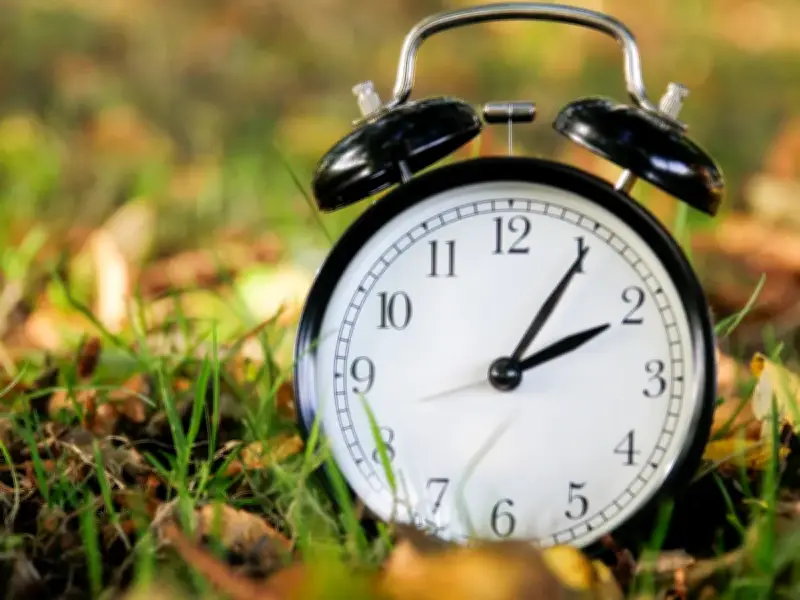
At 2 am on Sunday, October 25, clocks in the UK will turn back to 1 am, marking the end of British Summer Time (BST) and the return to Greenwich Mean Time (GMT). While many welcome the extra hour in bed, others question the necessity of the seasonal change, citing darker afternoons and potential health impacts.
The practice of changing clocks is relatively recent, with roots in a satirical letter written by Benjamin Franklin in 1784 to the Journal of Paris, where he joked about taxing windows with shutters and rationing candles to encourage people to make better use of daylight.
From Railways to Wartime Measures
The Industrial Revolution transformed how time was measured. Before railways, communities set clocks by local sunlight, meaning an hour could last 75 or 80 minutes on a summer day and just 40 or 45 minutes in winter. London was about 10 minutes ahead of Bristol and 16.5 minutes ahead of Plymouth due to the Earth's rotation.
The advent of railways brought chaos, as station clocks did not match, leading to crashes and near misses. In November 1840, the Great Western Railway instructed all stations to use London time, and by 1847, most railway companies followed suit. By 1855, virtually all public authorities set their clocks by Greenwich's Royal Observatory, according to Network Rail.
In 1895, New Zealand postal worker George Vernon Hudson proposed a two-hour daylight saving shift to dedicate more time to collecting insects. In 1907, Kent builder William Willett published The Waste of Daylight, campaigning for 80 minutes of time changes in four stages each Sunday in April, with the process reversed in September.
Dr Emily Akkermans, Curator of Time at the Royal Observatory Greenwich, told the Mirror: "His main argument was to increase health and wellbeing across the population, but he also pointed out economic benefits to garner approval. Despite considerable support, Parliament rejected his bill five times between 1908 and 1916."
World War I changed everything. Germany adopted the idea in April 1916 as a wartime measure, followed by Austria-Hungary, the Netherlands, Denmark, and Sweden. The UK introduced the 1916 Summer Time Act, one year after Willett's death, advancing clocks for one hour from May 21 until October 1.
Double Summer Time and Modern Debates
During World War II, Prime Minister Winston Churchill introduced double summertime, moving clocks two hours ahead of GMT in summer and one hour ahead in winter. This saved fuel, gave workers more daylight before blackouts, and boosted morale. The measure returned briefly in 1947 to help with the post-war fuel crisis.
In March 2025, Labour MP Alex Mayer told the House of Commons: "We needed to think outside the box. Today we face a different emergency – the climate crisis – but one where the same prescription could really help. I believe we should learn the lessons of wartime Britain and move to double summertime."
A 2009 Department for Transport report estimated that Churchill time could save approximately 80 lives each year by reducing road traffic accidents, though evidence remains inconsistent.
In the late 1960s, PM Harold Wilson's government ran a three-year experiment from October 1968 until March 1971 to examine the benefits of remaining on GMT+1 all year. The House of Commons voted to revert to the previous pattern after concluding that many costs and benefits could not be quantified.
US President Donald Trump has pushed the Senate to pass the Sunshine Protection Act, which would end the twice-yearly clock change. Trump claimed in a social media post that the current set-up "costs our country a fortune, is bad for crime, stress on people, sports, and just about everything else you can imagine."
Health Concerns and Global Trends
Dr Jeffrey Kelu, a circadian rhythms expert at King's College London, said: "There's increasing evidence to show that shifting the clocks, particularly in spring, has a significant impact on circadian rhythms and sleep health." He explained that the spring change can lead to chronic 'circadian misalignment', or 'social jet lag', associated with increased risk of obesity, metabolic syndrome, and mood disorders.
Dr Akkermans noted: "Our practice of changing the clocks still brings up debates today, and they follow the same arguments they did over a century ago. Some argue DST benefits our health, our economy and saves energy. Others argue it has a negative effect on these same issues." She added that reports show increased heart attacks and strokes following the spring change, and some studies show a rise in car accidents due to sleep disruption.
Several countries, including Azerbaijan, Brazil, Iran, Jordan, Namibia, Russia, Samoa, Syria, Turkey, and Uruguay, have stopped seasonal time changes, according to the Pew Research Centre. Egypt is the only African country to observe daylight saving time, having brought it back in a bid to save energy after removing it in 2014.