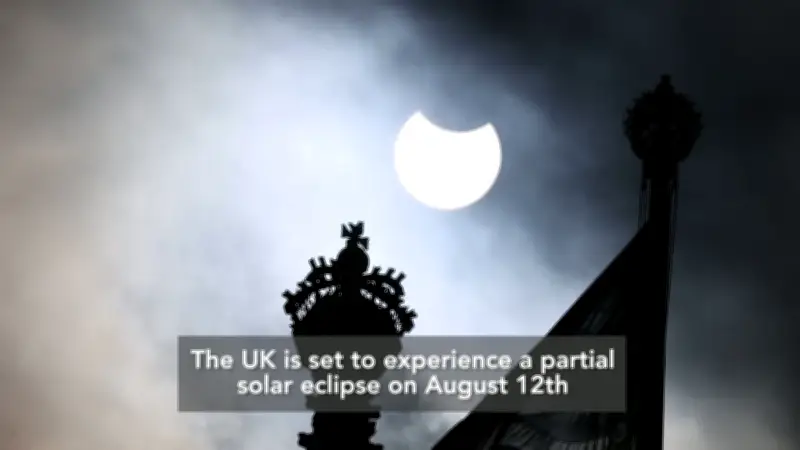
The UK is set to experience a partial solar eclipse on August 12, with more than 90% of the Sun obscured by the Moon between 6.17pm and 8.06pm. This will be the most significant eclipse visible from UK skies since 1999, and the next comparable event won't occur until 2081.
Why Regular Sunglasses Are Unsafe
Many people might assume that wearing sunglasses is the safest way to view this rare event, but the Royal Greenwich Observatory has warned that they are not safe enough. The Sun appears dimmer during an eclipse, tempting people to look directly at it, which can cause serious eye damage.
To watch the eclipse safely, you need solar eclipse glasses that meet the international safety standard ISO 12312-2:2015(E). These glasses block out so much light that you can only see the Sun through them, unlike regular sunglasses.
Alternative Viewing Methods
Imo Bell, a planetarium astronomer at the observatory, suggests using a solar telescope or projecting the image of the eclipse with a household item like a colander. By pointing the colander at the Sun with your back to it, you can see the eclipse projected in the holes.
Bell also advises finding a vantage point facing west with minimal buildings or hills blocking the view, as the Sun will be close to the horizon during the event. The maximum coverage is expected at around 7.13pm.
Weather and Global Visibility
The Met Office says it's too early to predict which areas will have the clearest skies, but the long-term forecast suggests more changeable conditions in the north, with showers and stronger winds, while parts of the south may see warm and dry conditions.
Meanwhile, a total eclipse will be visible in Reykjavik, Iceland, and several Spanish cities, including A Coruna, Oviedo, Zaragoza, Bilbao, and Valencia, where the Moon will fully obscure the Sun.