
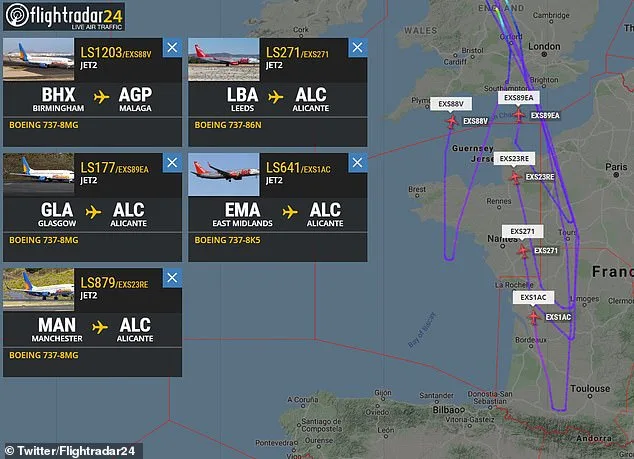
A Jet2 flight from Leeds Bradford Airport to Alicante was forced to turn around when it was just 40 minutes from landing, after Spain announced a state of emergency over the coronavirus outbreak. The plane, carrying Beryl Carrick, 78, and her family, was one of several Jet2 flights that made U-turns and returned to the UK on Saturday.
Mrs Carrick, from Driffield, East Yorkshire, was travelling with her husband Arthur, 80, their daughter and two granddaughters for a week-long holiday in Benidorm to celebrate Arthur's birthday. She described the moment the pilot announced the U-turn as 'bizarre', adding that passengers were disappointed but calm.
Spain declared a 15-day state of emergency on Friday, with cases rising to 5,753 and 120 deaths. Under the measures, people are only allowed to leave home for essential reasons, and beaches, bars, restaurants and other venues have been closed. The lockdown came into effect on Saturday, the same day as the Jet2 flights.
Jet2 confirmed that affected passengers would receive a full refund or be able to rebook their flights. Mrs Carrick's granddaughter Niki noted that the plane was only half full, suggesting many passengers had anticipated the disruption and cancelled beforehand.
Another passenger, Anne Thomas, 62, was flying back to her home in Spain after visiting her mother in West Yorkshire. She said she had barely slept due to the uncertainty. The incident highlights the rapid travel disruptions caused by the coronavirus pandemic, as countries impose strict border controls.




