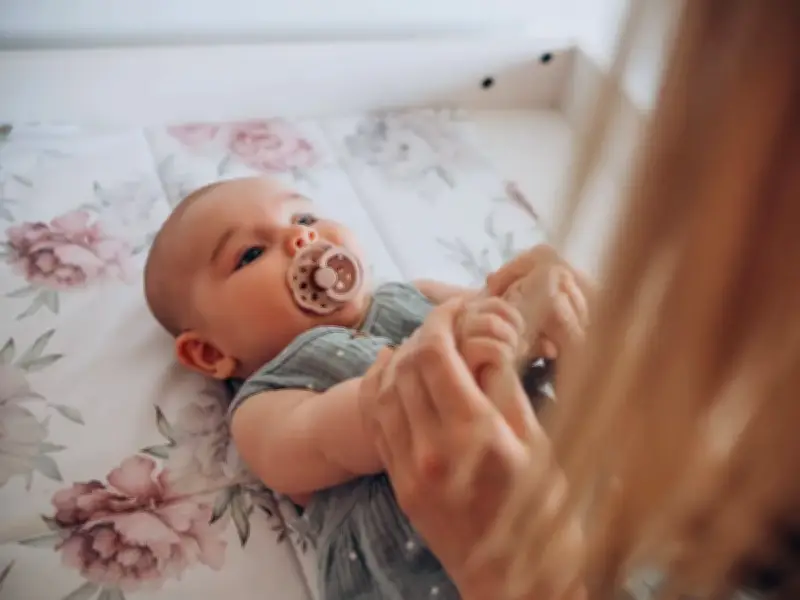
An NHS doctor has shared the vital rule everyone should follow around newborn babies after a heartbroken mother revealed her baby died from a cold sore. Meg Edmonds' daughter Magnolia died aged just 10 days back in February after contracting the herpes simplex virus (HSV), and it is suspected the virus may have been passed on by her mother.
For most adults, cold sores can usually be a bit painful but are a common infection. However in newborn babies, whose immune systems are not yet fully developed yet, HSV can cause a life-threatening illness.
The no kissing rule
NHS GP Dr. Shruti Nathwani took to her Instagram page to share a reel where the overlay text read, 'The no kissing the newborn rule isn't just for adults. Big brothers and sisters can get cold sores too.'
Providing more information in the caption, she wrote: "Children can get cold sores (HSV-1) too and in young children, a first HSV infection doesn't always look like the classic single cold sore. It can cause multiple painful mouth ulcers, red or swollen gums, fever and difficulty eating or drinking, known as herpetic gingivostomatitis."
Dr Nathwani said that neonatal herpes is "rare but potentially very serious" and can affect the skin, eyes and mouth, the brain and central nervous system, or spread to multiple organs. "Around 10% of neonatal HSV infections are thought to be acquired after birth and a recognised route is being kissed by someone with an active cold sore," she said.
Protecting newborns at home
The doctor said that if a sibling, parent, grandparent or visitor has a cold sore, they shouldn't kiss the baby until it is completely healed and should also wash their hands carefully before touching the baby. The GP said anyone with a cold sore should also avoid touching it and then touching the baby and should cover cold sores where possible.
According to the NHS, babies are thought to be most vulnerable during the first six weeks of their life. The doctor noted you 'shouldn't assume every mouth ulcer is a cold sore', as there are lots of other causes. However, she said that if there's a newborn at home, it's best to avoid kissing them and seek medical advice if you're concerned.
She also highlighted the fact that neonatal herpes doesn't always cause obvious blisters. "If a young baby with possible HSV exposure becomes unwell, including poor feeding, unusual sleepiness or irritability, fever, breathing difficulties, seizures, or sores on the skin, eyes or mouth, seek urgent medical help and mention the possible HSV exposure," she said.
Symptoms and stages of cold sores in babies
Unlike older kids who can explain tingling, babies show early distress through behavioural changes, such as fussiness and irritability, poor feeding, and a low-grade fever with swollen lymph glands under the jaw often developing before any skin mark appears.
Small, red, raised bumps appear around the mouth, lips, chin, or gums, rapidly filling with clear fluid to form clusters of delicate blisters. The fluid-filled blisters burst open, leaving shallow, open sores - the most painful and contagious phase. The open sores then dry out and form yellow or brown crusty scabs, with the risk of secondary bacterial infection rising if the baby rubs or scratches the scabs. Finally, the scabs flake off, leaving fresh red or pink skin underneath, healing completely without permanent scarring as long as scabs remain unpicked.
A primary HSV-1 infection in an infant often causes herpetic gingivostomatitis; a more widespread infection inside the mouth rather than just a single lip blister. Key signs include swollen, bleeding gums, internal mouth ulcers, excessive drooling, and a fever spiking above 38C.
Urgent red flags to look for
In infants under 4 to 6 weeks old, the immune system cannot isolate the virus, making HSV exposure a medical emergency. Seek immediate emergency medical care if a baby shows any of these signs: high fever or abnormally low body temperature, extreme lethargy or difficulty waking up, rapid breathing or grunting, sores near or in the eyes, or dehydration (no wet diapers for 8+ hours, dry mouth, crying without tears).