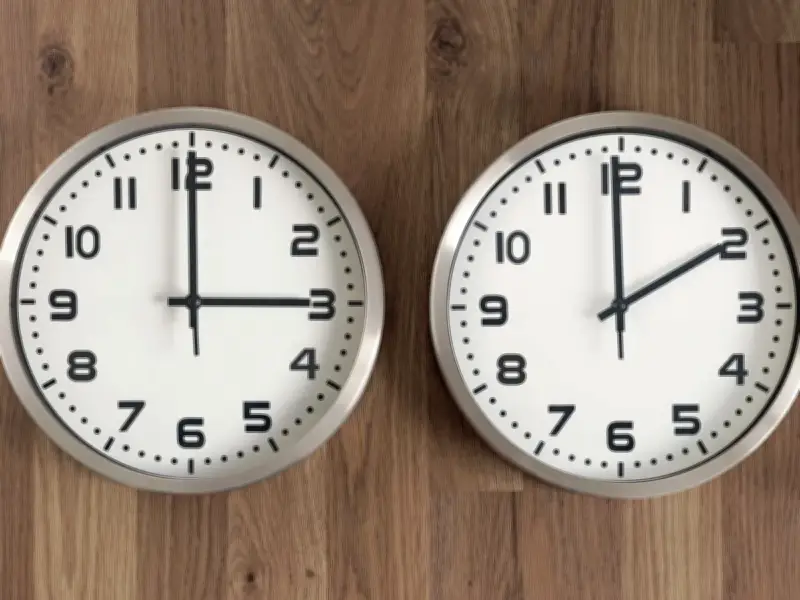
The clocks go back by one hour at 2am on Sunday, marking the end of British Summer Time and the start of winter, and neuroscientist Dr Ramona von Leden has warned that the shift disrupts the brain's internal timekeeping more than it saves energy.
Dr von Leden, host of the Hello Brain podcast, spoke exclusively to the Daily Mirror about how to cope with the change. She explained that a tiny cluster in the brain called the suprachiasmatic nucleus controls circadian rhythms - the body's 24-hour internal biological cycles - and resets itself from light reaching the eyes. "It takes a few days to catch up, but there are lots of ways to mitigate it," she said.
The history of changing the clocks
The idea for tinkering with time began in New Zealand, where Wellington post office worker George Hudson told the city's Philosophical Society in 1895 that clocks should go forward two hours in summer, giving him more daylight to collect insects after work. In Britain, builder William Willett championed the idea after noticing drawn blinds during a summer morning ride in 1905. He wrote a pamphlet, The Waste of Daylight, and in February 1908 Robert Pearce, the MP for Leek, introduced the first Daylight Saving Bill. Willett campaigned at his own expense until he died of flu on 4 March 1915, aged 58.
With Germany having already moved its clocks, the Summer Time Act passed on 17 May 1916, and British Summer Time began four days later. In 1934, Winston Churchill, an early backer, wrote an essay called "A Silent Toast to William Willett," ending with a tribute: "He gave more light to his countrymen."
Why the change is controversial
Britain went two hours ahead in summer during the Second World War, and from 27 October 1968 to 31 October 1971 it stayed on GMT+1 all year round. But complaints about dark mornings, particularly in Scotland, ended that experiment by 366 votes to 81 in the Commons. Since then, clocks have gone forward on the last Sunday in March and back on the last Sunday in October, in line with a European directive the UK put into law in 2002.
Dr von Leden is not a fan of the changing clocks. She said: "The theory was always that, for farmers, you need the extra time of sunlight and things like that, and we want to save it. Well, at this point in time, obviously that's really not accurate and it doesn't actually make a difference. Instead, the shift of the hour has a much more negative impact on our circadian rhythms than getting extra sunlight."
How to manage the darkness
The change falls on a weekend, because it was judged less disruptive to schools and businesses. This year, that means 2am on Sunday 25 October, when the clocks go back to 1am and Britain returns to Greenwich Mean Time. They go forward again on Sunday 28 March 2027. Sunset in London will be before 5pm around the change, meaning darker evenings, which affect bodies and brains.
Dr von Leden said: "Our body responds so much to sunlight and how it shifts our rhythms that naturally, when it's dark, our body wants to wind down and get ready for sleep. But we don't run on that type of schedule, as modern humans. Your circadian rhythm is like, 'oh, it's dark. It means it's time to start slowing down.' In reality, we still have to finish our workday. So it can be a little bit like we're a little out of sync with our body."
To mitigate this, she suggests red-light therapy and seeking out daylight. "Treat daylight like a meeting that you cannot move, especially if you work in an office," she said. Dr von Leden, a scientific advisor to Neuronic, which makes a photobiomodulation helmet, added that less sunlight in winter means less vitamin D, which affects mood. "It's like, you want to go into hibernation, essentially," she said.
The debate over scrapping the change
Seasonal affective disorder (SAD) is a type of depression with a seasonal pattern, usually worse in winter. The Royal College of Psychiatrists says about three in every 100 people in the UK have significant winter depression, while SAD is about three times more common in women than men. Estimates differ, with Rethink Mental Illness saying as many as one in 15 people in the UK get winter SAD symptoms, with around three in 100 severely affected.
Road safety charity RoSPA says the clocks should stay an hour ahead all year, while the British Sleep Society says Britain should stay on GMT. Scotland is a major sticking point. When Conservative MP Rebecca Harris brought forward a bill asking the government to study putting the clocks an hour ahead all year, then First Minister Alex Salmond warned it would plunge Scotland into morning darkness, with claims that sunrise in Lerwick, if BST was permanent, would be pushed to 10am. The bill was talked out of time in January 2012.
A YouGov poll in October 2024 found 46% of Britons want to keep the twice-yearly change compared to 42% wanting to scrap it. The government says it has no plans to change the system and sees no compelling case. Dr von Leden added: "Frankly, we're not actually changing anything in terms of how much energy we're using. If we're going into the dark winter months, we're using more light in the evening, because the sunlight's going down earlier. So, honestly, I think it's a pretty silly thing that we still do it."