
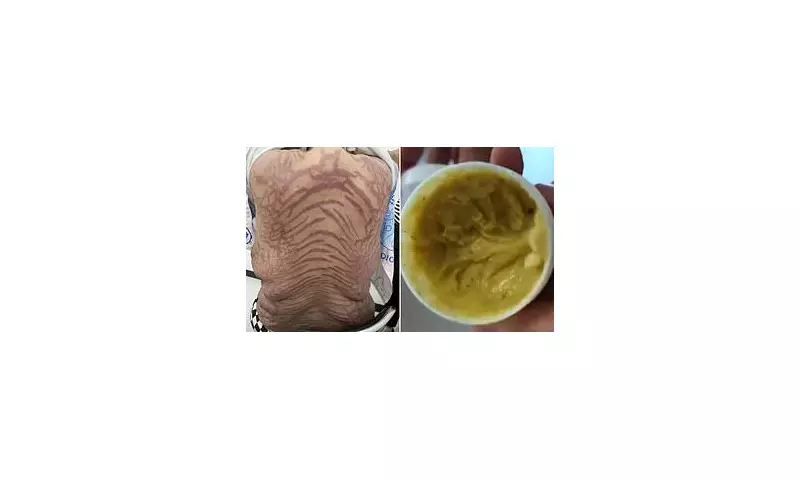
Decade-Long Use of Online Cream Leads to Baffling Condition
A Chinese woman has been left with a mysterious snake-like pattern covering her entire body after using a skin tincture she purchased online for ten years. The case, which has left medical professionals baffled, serves as a stark warning about the dangers of unregulated online health products.
The patient, a 40-year-old woman using the pseudonym Tingting, was admitted to Zhongda Hospital Southeast University in Nanjing last month. According to reports, her ordeal began a decade ago when she first developed red spots and persistent itching on her lower right leg.
A Desperate Search for Relief
As her condition worsened and the lesions spread across her body, Tingting became desperate for relief. Instead of seeking professional medical help, she turned to the internet, where she found a widely promoted skin cream. The seller claimed the product was made from 'pure traditional Chinese medicine' and could 'cure all kinds of skin disease'.
Convinced by these promises, Tingting purchased the cream and used it religiously for ten years, spending a staggering over 100,000 yuan (approximately £10,500) on the product. 'When I first started using it, the anti-itch effect was remarkable. I thought I had finally found the right medicine,' she said.
While the cream initially seemed to stabilise her symptoms, her health recently took a dramatic turn for the worse. She developed alarming new symptoms, including her entire body being covered in purplish-red, snake-like fissures.
A Serious Medical Diagnosis
Alongside the dramatic skin changes, Tingting began suffering from swelling in her lower limbs, nausea, vomiting, and numbness in her hands. At the hospital, Dr Wang Fei, the chief dermatologist, made a critical discovery.
Tests revealed that Tingting's cortisol levels were significantly low. Dr Wang diagnosed her with secondary adrenocortical insufficiency. This is a serious disorder where the pituitary gland fails to release enough essential hormones, including the stress hormone cortisol. It is similar to Addison's disease and can be life-threatening if not managed properly.
Fortunately, after medical intervention, Tingting's condition is showing signs of improvement. It remains unclear if she will seek legal compensation from the online seller.
A Warning About Hidden Dangers
Dr Wang stated that cases like Tingting's are not uncommon in her department. She issued a strong warning about products sold online. 'Many so-called "pure herbal and hormone-free" skin ointments sold online are secretly laced with powerful steroids,' she told the Yangtse Evening Post.
She explained that while steroids can provide rapid relief from itching and redness, prolonged use leads to skin dependence. Worse, steroids can be absorbed through the skin, accumulate in the body, suppress adrenal function, and cause irreversible damage. Skin medications are no trivial matter, especially hormone-based drugs, which must be used under a doctor's supervision.
In the UK, mild steroid creams are available over-the-counter, but stronger formulations require a prescription. The NHS uses topical steroids to treat conditions like eczema and psoriasis. However, many users struggle to stop using them due to a debilitating condition known as Topical Steroid Withdrawal (TSW), which can cause the original symptoms to rebound severely.
This case highlights the critical importance of consulting healthcare professionals for persistent skin conditions and the significant risks associated with self-medicating with products of unknown origin purchased online.


