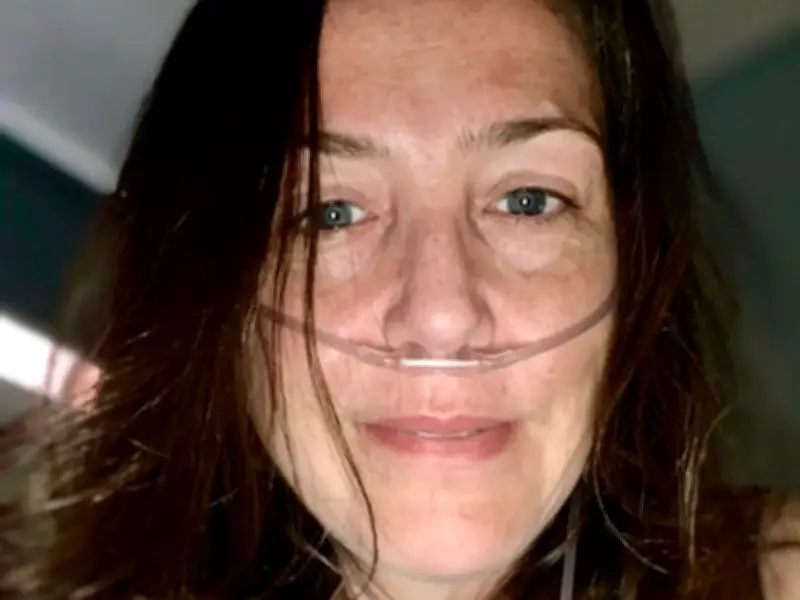
A mother who feared she would “never have a deep breath again” at her “lowest point” has secured funding for a modulator medicine that has enabled her to start living her life again.
Michelle Shore, 46, a solicitor who lives in South Yorkshire, was diagnosed with cystic fibrosis (CF) at eight months old and said her childhood was “manageable” with medication, physiotherapy and physical activity, such as trampolining.
However, from her 20s onwards, her health started declining and, at her worst, her lung function dropped to 34%, she required oxygen tubes to breathe, she could not walk around the house without breathlessness and she lost her voice. She said she started “fearing the worst”, especially as she had “a little girl who needed (her)”, and she even had to step away from her role as a solicitor – a career she had dedicated much of her life to.
Rare genetic mutations and the fight for treatment
After learning she had two rare genetic mutations in her 30s, which meant she was not able to benefit from the modulator medicines which have transformed the lives of many people with CF in recent years, she started contacting charities, laboratories and clinicians for help. She said she “pushed, questioned (and) advocated”, and this eventually led her to secure funding from NHS England for Kaftrio, a triple-combination therapy, in December 2025, which has been life-changing.
Michelle, who will soon become the chairwoman of trustees at Cystic Fibrosis Trust, has since returned to work, she can exercise again and she now sleeps through the night for the first time in more than a decade.
“At my worst, it felt like I would never have a deep breath again… but I refused to accept that there were no options left for me,” Michelle said. “Now, I think we need to raise awareness and ensure that nobody is left behind.”
Living with the condition as a child
According to Cystic Fibrosis Trust, CF is a genetic condition affecting more than 11,000 people in the UK and there is currently no cure. People are born with CF and experience a build-up of thick sticky mucus in the lungs, digestive system and other organs, causing a wide range of challenging symptoms affecting the entire body.
Michelle explained she was diagnosed at eight months, as the newborn blood spot test that can screen for CF, formerly called the heel prick test, was not introduced across the UK until 2007. Luckily, Michelle said her parents were referred to a specialist at the time who knew more about CF and eventually diagnosed her with the condition.
She continued: “It was at the time when the approach to treating babies with CF and children had changed. Prior to that, it had been to tell the parents not to feed anything that’s fatty based, and restrict the diet, restrict the activities and restrict the exercise that caused breathlessness.
“My doctor at the time apparently said, ‘No, we’re going to flip all of that on its head. Give her what she wants, feed her, give her the exercise, buy her a trampoline’, and all of that seemed to work.”
As a result of this advice, Michelle said she transformed from “this slight, frail baby to this podgy toddler” and she did not require hospital treatment until she was 10, when she had her first dose of intravenous antibiotics. While she needed medication and had nebuliser systems, which change liquid medication into a mist which can be breathed into the lungs, she said the trampolining added “enjoyment” to her routine.
Decline in health and the path to recovery
From the age of 10, Michelle said she required intravenous antibiotics in hospital once a year, but in her teenage years, she was more “rebellious” and not as regimented with her medication. At university, she said her hospital admissions increased to up to three times a year.
Describing her symptoms, she said: “At my worst, sometimes it starts with a cold and it’s like a cold on steroids. Often you get a burning in your chest, it becomes more difficult to breathe, your exercise tolerance reduces to virtually zero and you can have the breathlessness, the wheeze. In my later years, my voice started croaking – it’s still husky now – and if I’m particularly ill, my voice just disappears and it’s weeks of not being able to speak.”
After qualifying as a solicitor in her 20s, Michelle said she was more career-focused and, as a result, her exacerbations increased and there was a period of around six months where she intermittently lost her voice. In her 30s, after her daughter was born, Michelle’s health declined further and she was told she had two rare genetic mutations, meaning she was not able to benefit from modulator medicines. She said she then developed an infection called mycobacterium abscessus and contracted Covid, meaning she was prescribed oxygen and her lung function dropped to 34% by 2024.
“I had gone from spells in hospital that were individual to just an ongoing decline,” she said. “I remember commenting in 2023, ‘I’ve almost spent half this year in hospital’.”
Not eligible for a transplant and the trial of Kaftrio
Then, in March 2024, doctors told Michelle that due to the infection, she was not eligible for a lung transplant. “I felt like I’d been thrown into the sea,” she said. “In my head, I just thought, ‘Oh my goodness, is this going to substantially reduce my life in a way that I hadn’t expected?'”
That same evening, however, Michelle said she received an email from a professor at the Necker-Enfants Malades Hospital in Paris, whom she had contacted previously. Clinicians invited her to Paris, where they tested her cells to see whether they might respond to modulator therapy – and although there were obstacles along the way, Michelle said her cells “reacted positively”. Michelle said she and her consultant then applied to NHS England to request funding for an individual trial of Kaftrio.
She said: “In 2025, without any expectation, I started my own, heavily monitored, individual trial of Kaftrio. After a month, my lung function increased to 60% and my inflammation and infection markers fell to a normal level.”
Michelle said she was able to take a deep breath for the first time in months, she started sleeping through the night and she was no longer experiencing “coughing fits”, meaning she could return to the legal profession. In December 2025, she said NHS England agreed to fund her ongoing use of Kaftrio – and while she does still have a cough and a “husky” voice, the improvements have been life-changing. “It has lifted those limitations, so I feel like I’m me again. It’s like I’m back on track,” she said.
Cystic Fibrosis Trust report and awareness
This week, Cystic Fibrosis Trust published its latest UK CF Registry Annual Data Report, along with its new five-year strategy. According to the report, following the approval of the modulator Alyftrek in late 2025 and the expansion of eligibility criteria, 2.3% of people living with CF in 2025 are recorded as ineligible for CFTR modulator therapies based on their genotype.
However, more than 11% of people with CF with an annual review in 2025 had never used a CFTR modulator. The charity says the reasons for this are likely to be varied, including genotype or age ineligibility, living with a transplant, or a decision made between an individual and their care team.
Michelle said she was mindful she had been “lucky” and she wanted to thank her medical team at the Adult CF Unit at St James’s University Hospital in Leeds and Cystic Fibrosis Trust. As part of the charity’s goals, Michelle wants to ensure nobody with CF is “left behind” and to share the message that the CF community is “stronger together”.
“At my worst, I just had this underlying despair,” she said. “I think we need to raise awareness that the people who might be experiencing that aren’t forgotten. It’s every part of the CF community – the clinicians who wrote back to me, the doctors who supported me, Cystic Fibrosis Trust that gave me the information – and it’s that togetherness that made a difference.”
NHS England was contacted for comment, but did not respond in time for publication.