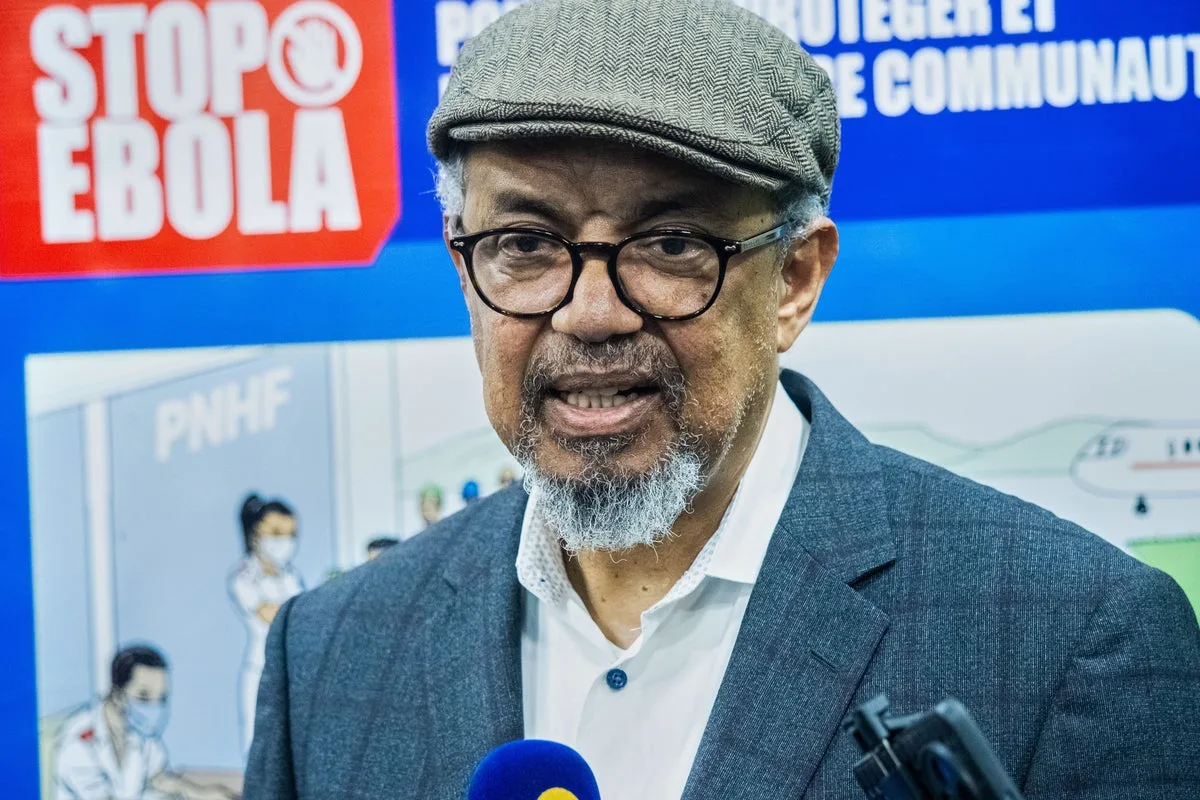
The head of the World Health Organization landed in Kinshasa late Thursday to oversee efforts against a rare Ebola outbreak in the Democratic Republic of Congo, where health workers face shortages, community distrust, and armed group activity.
WHO Director-General Tedros Adhanom Ghebreyesus said his visit aimed to show solidarity. “To come here is to really show to the community that they’re not alone,” he told reporters at the airport. He stressed the need for community engagement, adding, “Pushing orders from my comfortable office in Geneva is easy, but I’m asking my colleagues to work with the community and I am asking communities to protect themselves.”
The outbreak involves the Bundibugyo virus, a strain of Ebola with no approved treatment or vaccine. As of Tuesday, the WHO reported 1,077 suspected cases and 238 suspected deaths. Health workers in some areas have resorted to using expired medical masks. The European Union delivered medical aid to Ituri province on Thursday, and the United States announced an additional $80 million in assistance, bringing its total to over $112 million.

Violence and local anger over strict burial protocols have hampered the response. Residents have launched at least three attacks on health centres. Tedros called for a ceasefire in the conflict-affected region, saying, “We cannot build community trust or isolate the sick while bombs are falling.” Ituri province has suffered attacks by the Allied Democratic Force, a rebel group allied with the Islamic State, and ethnic militias. In early May, the ADF killed at least 40 people and burned homes in the area.
The outbreak has also spread to North Kivu and South Kivu provinces, where the Rwanda-backed M23 rebel group controls key cities including Goma and Bukavu. The rebels have reported two cases. The main airport in Goma, a hub for humanitarian operations, has been closed since January 2025 when M23 seized the city. The conflict has displaced at least 7 million people in eastern Congo.
Tedros discouraged countries from imposing travel bans on affected nations, stating that “there are ways to manage workers and to manage cases without having a strong, restricted travel ban.” The Trump administration recently announced a temporary ban on entry for non-US passport holders and green-card holders who have visited Congo, Uganda, or South Sudan in the past 21 days, and plans to send exposed Americans to a facility in Kenya. Congo’s neighbours Uganda and Rwanda have closed their borders.