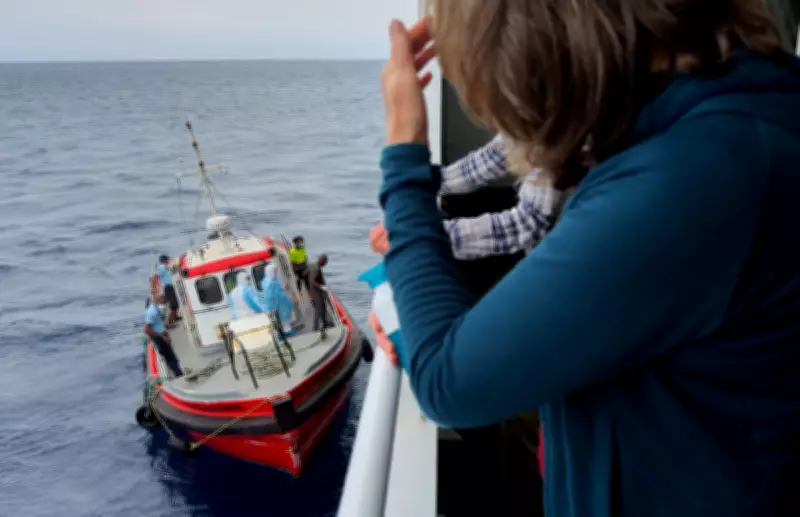
The Centers for Disease Control and Prevention (CDC) has confirmed it is sending a team to Spain's Canary Islands, where the hantavirus-stricken cruise ship MV Hondius is expected to arrive on Sunday, and US passengers will be evacuated to an airbase in Nebraska. However, experts say the US is unprepared for such a disease threat.
CDC's Limited Role Raises Questions
The CDC's limited role in responding to the hantavirus outbreak is raising questions, including whether it now has a diminished role in responding to health scares. Most of the response has been led by the World Health Organization (WHO), of which the US is no longer a member.
The hantavirus outbreak was reported to the WHO on 2 May; a notice issued two days later updated to seven confirmed or suspected cases. Three people had died, one person was critically ill and three others had mild symptoms.

On Wednesday, the CDC said in a statement it was “closely monitoring the situation” and said the state department was leading a “whole-of-government response including direct contact with passengers, diplomatic coordination, and engagement with domestic and international health authorities”.
CDC's Response Delayed and Subdued
It wasn’t until Thursday that the CDC activated its 24/7 emergency center in Atlanta to monitor the recent hantavirus outbreak and classified it at its lowest activation level.
Late on Friday the CDC issued its first health alert to US doctors, advising them of the possibility of imported cases after at least six American passengers disembarked at St Helena. The passengers are being monitored for hantavirus in several US states.
At the CDC’s first briefing, held on Saturday by telephone only for invited reporters, according to the Associated Press, officials pledged to be transparent in updating the public but said the media could not cite the speakers by name under guidelines issued by aides to the health secretary, Robert F Kennedy Jr.
Dr Jay Bhattacharya, director of the National Institutes of Health (NIH), which operates separately from the CDC under the Department of Health and Human Services (HHS), said in an X post: “Our CDC team began coordinating with domestic and international partners as soon as we were notified of a hantavirus situation. We understand that people are concerned and looking for information and that is why we provided clear, written health guidance to the American passengers through the State Department.”
Bhattacharya added that the “CDC has the world’s leading experts on hantavirus and is lending its technical expertise when coordinating with interagency partners, state health offices, and international authorities on response and repatriation planning”.
But experts and former government health officials say the response by the CDC has been feeble compared with how it dealt with similar outbreaks in the past.
“The CDC is not even a player,” said Lawrence Gostin, an international public health expert at Georgetown University, told the AP. “I’ve never seen that before.”
Experts Express Concern
The hantavirus outbreak is “a sentinel event” that speaks to “how well the country is prepared for a disease threat. And right now, I’m very sorry to say that we are not prepared,” said Dr Jeanne Marrazzo, chief executive officer of the Infectious Diseases Society of America.
The CDC’s response is not typical for an agency that has in the past been at the forefront with the WHO in comparable infectious disease mysteries, both in developing ways to control them and communicate to the public what they should know and if they should be concerned.
“I don’t think this is a giant threat to the United States,” said Jennifer Nuzzo, director of Brown University’s Pandemic Center. But how this situation has played out “just shows how empty and vapid the CDC is right now”, she said. The agency has laid off thousands of scientists and public health professionals, including members of the agency’s ship sanitation program.

At least four US states – Arizona, Virginia, California and Georgia – are monitoring residents who were onboard the ship. Health officials in Arizona and Georgia have said the individuals under their watch are not symptomatic.
California’s department of health said it has “no information that the California residents are ill or infected”. It added in a statement to the Hill: “At this time, the risk to public health in California is low.”
Virginia’s department of health said one resident who disembarked and returned to the US “is currently in good health and is under public health monitoring”, adding that “the risk to the general public [is] low”.
Information Vacuum Fuels Misinformation
But the information vacuum left by the CDC may have helped to create space for Covid-era theories to gain a foothold. Former congresswoman Marjorie Taylor Greene posted on X that she’d texted with alternative medicine medic Mary Talley Bowden about treatments for hantavirus and that Bowden had recommended the horse dewormer ivermectin.
“Ivermectin. Also vitamin D and zinc,” Taylor Greene wrote. “Those of us who refused to lockdown, mask up, and get vaxxed took the good ole horse paste and also developed natural immunity.”
Comparison to Past Responses
Gostin said that compared with the CDC’s engaged efforts in trying to control the spread of Covid-19 on the cruise ship Diamond Princess in 2020 when it was quarantined off Japan for two weeks, the agency’s work now is delayed and subdued.
He pointed to Trump administration’s preference for making bilateral health agreements with individual nations for information sharing and public health support over channeling information through the WHO.
That’s not sufficient, Gostin said. “You can’t possibly cover a global health crisis by doing one-on-one deals with countries here and there,” he added.