
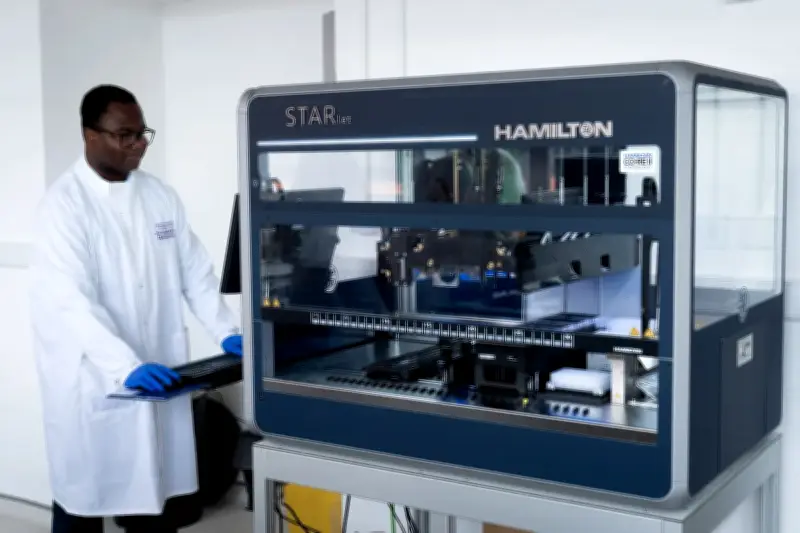
A world-leading NHS lab has launched in the UK to improve personalised testing and treatments for cancer patients. The Royal Marsden Centre for Cancer Genomics is the first of its kind to deliver a new generation of cancer diagnostics known as composite biomarker testing and will work with doctors and patients across the UK.
What is composite biomarker testing?
Composite biomarker testing involves combining information about a patient and their tumour with artificial intelligence (AI) to build the fullest picture of a person's cancer. The findings will help doctors ensure NHS patients can access clinical trials, more personalised treatments and can have flexible treatment plans that change as their cancer does.
Professor Michael Hubank, scientific director of clinical genomics at the Royal Marsden and professor of translational genomics at the Institute of Cancer Research, London, told the Press Association his team are constantly thinking ahead to how cancer treatment and diagnostics will look in the next three to five years.
How AI will shape future treatment
"Currently, workflows in the NHS very much focus on doing a single test for a patient with a single action that follows it," he said. "We think that, in the future, to really refine patient treatment to make sure that it's truly a personalised treatment and personalised therapy and not just kind of a one-size-fits-all, we'll be taking multiple measurements from patients during the course of treatment for cancer."
"So you'll have a diagnostic – a composite biomarker – where you'll be measuring maybe DNA, RNA, maybe protein… and AI will integrate that information to create a score which is very specific and tells doctors where that patient sits on a spectrum of how to treat them and what therapies to give them in the first place."
"But then, not only that, the continuous monitoring of those patients down the line will tell doctors how to tailor that treatment to each individual patient. So maybe you can give them treatment on holidays, so that they can come off toxic drugs because they're responding really well, or maybe you need to intensify the treatment. Maybe you need to change the treatment because something has changed in the cancer."
He said he believes many more patients in the future will also be followed-up with blood tests that look for tiny fragments of cancer in their bloodstream. Clinical trials have already shown positive results in using these circulating tumour DNA (ctDNA) blood tests to monitor patients to see whether their cancer is coming back.
Patient story: Elaine Nangle
Elaine Nangle, 45, from Wokingham, who works in finance, was diagnosed with stage 3 lobular breast cancer in March 2020 just as the country was going into Covid lockdown. She has three children – Freddie 18, and twins Rory and Darcey, aged 16.
Following her diagnosis, Ms Nangle was given a mastectomy and full node clearance to stop the cancer spreading. This was followed by six rounds of chemotherapy, 15 rounds or radiotherapy and drugs to block oestrogen, the hormone which encourages her cancer to grow. After initial treatment, Ms Nangle joined the TRAK-ER trial at the Royal Marsden, which gives patients a personalised circulating tumour DNA test every three months for up to three years.
By looking for those tiny fragments of tumour in the blood, doctors can detect whether cancer has returned way before the patient experiences any symptoms.
Ms Nangle told PA: "I had a stage three, grade two, 9cm tumour with lymph node involvement, so was quite panicked and had never really heard of tumours of that size. There isn't any breast cancer in my family. There's actually very little cancer in my family, it's more heart disease. So when I rang home and said to my parents: 'We've added a new one to the list, we're now dealing with cancer as well,' it was a bit of a shock for all of us. Also, I think I generally had associated a cancer diagnosis with an older person."
Ms Nangle underwent treatment which has cleared her cancer but also plunged her into early menopause. Being on a clinical trial for circulating tumour DNA means doctors can keep a close eye on her to see whether the cancer is coming back.
She said: "It's always an interesting one that you don't have scans at the end of treatment, and sometimes you can be left feeling a little bit: 'How do I know? I didn't realise I was sick in the first place, so how do I know I'm not sick again?' It's a hard thing to get your head around that kind of fear. In my most recent tests, I had an MRI scan which was all clear. I've also had my mammogram, which was all clear. With the ctDNA blood test, it's the fact that they're taking your tumour, they're taking a sample of your specific tumour and making this test that is just bespoke to you. You pop in, you have a blood test and within a couple of weeks, you get a phone call to say what's happening. It offers a little bit of reassurance that everything is working well. Anything that gives me a greater chance of being here for longer, and being well for longer, is amazing."
What the new lab means for patients
Dr Angela George, clinical director of genomics and consultant medical oncologist at the Royal Marsden, said the new lab will also use expertise to assess all the new technologies coming on stream for genomics.
She added: "The new centre will help make personalised treatment an option for more patients because we'll be able to deliver more tests and look at new targets that we couldn't previously do. Sometimes that will be about trialling new technology. That means that we can look at things like blood samples where we used to have to look at pieces of tumour in order to get a test, and that will be hugely important for patients where there is no solid tumour remaining, or where their disease is in places where we can't access it easily."
"It will also mean going forward that we'll be able to look much more carefully at things like patients having treatment breaks. So this is about looking for tiny pieces of tumour in someone's blood to see if there is still active cancer and if they need to continue on with treatment, or whether they have completely cleared the cancer at that point in time, and we can give them a break-off treatment. All of those types of things will be possible with the new laboratory."




