
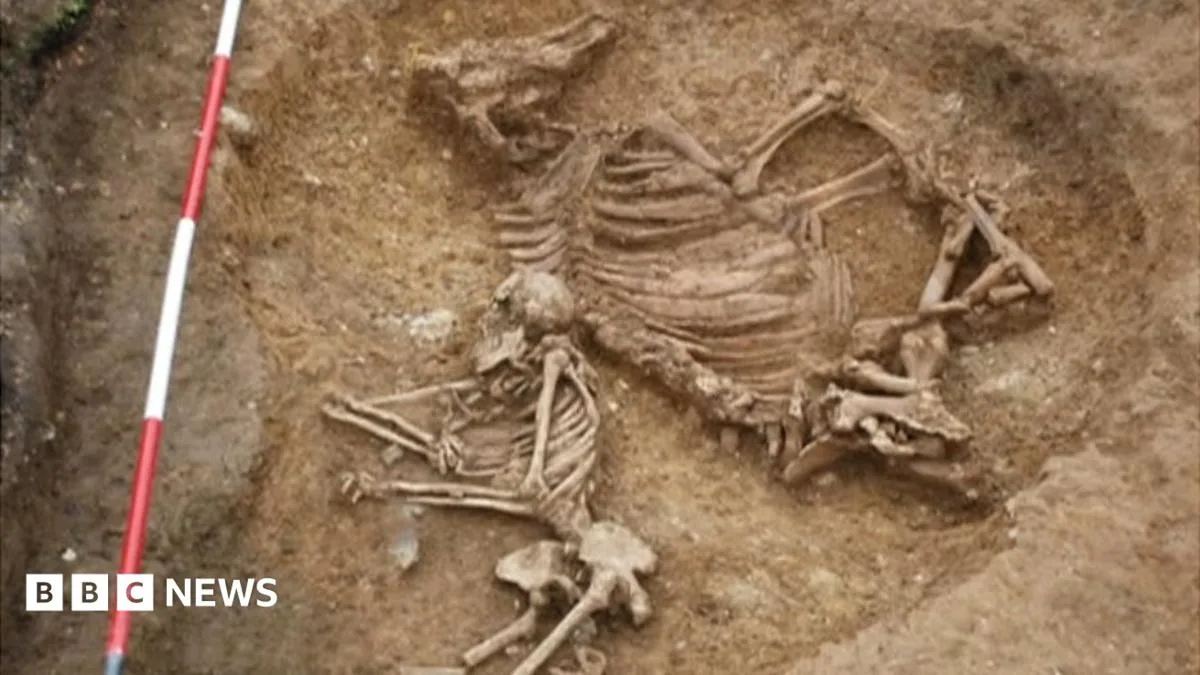
Archaeologists have described the discovery of a woman buried alongside a cow in an Anglo-Saxon cemetery in Cambridgeshire as a 'genuinely bizarre' find. The grave, uncovered in Oakington by students from Manchester Metropolitan University and the University of Central Lancashire, is the first known example of a woman from this period being interred with a cow.
Student Jake Nuttall, who was involved in the excavation, said: 'Male warriors might be buried with horses, but a woman and a cow is new to us. We were excited when we thought we had a horse, but realising it was a cow made it even more bizarre.'
Dr Duncan Sayer, co-director of the excavation from the University of Central Lancashire, noted that animal burials are extremely rare, with only 31 horse burials known in Britain, all associated with men. 'This is the first animal to be discovered with a woman from this period - the late 5th Century - and it's really interesting that it's a cow, a symbol of economic and domestic wealth and power,' he said.
The woman's skeleton was found with grave goods including brooches, hundreds of amber and decorated glass beads, and a complete chatelaine set, an iron girdle symbolising high status. Dr Sayer described her as 'almost certainly a regional elite - a matriarchal figure buried with the objects that describe her identity to the people who attended her funeral.'
Joint director Dr Faye Simpson from Manchester Metropolitan University emphasised the significance of the cow sacrifice: 'A cow is a big thing to give up. It's a source of food and something that would have been very expensive to keep, so to sacrifice it would be a big decision. They would have wanted to give her something really important to show respect and they wouldn't have done that for just anybody.'
Dr Sayer added: 'The cow burial is unique in Europe which makes this an incredibly exciting and important find. I don't think I'll find anything as significant as this again in my lifetime.'




