
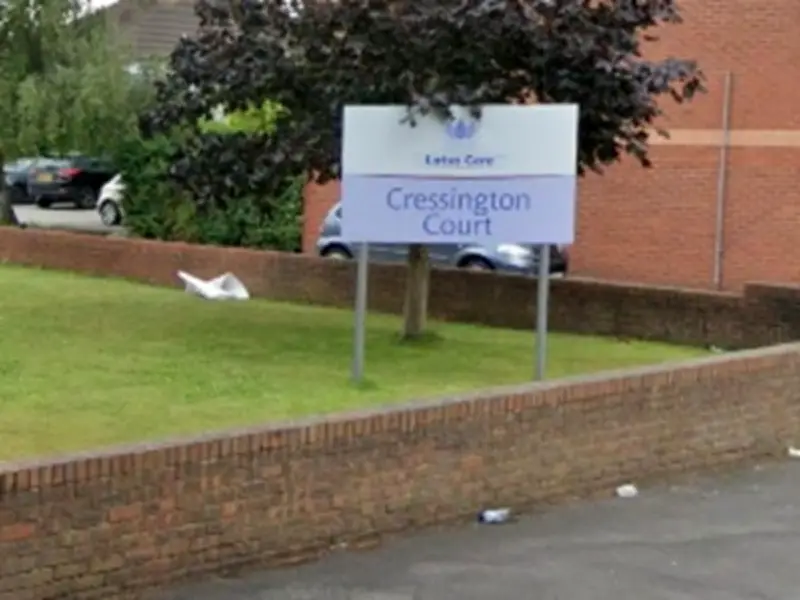
Operators of a Liverpool care home have rejected a social care inspector's report that claimed its residents were subjected to hours of loud nursery rhymes. Lotus Care has hit back after a damning assessment of its Cressington Court Care Home.
Unclean windows, dirty and damaged furniture, and residents left dishevelled were observations uncovered following a visit by the Care Quality Commission (CQC) in January and March, according to the inspection body's report. The home was placed into special measures as a result.
In a statement to the ECHO, a Lotus Care spokesperson said it did not agree with the findings released on Thursday. They added that only “one nursery rhyme-style song was played” because a resident liked it.
At the time of the inspection, 52 people were living in the home, some with dementia. The CQC has rated the home as inadequate for how safe and well-led it is, down from requires improvement. The service has been put into special measures, which involves close monitoring to ensure people are safe while they make improvements.
Inspectors said music was being played excessively loudly, including a three-hour period where the nursery rhymes Baa Baa Black Sheep and Mary Had A Little Lamb were on repeatedly.
The Lotus Care spokesperson rejected this assessment. The statement said: “The music was played at a higher volume because a number of residents are hard of hearing and require music or activities to be audible in order to participate and enjoy them. The volume was not intended to cause distress and was being used to support resident engagement.
“It is also not accurate to state that nursery rhymes were played repeatedly for a three-hour period. As part of the CQC process, inspectors would normally raise concerns at the time rather than four months later in a draft report.
“Only one nursery rhyme-style song was played, specifically because the resident's care plan identifies that she enjoys that particular song. This was a person-centred activity based on her known preferences.
“Following that song, other music was played which was not nursery rhyme music.”
Inspectors criticised the decision by management to use an office that they said did not give them regular oversight of day-to-day activities.
The spokesperson responded: “We do not agree that leaders being based in the manager's office meant they did not have daily oversight of the service or were unable to support staff in delivering person-centred care.
“During the inspection, members of the leadership team utilised the manager's office for periods of time to ensure the inspection process could be facilitated efficiently, documentation could be accessed promptly, and requests from inspectors could be responded to without causing unnecessary disruption to residents and staff.
“The decision for leaders to remain in the office for parts of the inspection was also made to avoid overwhelming residents, particularly those living with dementia, and to minimise confusion or distress that can arise when multiple unfamiliar people are present in communal areas.
“Leaders remained available throughout the inspection and continued to oversee the service, support staff, and respond to issues as they arose. Daily oversight is achieved through regular walkarounds, handovers, supervision, observation of practice, and ongoing engagement with residents, relatives, and staff.”
On the first floor, maintenance staff equipment was lying on the floor causing potential trip hazards to people. This included dust mats and tools outside people's rooms.
Pressure relieving cushions on seats were described as visibly dirty and had cracks which presented an infection prevention and control risk as they could not be cleaned effectively. It was said the environment was dirty in places, with furniture visibly unclean and damaged.
On the first two days of the assessment, the windows appeared to be dirty and to have not been cleaned for a long time. This was only rectified when inspectors raised it with management.




