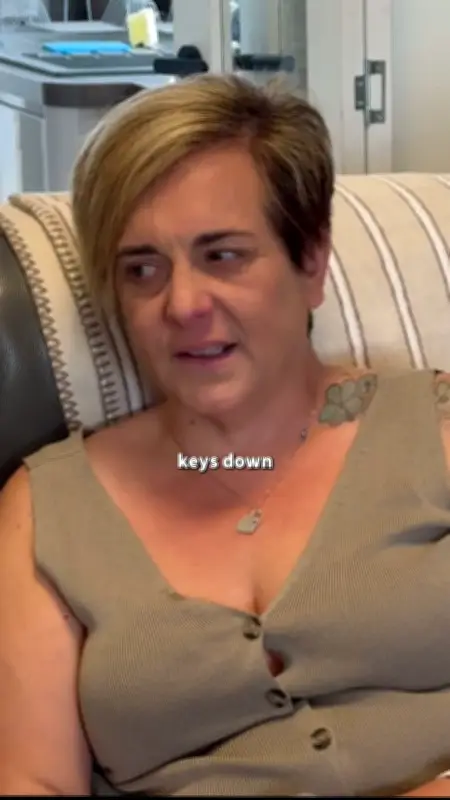
Joanne Harrigan, 45, a mother and grandmother from Cefn Hengoed near Ystrad Mynach, lives with the knowledge that an incurable illness will one day take over her life, causing her to forget her most favourite memories and the people she loves most. The disease slowly damages brain cells over many years, and this damage spreads to areas that control basic body functions like swallowing, movement, and the immune system, leading to fatal medical complications.
Joanne was told as a young mother that she carries a gene, passed down from her mother, which guarantees that she will develop early Alzheimer's disease. Her mum died from the disease at just 59 years old, and doctors have told Joanne that by the age of 48 she will start experiencing symptoms of dementia until she dies.
Pre-planned end-of-life decisions
As a result, Joanne has been put in the unimaginable position where she lives her life knowing that the symptoms of this impending life-altering disease will soon present themselves. She has pre-planned her death and what her family should do when she loses capacity.

"I've had a will since I was 25," she tells WalesOnline from her home. "I've got a lasting empower of attorney that gives my husband and my children the power to act on my behalf medically and financially. All my wishes are written down so that my family know they don't have to make any of the difficult decisions - I've made them for myself."
"As a family watching my mum go through it, it was something that myself, my sister and my dad struggled with - knowing if we were doing the right thing. I've made sure that they don't ever have to worry about if they're doing the right thing. I have decided when is the right time to put me into care, which for me is when I'm no longer participating in this family."
"All end of life is already taken care of, all my wishes for end of life and all the decisions and all the questions that they will be asked by medical staff like tube feeding and DNR (do not resuscitate) - I've taken all of those decisions so that they don't have to. I don't want them to ever feel guilt and wonder if maybe they could've done more - that's never going be an option for them."
Living life to the fullest
Joanne is a mum of three and a grandmother who works full time as a project manager. She says that she lives life to the fullest, because she knows her time is limited. She never says no to plans, and prioritises what she wants out of life - spending time making memories with friends and family.
She has also devoted countless hours to assisting in clinical trials and research into the disease, which she could have passed down to her three children. "Finding out that my children could have it because of me, well the feeling was just absolute devastation and guilt that I had lumbered them with the scars and fears that I've lived with," she says while looking through family photos with her daughter Charlotte Vaughan.
"I have a granddaughter and so also knowing that I put her at risk, it was devastating. I know we can't help it because it's genetic, but that doesn't come into your mind when you are told something like this. You automatically just think your job as a parent is to protect your children and I've done the opposite, I have lumbered them with an absolutely horrific disease."
Daughter awaits test results
Charlotte, 23, Joanne's second-born, says the hardest part is not the prospect that she may have the gene but that she is growing older knowing her mum may not be around for special moments such as having children or getting married - and there is nothing she can do to stop it.
Charlotte says: "It's frustrating cause I feel like I can't do anything and just want to do everything to try and stop it, but we know it is coming whether we like it or not. The most upsetting thing is that by the time I get married or have kids my mum might not be here."
Charlotte is awaiting test results which will tell her whether or not she carries the gene. If she does she will be entitled to a drugs trial which will give her access to treatment that can prevent the symptoms from ever starting.

For Joanne the drugs trial is unavailable. She is too close to the age where her symptoms are due to appear. She could receive the treatment privately at a cost of £100,000 for an administered dose, which is unattainable for most people whose lives have been impacted by the disease.
Son's negative result brings relief
Joanne's eldest son was recently given the news after undergoing the testing process that he does not carry the gene. Joanne says finding out his test results was "the best news in the world".
Joanne says: "I remember he arrived at my work with his wife, which was very odd, and said: 'I popped in to see you mum, I had my results today.' I instantly went cold but he just said 'I haven't got it Mum' and it was like the best news I could have ever heard. It was the best feeling in the world because it meant my granddaughter has no chance now of getting it. There is no chance my son getting it so they can just get on with their lives and forget all about Alzheimer's - except of course, that he has to watch me go through it."
Joanne and Charlotte are working to challenge the belief that the disease is exclusive to the elderly. Charlotte says: "I'm angry that there's nothing to help my mum after how much she's done. It's not even about how much research and the trials she's undergone for everyone. It's just I think she deserves more as a human being. She deserves to be given something to help. I ultimately just want people to see our story and become aware - beyond our little family in our village - that Alzheimer's, dementia, is not an illness which is exclusive to elderly people. It is younger people as well. I hope more research gets put into it and more funding. We need more doctors involved, more scientists."
Joanne adds: "I've lived with the knowledge since I was 25 and when you live with the knowledge of being at risk of something everything changes in your life. People will always say to me: 'Oh I put my car keys down somewhere and then I can't find them.' For me, putting my car keys down and being unable to find them is a massive panic attack. For me not being able to find the TV remote is a massive panic attack and I've lived like that since I was 25."
Joanne is expected to start presenting symptoms of early Alzheimer's disease within the next three years. There is no cure for Joanne, but she hopes by sharing her story, she paves the for change - for access to treatment and further research.
There are an estimated 982,000 people living with dementia in the UK. An estimated 70,800 people in the UK suffer from early-onset dementia, which means their symptoms started before the age of 65. This group makes up about 7.5% of all people living with dementia in the UK. Alzheimer's disease is the most common cause, responsible for about one-third of young-onset cases. There is currently no cure.