Louise Thompson's Maternity Commissioner Campaign Secures Crucial Parliament Debate
Former Made In Chelsea star Louise Thompson has revealed she was left reeling with shock after receiving a major update in her campaign for a maternity commissioner. The 35-year-old reality television personality, who was diagnosed with PTSD following the traumatic birth of her son Leo in 2021, shared the news via Instagram on Saturday.
Parliamentary Debate Scheduled for April 20th
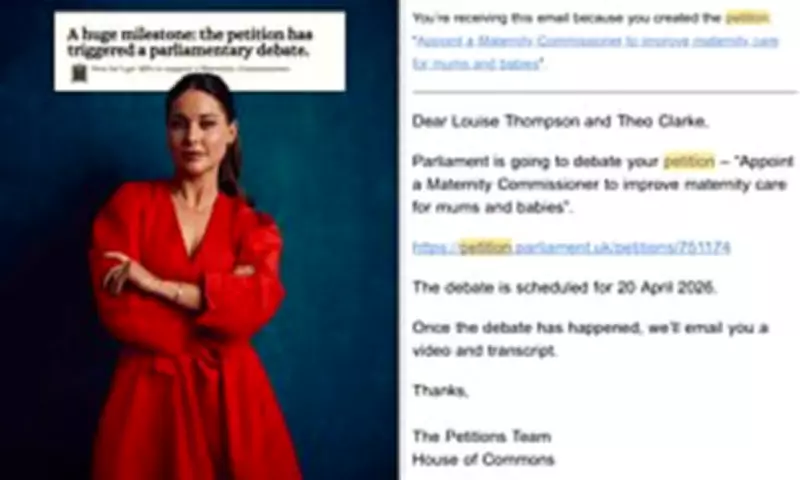
In an emotional statement, Louise disclosed that her petition calling for the government to appoint an independent maternity commissioner has secured a parliamentary debate date. 'I almost just keeled over in shock,' she wrote. 'This morning 147,000 people received the same email in their inbox. We have heard from the petitions committee and we have a debate date. On the 20th April MPs will debate our petition asking the government to appoint a maternity commissioner.'
The debate will take place on a Monday, which Louise noted is advantageous because MPs are more likely to be present in the Houses of Parliament rather than in their constituencies. She has been invited to sit in the gallery with a guest, and the public are welcome to attend on a first-come, first-served basis.

Campaign Born from Personal Trauma and Parliamentary Investigation
Louise has been campaigning alongside former Conservative MP Theo Clarke following a parliamentary inquiry they conducted which uncovered what they described as 'shockingly poor quality' in maternity services across the United Kingdom. Her advocacy stems from her own harrowing experience during childbirth, which left her with severe physical and psychological injuries including Asherman's Syndrome, worsening bowel problems, and emergency surgery after a post-natal haemorrhage. These complications mean she cannot carry another child.
'I only have to glance at my son in the morning to imagine what my life could have been without him,' she shared in a previous update. 'This campaign is so so important. Every life counts.'
Urging Public Support and Political Action
In her latest appeal, Louise urged her followers to contact their local MPs to advocate for the maternity commissioner proposal. 'We want MPs to back their constituents too,' she emphasized. 'Please get in touch with your local MP so they can argue in favour of a maternity commissioner if you believe that will lead to positive change.'
She has made a template letter available on her website for supporters to use when contacting their representatives, noting that the petition has now surpassed 157,000 signatures. 'The way I see it - there is no one that loses from having a maternity commissioner. Only so much to gain,' she asserted.
Recent Parliamentary Engagements and Frustrations
Louise's announcement follows her recent visit to the House of Lords, where she observed oral questions after Baroness Gohir successfully pushed for their petition to be addressed. While she expressed gratitude for the support of some peers, she was disappointed with the overall response, describing it as 'very predictable' with the government focusing on the Baroness Amos enquiry instead.
She has also reached out to Secretary of State for Health and Social Care Wes Streeting, sending him a personal letter after initially agreeing to a meeting a month ago, though she has yet to receive a response.
Call for Independence from Political Instability
Louise argues passionately for an independent maternity commissioner who would operate outside party politics. She cites the political turbulence since the Brexit referendum as creating an environment where maternity care improvements consistently fall to the bottom of the priority list.
'Giving birth affects the safety of multiple lives,' she stated. 'Surely that has to sit outside of conventional politics. Maternity care deserves consistency it deserves to lean on ONE FIXED CONSTANT.'
Her campaign continues to gain momentum as she seeks to represent the thousands of women who have shared their own traumatic birth experiences with her, pushing for what she describes as a 'national maternity strategy' to prevent further suffering.