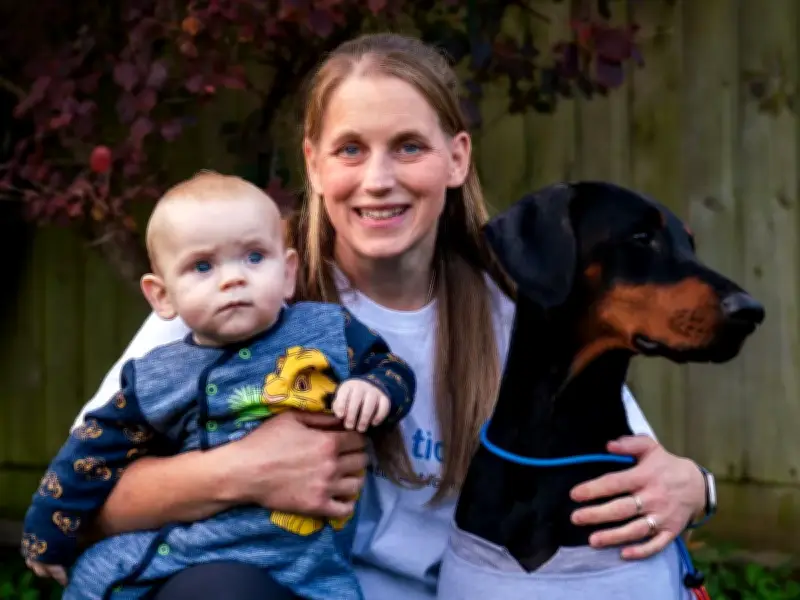
A family dog's unusually clingy behaviour proved to be a vital warning sign that led to life-saving treatment for a six-month-old baby with a dangerously fast heartbeat.
Kim Reynolds, 41, a former canine hydro-therapist and first-time mum from Shepton Mallet, Somerset, was puzzled when her pet Doberman Saraya became overly attached to her son Alexander. The dog refused to leave the baby's side and cried every time he was taken away from her that morning.
Alexander later became upset and looked unwell, prompting Reynolds to rush him to Royal Bournemouth Hospital's A&E department. Doctors discovered the infant was suffering from a dangerously fast heart rhythm of 280 beats per minute. Two days later, he was diagnosed with Wolff-Parkinson-White syndrome.
Dog's Alert Leads to Diagnosis
Reynolds said: "Saraya knew his heart rate was higher than it should've been. I had no idea. She sensed it. I dread to think what would have happened if I just put him in the cot and walked away. The doctors say SVT isn't dangerous but sustained SVT is."
She added: "Saraya's behaviour was like a noise playing in my mind. It was bugging me that she was trying to tell me something wasn't right. I was confused why she was being so needy and obsessive. It certainly added to my concern and made us go in to get checked."
When Reynolds took Alexander to A&E in September, she feared they were wasting the professionals' time as he had stopped crying. Then she learned how fast his heart was beating.
Emergency Treatment and Diagnosis
To shock Alexander's heart rhythm back to normal, medical staff had to "dunk him" in a large bucket filled with cold water and ice. Reynolds said: "They put him in and the scream was horrific, that's all I hear now. They did it twice and his heart rate still hadn't come down."
After submerging his head for 10 seconds, Alexander's heart rate remained high, and he was placed in Reynolds' lap. She decided it was "enough" and requested intravenous medication. Three doses of the medication finally brought his heart rate down, and the family was transferred by ambulance to Poole Hospital.
Reynolds stayed for two nights and received the Wolff-Parkinson-White syndrome diagnosis. She described the syndrome as "an extra bit of tissue in his heart, which basically means electrical pulses can get through where they shouldn't. That's when he can't calm his heart rate."
Ongoing Care and Fundraising
Alexander now takes the beta blocker propranolol three times a day through a syringe. Reynolds said he "knows he needs it" and drinks from the syringe himself "hassle free".
This month, Saraya began acting differently around Alexander again. Reynolds said: "He was in his bouncer and she was next to him, licking his hands, looking at me. My first thought was 'oh god are we going to go into SVT again'." After checking his pulse, she noticed his throat looked red and took him to A&E. He was diagnosed with bacterial tonsillitis and prescribed penicillin.
Reynolds said: "I 100 per cent trust Saraya. She's not a trained or registered assistance dog. But to me, every opportunity I have she will be by his side."
Reynolds' sister Francine introduced her to the small charity Tiny Tickers, which works to improve the early detection and care of babies with serious heart conditions while supporting their families. The pair are taking part in the 100-mile challenge in October to raise money for Tiny Tickers.
Reynolds said: "I didn't realise the work they did. It's become really, pardon the pun, close to my heart. I went to a health physician to get him weighed a couple of weeks after and they had no idea what SVT was. I'm a first time mum and it's been a whole experience. It's really important to raise awareness. You wonder how many babies have it and don't realise."
She added: "I'd never heard of his syndrome when they scanned him. It wasn't picked up at birth or at previous hospital visits. I have to say his care at Bournemouth and Poole was faultless. I'm well aware some babies have much more serious heart conditions but it is just as important, and the charity helped me realise that."