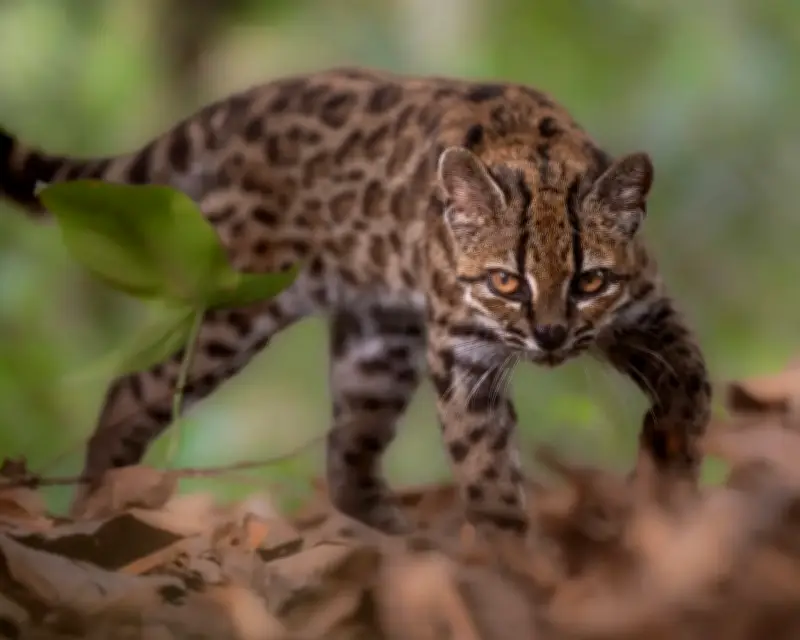
This week’s best wildlife photographs from around the world feature a leopardus tilcayo cat, the first new wild feline species to be identified in more than 100 years, a family of black bears taking a dip in a backyard pool in Los Angeles, California, and a frilly pink sea cucumber discovered on the deep-sea floor.
A new feline species and backyard bears
A leopardus tilcayo cat, the first new wild feline species to be identified in more than 100 years, was photographed at the Senda Verde animal refuge in Bolivia. Smaller than a domestic cat, the tilcayo was found in La Paz by a man who looked after it believing it was a stray, until its behaviour tipped him off that this was no ordinary kitten.
In Los Angeles, video footage showed a family of black bears playing in a backyard pool and doing a passable dog-paddle. In California, bears and humans are coming into closer contact as communities expand and the climate crisis affects the bears’ food sources.
Owl photography award and deep-sea discovery
A short-eared owl giving the camera a Kate Moss stare won gold in the Birds in Flight category of the Bird photographer of the year 2026 award. Ivan Sjögren caught the owl hunting over the salt marshes of the Fraser River delta in British Columbia, Canada. “This was a magical evening, with five owls feeding around me as dusk fell,” he said.
Barbie Pig, a new type of sea cucumber, was discovered on the deep-sea floor by a team from the Natural History Museum in London. The frilly-footed fuchsia beauty was filmed by a robot on the Pacific seabed, 5km deep, in an area called the Clarion-Clipperton Zone. A documentary opening next month, How Deep Is Your Love, gives a scientist’s-eye view of the astonishingly biodiverse region.
Global wildlife highlights
A wild male Bornean elephant gives himself a shower near the Kinabatangan River in eastern Borneo. A wild boar piglet runs in a meadow in a forested area near Frankfurt, Germany. An anhinga takes flight at Green Cay wetlands in Boynton Beach, Florida, US. Nicknamed snakebirds because they swim with only their long necks visible above the water, anhingas do not have waterproof feathers, which helps them sink to hunt underwater for up to two minutes, but forces them to dry off by stretching out their wings for 15-20 minutes after each dive.
A red deer roars near Mount Uludağ in north-western Turkey as the mating season begins. A kingfisher watches for prey along the waterways of the Kocaçay delta in north-western Turkey. A leopard hunts in Kenya’s Masai Mara reserve. A glossy ibis forages in the shallow waters of the Kocacay delta in Bursa, Turkey.
Fat Bear Week and more
The annual Fat Bear Week competition, run by Katmai national park in Alaska, US, is returning for its 13th year. People can vote for the brown bear that they feel has put on the most weight ahead of their winter hibernation, by comparing photos from early and late summer.
A grey fox in its den at a wildlife rehabilitation facility in El Santuario, Colombia, is about to be released into its natural habitat following five months of assisted rearing and rehabilitation. A frog sits at the Hevsel gardens, a UN World Heritage Site on the banks of the Tigris, Turkey. A robin perches on a branch in the Bois de Vincennes in Paris, France.
A wasp spider was spotted in Cheshire – the first one ever seen in the north of England. Staff at Chester zoo, who spotted it in the wild, fear it may be one of a growing wave of “climate refugees” forced to change their habitat as the planet warms. A zoo official said: “You know your big, chunky house spiders – the ones you think are massive and frighten the life out of you in your living room? A female wasp spider is probably a bit bigger than those.”