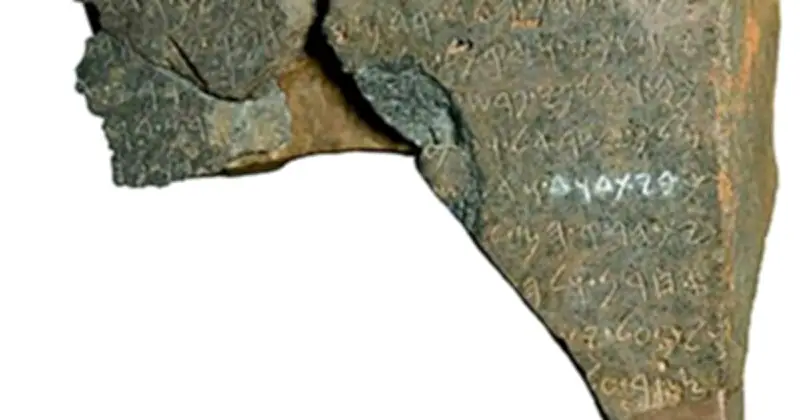
A landmark archaeological find has dramatically reshaped our understanding of Biblical history and "proved" the authenticity of the Bible. The Old Testament's King David was referenced in the Tel Dan inscription, a ninth-century B.C. stone slab that provided the first concrete historical evidence of the ruler, lending credibility to the entire Bible and the existence of Jesus.
Discovery of the Tel Dan Inscription
The Tel Dan inscription, or "House of David" inscription, was discovered in 1993 at the Tel Dan site in northern Israel during a dig led by Israeli archaeologist Avraham Biran, according to Joy! News.
The damaged inscription commemorates the triumph of an Aramean king over his two southern neighbours: the "king of Israel" and the "king of the House of David," reports the Daily Star.

Content and Significance
In an extraordinarily detailed carved text written in precise Aramaic characters, the Aramean king claims he, under the divine guidance of the god Hadad, vanquished several thousand Israelite and Judahite horsemen and charioteers before personally slaying both of his royal opponents, as per the Bible story.
Few modern Biblical archaeology discoveries have caused as much excitement as the Tel Dan inscription—writing on a ninth-century B.C. stone slab (or stela) that furnished the first historical evidence of King David from the Bible.
Scholarly Debate and Impact
Unfortunately, the recovered fragments of the "House of David" inscription failed to name the other specific monarchs involved in the conflict, though most scholars believe the slab depicts a campaign by Hazael of Damascus in which he overcame both Jehoram of Israel and Ahaziah of Judah.
What rendered the Tel Dan inscription so compelling to Christians and archaeological scholars was its direct reference to the "House of David." The slab's damaged inscription, initially deciphered and translated by the expert Joseph Naveh, revealed that King David from the Bible was a genuine historical figure rather than a creation of Biblical writers and editors.
Perhaps even more unusually, the slab, erected by one of ancient Israel's fiercest adversaries over a century after David's death, still recognised David as the founder of the kingdom of Judah.
Ongoing Questions
The "House of David" inscription had its sceptics. The so-called Biblical minimalists dismissed the "House of David" interpretation as a fairytale. One prominent scholar, Philip Davies, contended the Hebrew term bytdwd referred to a specific location (akin to bytlhm for Bethlehem) instead of the ancestral dynasty of David. Nevertheless, most Biblical scholars and archaeologists swiftly accepted the Tel Dan slab had furnished the first tangible evidence of a historical King David from the Bible, rendering it among the most important Biblical archaeology discoveries.
Despite the "House of David" inscription having confirmed that King David from the Bible existed, scholars have not achieved any consensus about the nature and extent of his reign. Was David the great monarch of Biblical tradition who established his royal capital at Jerusalem and founded an Israelite kingdom? Could David have merely been the leader of a modest, close-knit community? Such questions routinely arise from Biblical archaeology discoveries and sit at the very core of the intricate interplay between archaeology, history and the Bible.