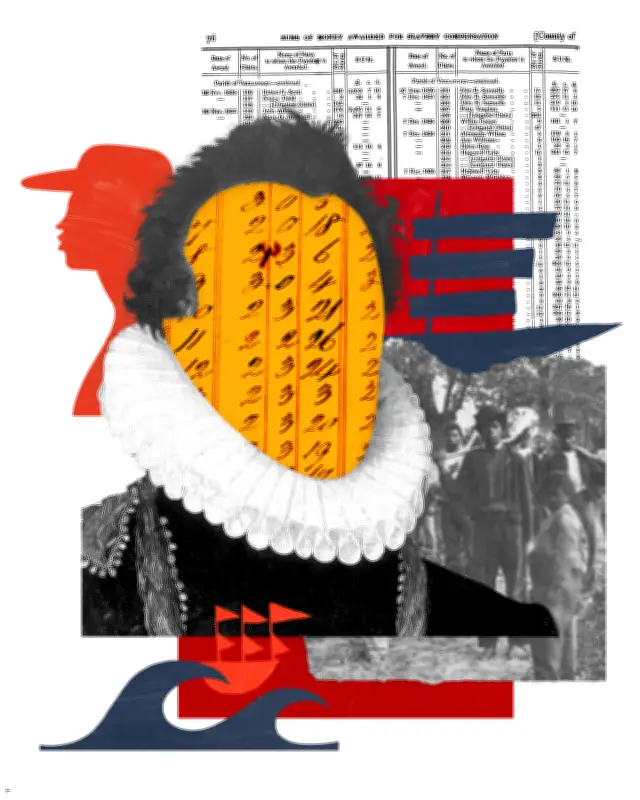
The Register of British Slave Traders is the product of three years of research by a team of historians into all known investors in Britain’s near 250 years of trafficking enslaved African people, from the 16th to 19th centuries.
It provides profiles and biographical details of thousands of people who financed the British slave trade, which violently trafficked approximately 3 million African men, women and children across the Atlantic.
The register defines slave traders as individuals who invested in directly financing a ship’s transportation of enslaved African people in expectation of a profit share.

Research foundations
The project builds on research over recent decades documenting European countries’ trafficking of an estimated 12 million enslaved African people.
Its starting point was the Slave Voyages database, a collaboration between universities launched in 2008, which documents enslaving ships, how many people were trafficked and how many died on the notorious Atlantic crossings, as well as the owners and investors.
The earliest slave traders were privateers and piratical ship captains and owners such as John Hawkins, whose voyages in the 1560s were backed by Queen Elizabeth I, her chief minister William Cecil, leading courtier Robert Dudley and Sir Thomas Lodge, the lord mayor of London.
Institutional involvement
The register documents the investment that followed by people from across society. The monarchy’s involvement became more institutional from 1660, with three royally chartered companies formed: The Company of Royal Adventurers into Africa, founded in 1660; The Company of Royal Adventurers Trading to Africa, founded in 1663; The Royal African Company, founded 1672, which trafficked about 150,000 enslaved African people. The South Sea Company, founded in 1711, trafficked close to 45,000 enslaved African people. As a crown- and state-backed mass-subscription company, the register documents its directors rather than all its investors.
The Royal African Company’s monopoly on the trafficking of enslaved people from Africa was removed in stages from 1689, under pressure from individual “separate traders” who lobbied parliament because they wanted to participate in the trafficking themselves.
The register then traces investors beyond London to Bristol, Liverpool and other port towns and cities as Britain’s trafficking of enslaved people increased dramatically.
Investor profiles
In total, the historians identified 13,000 people who were investors in the British slave trade, from Hawkins’s first voyage in 1562 to parliament’s abolition of the slave trade in 1807. Of these, about 2,500 were shareholders in the South Sea Company, a mass public subscription, who are not part of the register. Of the other 10,500 investors, the historians found identifying information and records for about 6,000. The register also includes details on the directors of the South Sea Company.
The researchers examined those individuals’ dates of birth and death, marriages and political participation, identifying dozens from Tory and Whig parties – forerunners of today’s Conservatives and Liberal Democrats – as well as local mayors and aldermen (councillors).
They also examined wider biographical information and wills, which showed that many slave traders bequeathed money to hospitals, schools and other welfare organisations, including hundreds who donated to the poor through their local churches and parishes across Britain. About 1,000 of the investors were women.
Project aims and team
According to the register’s lead historian, Prof William Pettigrew, the aim was to compile “the most comprehensive examination of a nation’s slave traders ever attempted”.
The Register of British Slave Traders is a joint venture between Lancaster University, the University of Manchester and University College London, funded by the Arts and Humanities Research Council.

It was led by the principal investigator and editor Prof William Pettigrew, now of King’s College London and co-investigators Dr Nicholas Radburn, Prof Edmond Smith and Dr Nicholas Draper. The research team included Dr Michael Bennett, Dr Lila O’Leary Chambers, Dr James Dawkins, Dr Charmian Mansell, and Dr Kimberley Thomas. The advisory board included Dr Miranda Kaufmann, Dr Omar Khan, Dr Aidan McQuade, Prof David Olusoga and Arthur Torrington.