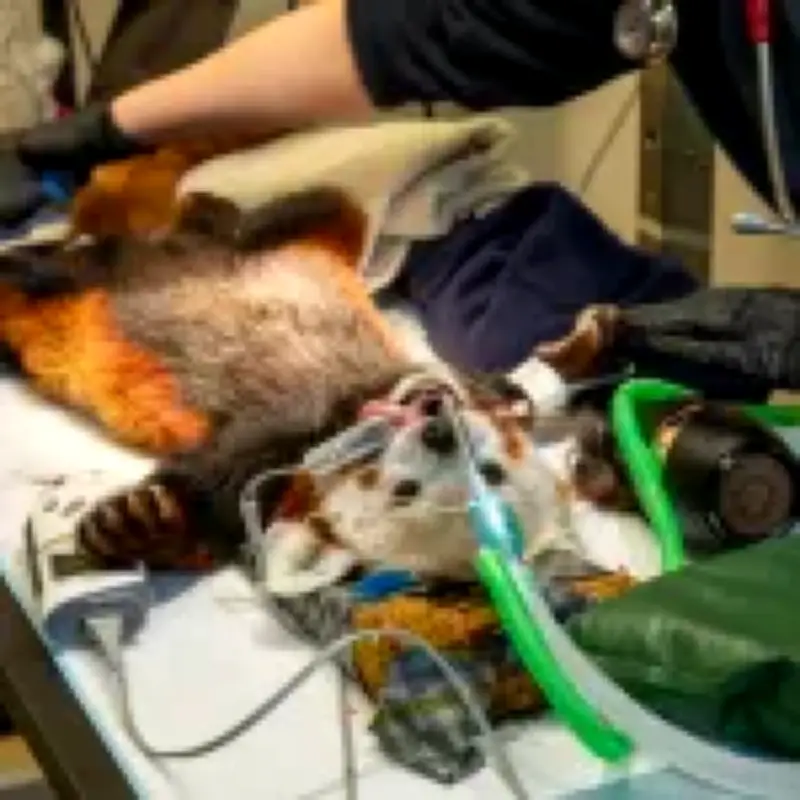
An 11-year-old red panda named Bruce has undergone full-body anaesthesia at Edinburgh Zoo after keepers noticed he had stopped eating his food. The zoo's veterinary team placed him under general anaesthetic for a health check-up, concerned about his loss of appetite.
During the examination, vets were relieved to discover that Bruce's only problem was a sore tooth. The troublesome tooth was removed, and Bruce was given a complete health check to ensure nothing else was wrong. Pictures show the endangered animal lying on a veterinary table while connected to monitoring equipment.
Clean bill of health
Bruce was given a clean bill of health and has now returned to his habitat. He is once again exploring in search of bamboo and taking naps high in the trees.
The Royal Zoological Society of Scotland said: 'Edinburgh Zoo placed red panda Bruce under general anaesthetic for a health check-up after keepers noticed he was off his food.'
'On closer inspection, vets at the Royal Zoological Society of Scotland were happy to discover that his only problem was a poorly tooth. Vets removed the tooth and gave Bruce a full-body MOT to make sure he was otherwise well.'
Family and conservation
Bruce was born in 2015 and arrived at Edinburgh Zoo the following year. He is now the zoo's only red panda and is also the grandfather of three-year-old Priya. Priya moved from Edinburgh to the Highland Wildlife Park in March this year, where she has since been joined by one-year-old male Flyn. Keepers hope the pair will eventually produce cubs as part of efforts to protect the endangered species.
Despite their shared name, red pandas are not closely related to giant pandas. The animals belong to their own family, known as Ailuridae, and are more closely related to raccoons, skunks and weasels.
Endangered species
Red pandas live in high-altitude temperate forests across the Eastern Himalayas and south-western China, including parts of Nepal and India. The tree-dwelling animals are excellent climbers and spend much of their time sleeping on branches.
The species is classed as endangered, with its population continuing to fall because of threats including deforestation, habitat loss and poaching. Fewer than 10,000 are believed to remain in the wild.