
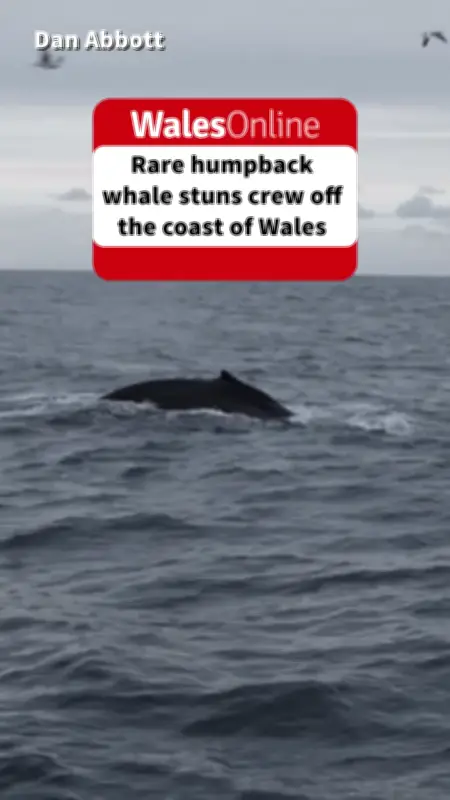
A shark guide was stunned when he realised a whale he had spotted off the Pembrokeshire coast was a humpback. Dan Abbott was around 25 to 30 miles off the shore of Milford Haven in the Celtic Deep when he first spotted the whale.
He initially thought it was a fin whale, but as it got closer he realised he was looking at something much rarer for the area.
How the identification was made
“When we first started seeing the blows - the vapour that goes up in the air from the whales - my first thought was that it must be a fin whale because that’s what we usually see,” he said.
“There were a few other whales around but the one that we were looking at was getting closer.
“As it was getting closer I was examining it and as it passed the boat the first time you could see barnacles around the face, you could see the white pectoral fin which fin whales don’t have.
“The other thing humpbacks do is they lift their tails out of the water, which fin whales don’t do. After those three things it became clearer that this was not a fin whale, it was a humpback.”
Final trip of the season
Dan, who runs blue shark snorkelling experiences with Pembrokeshire Boat Charters, was on his final trip of the season when the whale appeared.
“We’ve had a great season, loads of sharks, loads of other things out there too like bluefin tuna,” he said.
“We do sometimes see whales, but the whales we would normally see are minke whales which are the smallest baleen whales that we have in the UK, and also fin whales which are the largest whale we see in the UK and the second largest animal in the world.”
The video of the encounter was filmed around a minute after Dan realised what he was looking at. “You can hear from my voice I am very surprised that this is a humpback,” he said.
Rarity in the Celtic Deep
Dan is known online as Sharkman Dan and has a background in sharks, having filmed great whites in South Africa and appeared on a Netflix programme about the creatures.
He said humpback whales are not unusual in UK waters, but seeing one in this particular part of the Celtic Deep is.
“Seeing whales out there isn’t unusual, and seeing humpbacks in the UK isn’t unusual,” he said.
“There have been good sightings of them out in Cornwall in the winter, which I’ve also gone out and filmed on the drone.
“They see humpbacks around Ireland, in Scotland you can see whales every day of the week, so it isn’t unusual in that regard - there are whales around.
“But in that particular area, around 35 miles out when we are in the Celtic Deep, those aren’t the species that we would see - or the fishermen when they’re out looking for things. It’s usually the minke whales and the fin whales.”
Buzzing boat after encounter
The boat was “buzzing” after the sighting, with passengers having already spent around four hours in the water with blue sharks.
“I had just spent four hours in the water with these guys with blue sharks which was really phenomenal; the blue sharks coming right up to these guys,” Dan said.
“It’s an incredible shark experience, I would put it as one of the best shark experiences you can have on the planet and I’ve had a fair few.
“So for them to have already experienced that, this really is some of the best that nature has to offer. It doesn’t happen every trip - let’s put it that way!”
Dan said he had actually been excited to see what he thought was going to be a fin whale.
“Because I was so convinced in my head that this was going to be a fin whale which would have also been absolutely amazing,” he said.
“Perhaps my favourite experience in my filming career has been filming fin whales in the Celtic Deep.
“I would have been very excited to see a fin whale, but it was just that it turned out to be an animal that I knew was really rare to see out there in the Celtic Deep.”
A conservation success story
Humpbacks are one of the large baleen whale species which have made a major comeback since the days of whaling.
“They’re one of the large great whales that have made a huge comeback since the days of whaling (banned in 1986),” Dan said.
“Across the UK there are some phenomenal places where you can see them.
“They’re the ones famous for their bubble net feeding that we see in places like Antarctica and Canada when they use their bubbles to corral the fish into a ball.
“People go and watch them in Norway, it’s coming into the season now in the winter time where they are feeding on herring in the fjords.
“They’re one of the most charismatic whale species because they’re quite prolific at the surface.
“Typically these are the ones that we see breaching up out of the water doing big pectoral fin slaps, big tail slaps as well.”
Dan said there could be a number of reasons why the humpback was in the Celtic Deep, but he did not believe the sighting itself was a cause for concern.
“There could have been a number of reasons, but it might mean nothing,” he said.
“You always see comments on these sorts of things online saying it’s bad news because they don’t have enough food.
“That’s not always untrue, but in this scenario they travel huge distances all the time anyway and to say there are humpbacks in the south of Ireland, to get across to the Celtic Deep actually isn’t that big a distance for a humpback to travel.
“I wouldn’t say that particular one is one to be concerned about. It could literally just be the case that this animal is travelling and there is a lot of food in the Celtic Deep.”
Dan said the return of humpbacks and other great whales was an encouraging conservation story, although they still face threats from climate change, ship strikes, habitat destruction and overfishing.
“The great whales, the big ones such as fins, blues, humpbacks, are a success story in that they are making a comeback,” he said.
“But they are still threatened by other things: climate change and ship strikes being the most common things, and habitat destruction.
“But they have been success stories as well, there has been a huge comeback especially with humpbacks since the end of international whaling which we (the UK) played a part in.
“To see them again is a really amazing thing and is an encouraging marine life story.”




