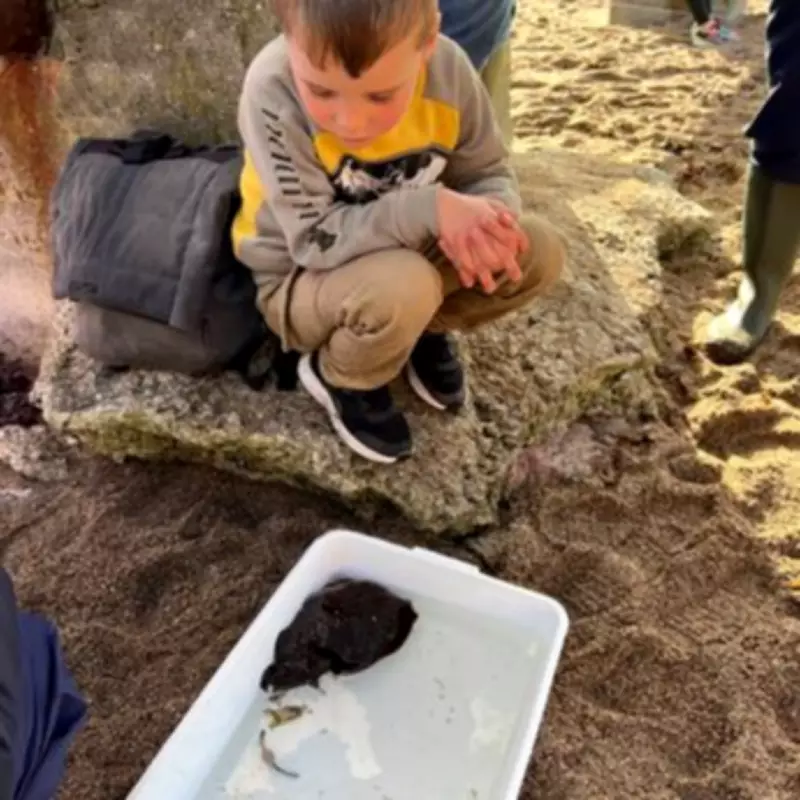
In an extraordinary discovery on the British coastline, a five-year-old boy has come face-to-face with a rare "alien-like" sea creature rarely seen in UK waters. Charley Taviner made the remarkable find while exploring Mount Batten Beach in Plymouth, Devon, during a rock-pooling event.
An Unexpected Encounter
Young Charley was following a crab when he stumbled upon what he initially believed to be a large clump of seaweed. To his surprise, the object turned out to be a living organism - specifically Aplysia depilans, commonly known as the "Mediterranean sea hare." This species is typically confined to the Mediterranean Sea and East Atlantic, making its appearance on British shores highly unusual.
Expert Analysis and Warnings
Joe Feasey-Kemp, Aquarium and Research Facilities Technician at the Marine Biological Association, confirmed the identification and noted that the creature does secrete toxins. He advised dog walkers and beachgoers to exercise caution if they encounter similar specimens. "For what I initially thought was seaweed, this has taken a surprising turn!" said Charley's father, Chris Taviner. "If it wasn't for my son Charley chasing after a large crab, we wouldn't have found it."

Climate Factors Behind the Discovery
The Marine Biological Association suggests that changing environmental conditions are likely responsible for this rare sighting. A spokesperson stated: "It is possible that warming waters and increased storms have allowed this species to make itself more at home on our shores." This aligns with broader scientific observations about how climate change is affecting marine species distribution patterns.
Physical Characteristics of the Sea Hare
The Aplysia depilans is a type of mollusc that can grow up to 40 centimetres in length and weigh as much as 380 grams, making it significantly larger than the more common Spotted sea hare found in British waters. These creatures possess two large "wing-like flaps of tissue" called parapodia, which they flap to swim with surprising agility.
Broader Implications for Marine Research
The discovery occurred during The Rock Pool Project's monthly "BioBlitz Battle," organised by the Marine Biological Association. Since its launch in October 2024, The Big Rock Pool Challenge has identified and recorded over 255 various species at Mount Batten. Loretta Kwok, South West Lead of the challenge, commented: "These findings highlight just how rich and dynamic our coastal ecosystems are, and how much there is still to discover right on our doorstep."
While experts caution against drawing broad conclusions from a single discovery, the incident underscores the incredible biodiversity present in UK coastal habitats. "It's still too early to draw conclusions from this single discovery," Kwok added, "but one thing is certain - that our local rock pools and coastal habitats are incredibly diverse."
The Mediterranean sea hare's unexpected appearance serves as both a fascinating natural history moment and a potential indicator of how marine environments are responding to changing global conditions. For young Charley Taviner, it represents an unforgettable encounter with the mysterious wonders of the natural world.