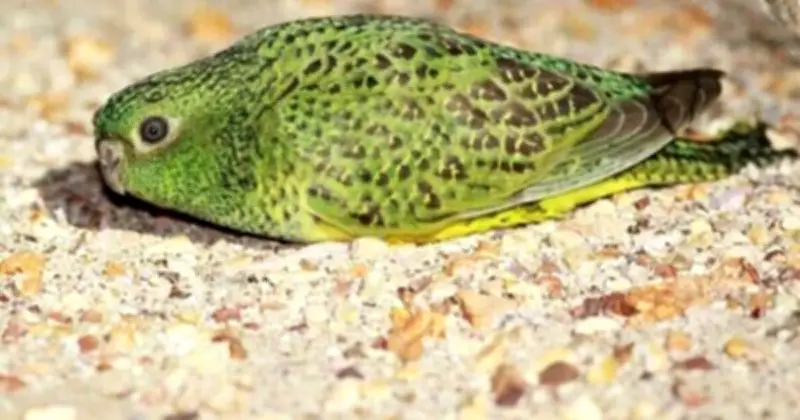
Rangers and scientists estimated at least 50 night parrots in Australia's Ngururrpa Country during surveys carried out between 2020 and 2023. The findings, announced in 2024, could help conservation efforts for the rare bird.
Elusive species confirmed after century without sightings
The night parrot is a diminutive green-and-yellow-hued species, scientifically classified as Pezoporus occidentalis, which had not been spotted in its Australian homeland for more than a century. Monitoring and safeguarding rare bird species can prove challenging, particularly when they are predominantly active after dark like this elusive breed, but experts believe they have finally confirmed its presence.
Ornithologists embarked upon an expedition in Ngururrpa Country to establish precisely where these parrots are living, what threatens their survival and how they might help in their conservation. Between 2020 and 2023, rangers and researchers positioned extensive equipment across numerous locations throughout the area, resolute in their pursuit of the bird.
Specialist equipment and survey findings
The specialist apparatus employed to locate the creatures is called a 'songmeter', which functions by capturing the animals' vocal communications. It was confirmed in 2024 that their efforts had proved fruitful, not just locating one of the birds but what is considered to be the world's largest population of the species.
They identified what is estimated to be at least 50 of the rare birds inhabiting the region, having previously only recorded occasional sightings. These creatures are so scarce they feature on the IUCN Red List, which categorises them as facing a significant threat of complete extinction.
Population estimates were provided by the International Union for Conservation of Nature in 2022, the BBC reports, suggesting between 40 and 500 remain in their natural habitat.
Research methods and predator threats
The investigation proved far from straightforward, requiring a substantial team of committed experts who began by deploying weatherproof audio recording equipment. The eight parrots produce highly distinctive vocalisations that these devices can pick up, and once one was confirmed in a location, camera traps were deployed to gather additional intelligence.
These cameras allowed researchers to monitor which predators emerged in the vicinity following the endangered species' appearance. Subsequently, they gathered predator droppings to aid identification and meticulously cross-referenced this with historical footage to determine their typical movement patterns across the terrain.
University of Queensland ecologist Nick Leseberg, who co-authored the pioneering research, detailed precisely how these techniques functioned. According to Earth.com, he said: "One of the night parrot's diverse array of calls sounded like 'didly dip, didly dip', like a telephone," explains Leseberg. Another sounded like 'dink dink', resembling a bell.
Their research revealed that dingoes were frequently detected in close proximity to the rare parrot's habitat. While the dogs appeared largely benign, cats remained a persistent presence, presenting genuine threats as predators due to their nocturnal hunting patterns.
The rediscovery of the rare night parrot has demonstrated the remarkable effectiveness of collaboration between dedicated rangers and scientists working towards a crucial conservation goal. The complete published study, offering further insights into the species and its behaviour, is available in Wildlife Research.