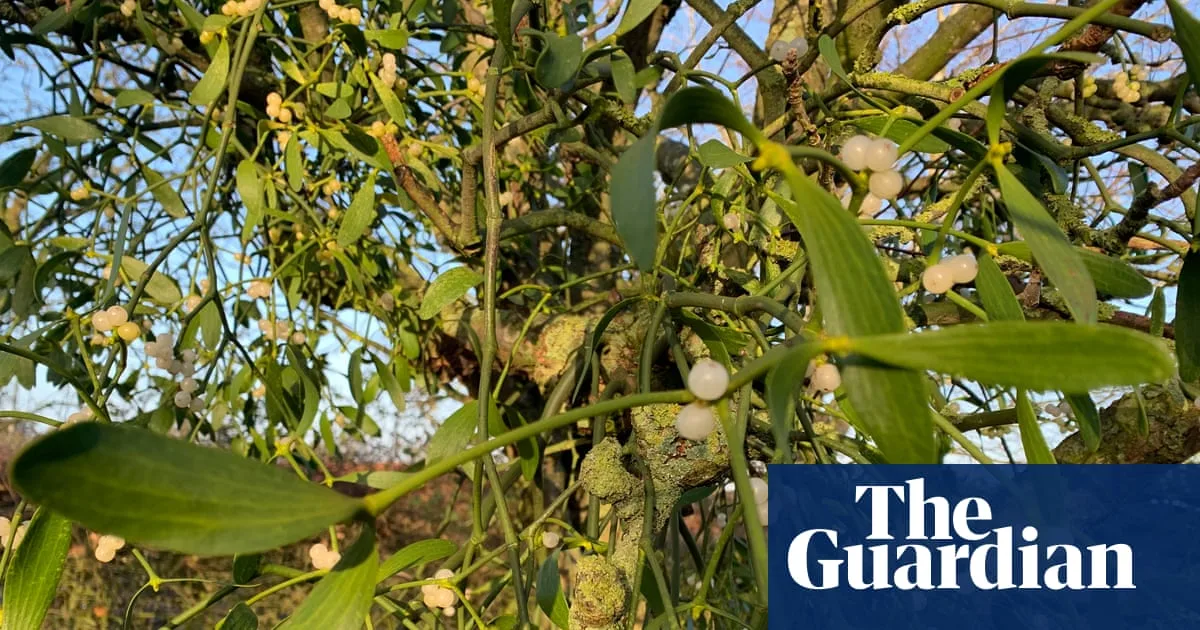
Stripped of leaves, the trees of Caistor St Edmund in Norfolk reveal their hidden occupants: ivy-thick trunks shelter wrens and robins, rook nests sway in the breeze, and great balls of mistletoe hang among bare branches, present all year round. Some trees bear so many of these evergreen orbs they appear to be in spring leaf.
Mistletoe is a hemiparasite, gaining energy through rootlike haustoria that penetrate bark to extract water and nutrients, while also photosynthesising via its distinctive leathery leaves. Though a burden to host trees, it holds a unique place in culture—from Greek mythology to druidic fertility rites that inspired modern-day kisses under the mistletoe.
Ecologically, mistletoe is a keystone species. A study found that its removal from woodlands led to a 20% drop in species richness and a 25% loss of woodland birds. Species like the mistle thrush and mistletoe marble moth depend directly on it, and the broader ecosystem suffers without it.
On an apple tree, I find a low shrub of mistletoe with pearly white berries. I pick a sprig for Christmas kisses and a few berries to attempt propagation. Mistletoe spreads naturally when birds eat the berries and rub the sticky seeds onto branches or excrete them intact. I squish the berries, coat my fingers in gluey gunk, and rub the seeds against a mature apple tree branch until they hold. Germination may take months, but patience is required. Some spread festive cheer; I spread parasites.