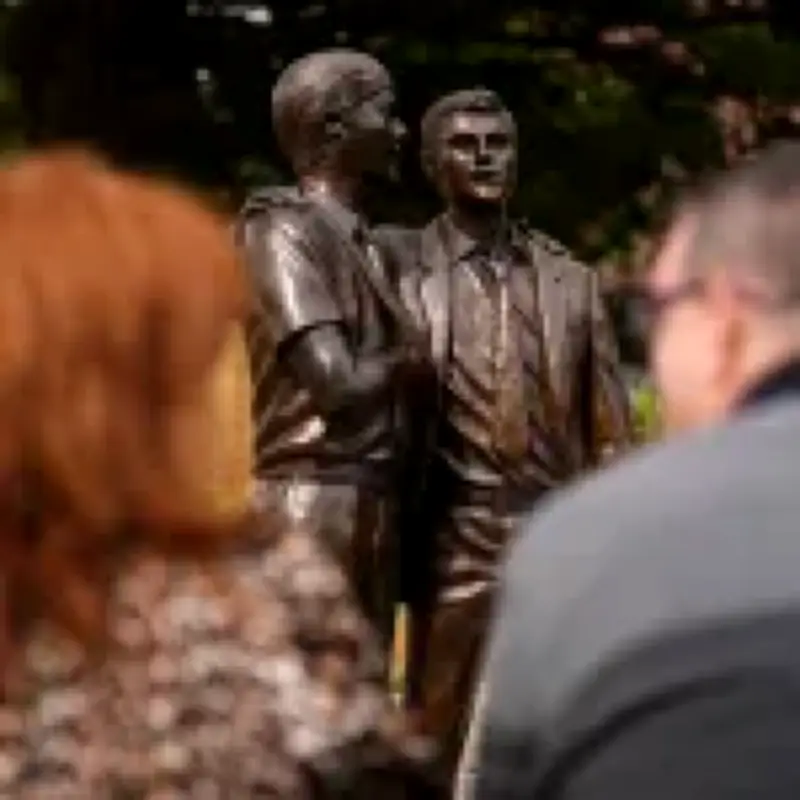
A memorial has been installed at Lord Mayor's Treloar's College in Hampshire to honour 122 haemophiliac pupils who were infected with HIV and hepatitis during unethical medical research in the 1970s and 1980s. The statue depicts two pupils, one with a sling and another holding a cane, embracing each other. An inscription reads: 'Remembering 122 haemophiliac pupils of Treloar's. Infected as children, victims of unethical research'.
Only 30 of 122 pupils still alive
Of the 122 pupils with haemophilia who attended the boarding school between 1970 and 1987, only around 30 were still alive when the Infected Blood Public Inquiry published its main report in 2024. The report highlighted how few of the pupils had 'escaped being infected' and concluded that the boys, commonly referred to as the Treloar Boys, had been treated as 'objects of research' by NHS clinicians who knew the dangers it posed.
Survivors recall their experiences
Adrian Goodyear, 55, said that when he first arrived at the school it felt like a new dawn. 'When I first arrived here with 10 other friends I was nine years old – we couldn't believe the place we were looking at: rolling country hills, swimming pools, canoes, a Jacobean mansion, it was just remarkable at first,' he said. 'We left school with death sentences,' he added. 'In 1985, a doctor tearfully said that I had two to three years to live. I was told this with five other boys, and the doctor went round the room and said: 'You have… you haven't… you have… you haven't… you have got HIV'. I was the last remaining boy in that room.'
Inquiry findings
The inquiry concluded that children at Treloar's were treated with multiple commercial concentrates known to carry higher risks of infection, and that staff favoured the 'advancement of research' above the best interests of the children. From 1977, medical research was carried out at Treloar's 'to an extent which appears unparalleled elsewhere', and children were treated unnecessarily with concentrates, particularly commercial ones rather than safer alternatives.
Haemophilia is an inherited disorder where the blood does not clot properly. In the 1970s, a new treatment called factor concentrate was developed to replace the missing clotting agent, made from donated human blood plasma.
'When we were here we made promises… they died in front of us, one winter we lost five boys,' Adrian said. 'I made promises to them, as did the other lads here today, that we would never give up, we would find out what happened.'
Gary Webster, 61, who was infected with HIV and hepatitis C when he attended Treloar's between 1975 and 1983, recalled being told as a child that he had HIV 'and had two years to live'. He said the memorial was important 'to remember what happened and to make sure it never happens again'.
Sir Brian Langstaff's report found there is 'no doubt' that healthcare professionals at Treloar's were aware of the risks of virus transmission through blood and blood products.