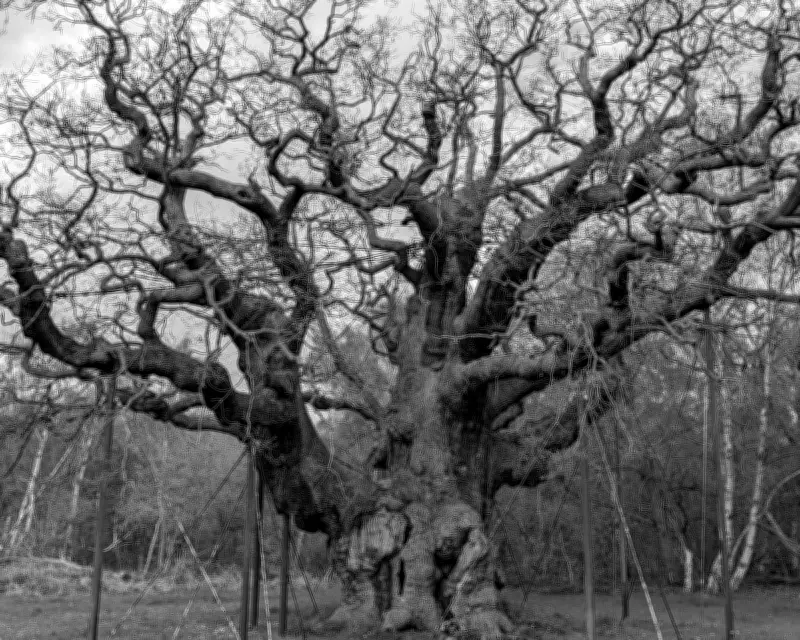
The Major oak, one of the UK's most recognisable natural landmarks and a legendary hideout for Robin Hood in Sherwood Forest, has died after failing to produce leaves for the first time in approximately 1,000 years. Readers have shared their memories of the tree, which sparked imagination and wonder for generations.
Childhood Adventures and Family Visits
Joanna de Graaf from Leicestershire recalled visiting the tree as a child in the 1960s. 'I grew up in Nottingham and we visited Sherwood Forest quite often as a family. I can remember being so excited to actually be inside the Major oak where Robin Hood and his merry men had hidden (and, for a little girl in the 1960s, Maid Marian too).' She later brought her own children and international friends to see the tree, noting the global recognition of the Robin Hood legend.
Rosie Emery, who spent her early childhood at Thoresby Hall near Sherwood Forest, credited the tree with inspiring her career. 'I credit my career teaching children how all of life is connected to the hours I spent sitting inside that wonderful tree. I would dream about Robin Hood and Maid Marian.'
A School Visit That Left a Lasting Impression
Ian, who did not provide his surname, described a school visit to the Major oak as one of his fondest childhood memories. 'At that time we were allowed to actually stand inside the tree and I recall being totally amazed by the fact (at least in my infant school mind) that I was looking at exactly the same shapes and curls and knots in the wood that Robin Hood saw when he was hiding from the Sheriff of Nottingham.' He expressed surprise at his sadness upon learning of the tree's death, calling it 'one of England's greatest natural treasures.'
International Visitors and a Connection to the Past
Jens Binder, an associate professor at Nottingham Trent University and father of three, wrote that he had taken friends from Spain, Germany, Portugal, Hong Kong, El Salvador, India, and elsewhere to see the tree. 'Everyone could instantly feel the significance of this magnificent tree. To me, it has always been an instant connection with the past, down the centuries.' He took comfort in knowing that Sherwood Forest still contains other extraordinary oak trees, most hidden more safely in the greenwood.
Calls for Greater Protection of Woodlands
Guy Birkin, chair of the Annesley Archers club, expressed sadness at the loss of the 'iconic tree, so much a part of Nottinghamshire history and legend.' He noted that while the Major oak was protected by its fame, many other ancient trees are not so lucky. 'With evidence that trees support adaptation to increasing temperatures, especially in urban areas, and that being in woodland promotes mental and physical wellbeing, we should take greater care of our arboricultural heritage for the sake of our own and future generations.'
An Enduring Legacy
Pat Hutton from Stroud, Gloucestershire, wrote: 'I have loved this tree since I was a child. Visiting Granpop, who lived in Worksop, from our home in Cleethorpes, we would always find time to go to Sherwood Forest and visit the Major oak. My imagination in full flow, I could see Robin Hood and his merry men hiding there (Richard Greene, from the television programmes of the time). Sadly, I haven't seen it for many years, but it lived in my memory, and will live on there.'
The affection for the Major oak, which inspired curiosity and adventure for centuries, will clearly endure beyond its physical lifespan.