
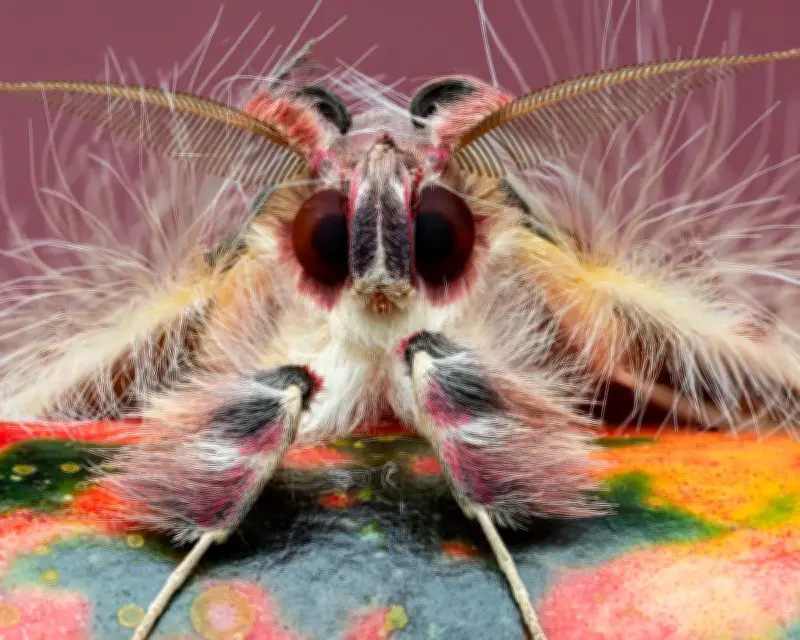
Macro photography, the art of capturing the natural world at an extremely close range, has seen a surge in popularity in recent years, driven by a wave of influencers, more affordable lenses, and the coronavirus pandemic, which left many photographers with nowhere to go but their own back gardens.
A demanding discipline
Photographers rely on “focus stacking”, a technique that combines multiple images taken at slightly different focus distances to create one final frame. That is difficult enough with a still subject. However, insects, by nature, are not often static subjects. Add in wind, and a creature that can simply fly away mid-shoot, and a single successful image can represent hours, or even days, of failed attempts.
Macro photography is also an increasingly viable career, with more routes to income than people may expect. A well-run account can generate income through monetisation, alongside the production of print sales and books. Brand partnerships can also play a significant role, with camera and lens manufacturers seeking to work with macro specialists for content.
Photographers' stories
Dara Ojo, 35, grew up in Lagos, Nigeria. He recalls planting yam, corn, tomatoes and beans with his late father. “I was just fascinated about putting something so tiny in the ground and coming back in a few days time and it’s starting to grow out. It was like magic to me,” Ojo says.
That sense of wonder resurfaced later. Ojo developed a love for photography during the pandemic, initially photographing birds in China, where he was based at the time. Feeling stagnant in his photography, a friend suggested Ojo try capturing insects. “When I started taking photos of them, when I’d never seen them that close up before, I was just fascinated by the design of their faces. It’s very intricate and it made me fall in love with them.”
His favourite thing that he has ever captured is a video of a damselfly grooming itself. “I tried for two or three years to capture that moment,” he says. Ojo found it in an 8-hectare (20-acre) botanical garden. He arrived there just as the sun was coming up, his research telling him that a damselfly would be most likely to clean itself at this time. After finding one, Ojo focused on it: “I waited for an hour and 30 minutes for it to do it. I always tell people if you’re doing macro, you’re not going to get your steps in.”
Finding beauty close to home
For Marit van Ekelenburg, who photographs as Macro by Marit from the Netherlands, it started with a favour for her mother eight years ago. “My mum asked me if I could take some photos of her beautiful garden in the Netherlands, as she wanted it for her website,” she says. While photographing flowers, van Ekelenburg found herself distracted by what was happening inside them: “It started with a bee, then a weevil, and before I knew it I was so mesmerised.” She began with equipment far too complicated for a beginner, and taught herself the hard way. “I messed up a lot. But I’m stubborn, so after many hours of practice, I learned. Once I started zooming in, I think I just never stopped.”
What hooked her was the same thing that hooked Ojo: “I could finally see details that I couldn’t with the naked eye. Once you start really looking, it’s like, wow, what on earth is that? What are those colours, structures, and details that you just can’t see otherwise?” And crucially, van Ekelenburg adds, you do not have to travel to find it: “They’re right by you and you walk past them every day.”
A scientific angle and a mission
In France, biologists-turned-photographers Maceo and Andrea Grammatico (who post their work together on Instagram as TwinWildLens) came to macro from a more scientific angle. They discovered the genre through YouTube tutorials about two years ago before saving up for their first dedicated lens. What drew them in, they say, was diversity: “We chose insects because there is so much difference in their shapes, colours and behaviours. We can find them very close to us, in our garden or in the forest nearby. We wanted to show people all of the incredible details you can see when you look closely.”
Their most memorable shoot took persistence. They spent three days searching an area of Mediterranean scrubland for a conehead mantis, which was found only in the final hours. A trip to Costa Rica also delivered fascinating discoveries, spanning frogs to snakes, and a moth with markings that they nicknamed “the Dobby moth”.
These photographers say they photograph insects as most people have simply never been shown that they can be beautiful at all. Van Ekelenburg says that she enjoys “capturing common insects in a way in which people can think: ‘Oh my gosh, that’s so cute,’ instead of having an initially negative reaction. I never kill them and always keep them alive.”
Ojo says: “I want to appreciate [insects]. Lions, tigers and giraffes get all the PR. Insect decline is at about 45% to 47% right now, and they are such a fundamental part of the ecosystem. They’re the foundation of it.” That mission extends well beyond Instagram. Ojo also runs workshops with children in schools, hoping to instil a love for invertebrates in children. Van Ekelenburg has built out a similar strand of teaching, running group workshops from Olgarden on the outskirts of the Dutch village of Deurningen.
As she puts it: “The power of macro photography is that the curiosity you had as a kid still sparks. It’s like a whole new world, and you don’t even have to go that far for it. These are creatures that we live with. Maybe we should treat them better.”




