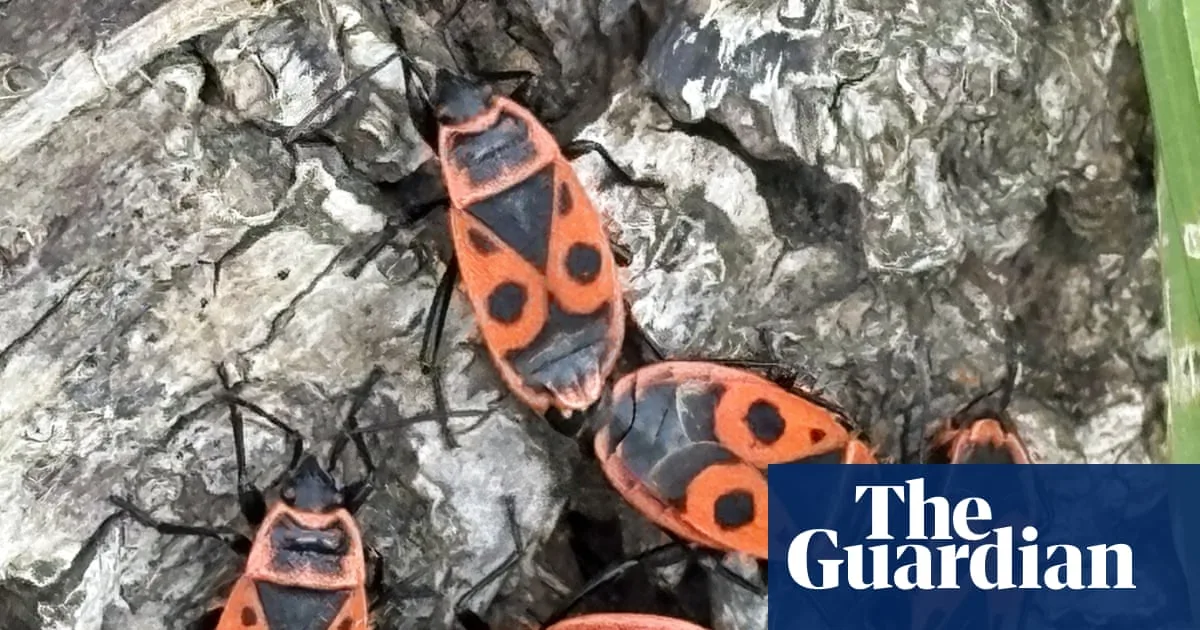
At this time of year, the farm in Caistor St Edmund, Norfolk, is a popular spot for walkers, riders, and picnickers. One of the unexpected benefits of public access is the extra pairs of eyes noticing wildlife. Recently, Laura, a regular dog walker and keen photographer, spotted something new: a colony of firebugs congregating on the sunny side of an old lime tree.
Around 50 firebugs, each nearly a centimetre long, cluster like flames on the trunk. Their ember-bright red backs are marked with bold, symmetrical black shapes. These aggregations, typically on lime or mallow trees, are for mating and feeding. Firebugs eat seeds, aphids, or even dead relatives, sucking out moisture with their proboscis.
Firebugs were once very rare in the UK, with only one population in Devon. Now, chasing the spreading warmth, they can be found in most of southern England, their range pushing northwards. Despite their dramatic looks, they are harmless to people, trees, and gardens. Birds and amphibians sometimes ignore their warning colours and eat them anyway.
A few pairs of firebugs are connected end to end, mating for hours. Unlike many prolific insects, they produce just one new generation a year, and the nymphs often remain gathered at the hatching site as they mature. The warmth of the sun draws them up the trunk, while shade sends them down to the leaf litter.