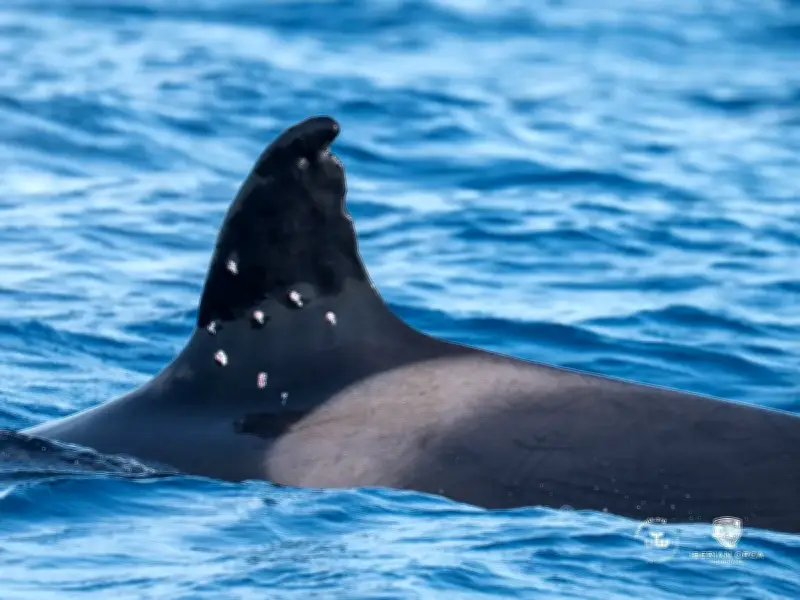
Spanish officials have opened an investigation after Toñi, the oldest known female in the endangered Iberian orca population, was found with suspected shotgun wounds on her dorsal fin in the Strait of Gibraltar.
Spain’s Ministry for Ecological Transition has confirmed the injuries, with ministry sources indicating several projectiles may still be lodged in the whale’s fin, raising fears she could develop an infection.
Conservationists alarmed by sudden injuries
The discovery has alarmed conservationists who have closely followed Toñi and say she appeared uninjured when they saw and photographed her only weeks earlier.

The WeWhale team said: “The sudden appearance of these injuries within a matter of weeks, together with their number, size and distribution, clearly leads to believe that they are the result of a shotgun discharge.”
Toñi had recently travelled with her pod from waters near Faro, and Spanish authorities are now working with officials in Portugal as they try to establish how she was injured. The whale is well known to WeWhale and the Iberian Orca Guardians Foundation, which have monitored members of the small population over a number of years.
Devastation for those who know the whale
Janek Andre, founder and president of WeWhale and the Iberian Orca Guardians Foundation, said: “We know Toñi. We were with her a few weeks ago and these wounds were not there. Now we are seeing multiple impact wounds across her dorsal fin and back which, in our assessment, are consistent with her having been shot with a shotgun.
“For us, these aren’t anonymous animals. We know them individually, we know their families. Seeing Toñi like this is devastating. If someone has deliberately fired a shotgun at her, this is not only an act of extreme cruelty against an individual animal. It is an attack on one of the last remaining members of a critically endangered population.”
Background of Iberian orca encounters
The Iberian orcas have attracted international attention in recent years following repeated encounters with boats off the coasts of Spain and Portugal. Since 2020, crews have reported the animals making contact with rudders, turning vessels and causing extensive damage. At least four boats have reportedly sunk following encounters with the whales.
But scientists have warned against interpreting the behaviour as deliberate attacks, with theories ranging from social play to the animals practising hunting behaviour.
The encounters have nonetheless caused growing frustration among some sailors, with controversial attempts to keep the animals away previously caught on camera. Footage emerged in 2023 showing people throwing firecrackers into the water as orcas approached a boat’s rudder.
Threats to a tiny population
There are estimated to be just 30 to 40 Iberian orcas left, and conservationists say the population already faces a number of pressures including food shortages, pollution and heavy shipping traffic.
WeWhale warned that the loss or serious injury of even a single whale could have a significant impact on such a small population.
Their statement reads: “Losing or seriously harming even one animal has significance far beyond the individual when dealing with a population this small.”
Andre said: “Whatever someone’s opinion about vessel interactions may be, shooting at these animals can never be acceptable. These orcas need protection, not retaliation.”
Spanish marine protection agencies have appealed to sailors and boat operators for any information which could help investigators establish what happened to Toñi. WeWhale and Iberian Orca Guardians said they will continue documenting the whale’s condition and behaviour while the investigation remains ongoing.