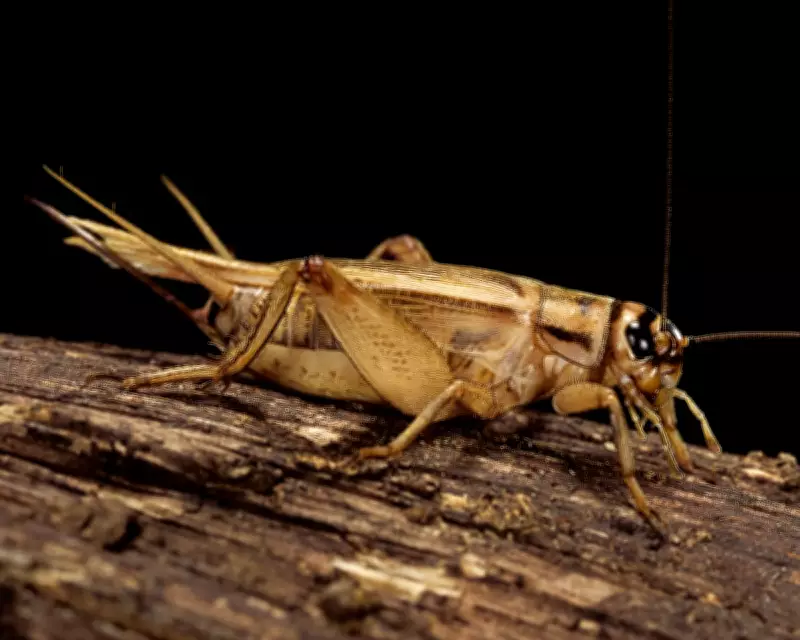
House crickets, scientifically known as Acheta domesticus, have been observed stroking and grooming a sore antenna, according to new research. This behaviour suggests that insects may experience pain, though establishing evidence for pain in other species remains challenging.
Study Reveals Behavioural Cues of Pain in Insects
Associate Professor Thomas White, an entomologist from the University of Sydney, explained that pain is a prolonged, unpleasant sensation distinct from a reflexive nerve response. Scientists look for behavioural indicators such as flexible self-protection, where an animal directs care to a specific body part over time.
In the study published in Proceedings of the Royal Society, researchers applied a heated soldering iron set to 65 degrees Celsius to one antenna of several crickets. Those that received the hot probe overwhelmingly groomed and attended to the affected antenna more frequently and for longer periods. In contrast, crickets that received an unheated probe or were part of a control group resumed normal activity quickly.

White noted that such responses would be immediately recognised as pain in pets or humans, raising the question of why similar inferences are not made for insects. He attributes this to human history, culture, and the lack of similarity between insects and ourselves.
Growing Evidence of Insect Sentience
Scientific understanding of insect brains and behaviour is evolving. Studies have shown that bumblebees engage in play-like behaviour and stressed bees exhibit pessimism. The New York Declaration on Animal Consciousness, signed by over 500 scientists and philosophers, acknowledges a realistic possibility of conscious experience in all vertebrates and many invertebrates, including insects.
Animal welfare laws are also progressing, with some countries recognising sentience in invertebrates such as cephalopods and crustaceans. Associate Professor Kate Umbers from Western Sydney University suggests insects could be next, noting that evolutionarily, insects share a common ancestor with crustaceans.
Umbers, managing director of Invertebrates Australia, emphasised that people often underestimate insects. Despite their small size and many legs, insects are capable of remarkable feats, such as the Bogong moth navigating hundreds of kilometres at night to an unfamiliar location. She hopes the study inspires people to look past differences and embrace empathy for all living things, challenging how we interact with insects and discouraging the use of bug spray.
Implications for Insect Farming and Welfare
Most research into insect pain and cognition has focused on bees, but the question is particularly relevant for crickets, which are farmed in billions and trillions for food, feed, and research. White argues that if crickets are capable of having better or worse lives, then that should be taken into consideration.
The study adds to a growing body of evidence that insects may possess a rich inner life, capable of learning, making complex decisions, and experiencing pain. This challenges the perception of insects as mere automatons and calls for a re-evaluation of our treatment of these creatures.