
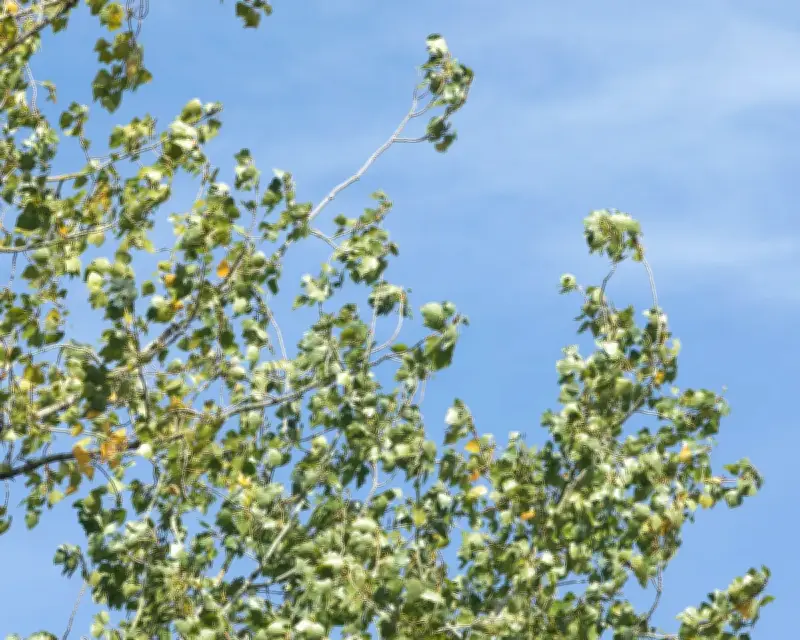
Along the bottom of the valley, the wind-catchers miss nothing. Even the lightest breath sets them whispering, and when the wind strengthens, they imitate the river streaming over boulders below. Pass a poplar and you are enjoying the best example of psithurism, the sound of wind in trees.
The poplar's unique sound
Throughout the growing season, oaks, alders, and willows have been heard politely, but for chatty company, a poplar would be the choice. The name psithurism appears to have been coined from Greek roots in the 19th century, yet the practice is ancient. Wind itself has no voice, as explorer-conservationist John Muir observed: “winds are advertisements of what they touch.”
All poplars are physiologically equipped to produce a wide range of sound and movement. Each broad leaf, shaped like an ace of spades, sits well separated from its neighbour on a long stem, like washing on a line. Blow, wind, blow.
Fresh breeze and leaf movement
Current conditions are what meteorologists call a fresh breeze, bringing a sway and a swoosh, the noise like a tide over fine pebbles, with upper trunks tilting to the rhythm. The top boughs show wind as wave, each sprig springing to life in turn, hundreds of leaves twirling at once, resembling green glitterballs. Close up, each leaf spins in agony or ecstasy, desperate to break free or stay attached.
Seasonal change ahead
Over coming weeks, these wind chimes will break, leaves raining down. Up above, in the tall trees, a new percussion will emerge—the click-clack creak of branch on branch, the incoming drumbeat of winter.




